Double Board Certified · Upper Face Rejuvenation
Brow Lift in NYC — refresh the upper face without erasing expression.
A brow lift repositions a descended brow; it does not simply remove upper-eyelid skin or repair a low eyelid margin. The approach and vector are selected after evaluating brow position at rest and in expression, forehead length, hairline, asymmetry, eyelid skin, true ptosis, scar tolerance, and the patient’s preferred brow shape.
ABFPRS
Facial Plastic & Reconstructive Surgery
ABOto
Otolaryngology — Head & Neck Surgery
AAFPRS
Fellowship Director
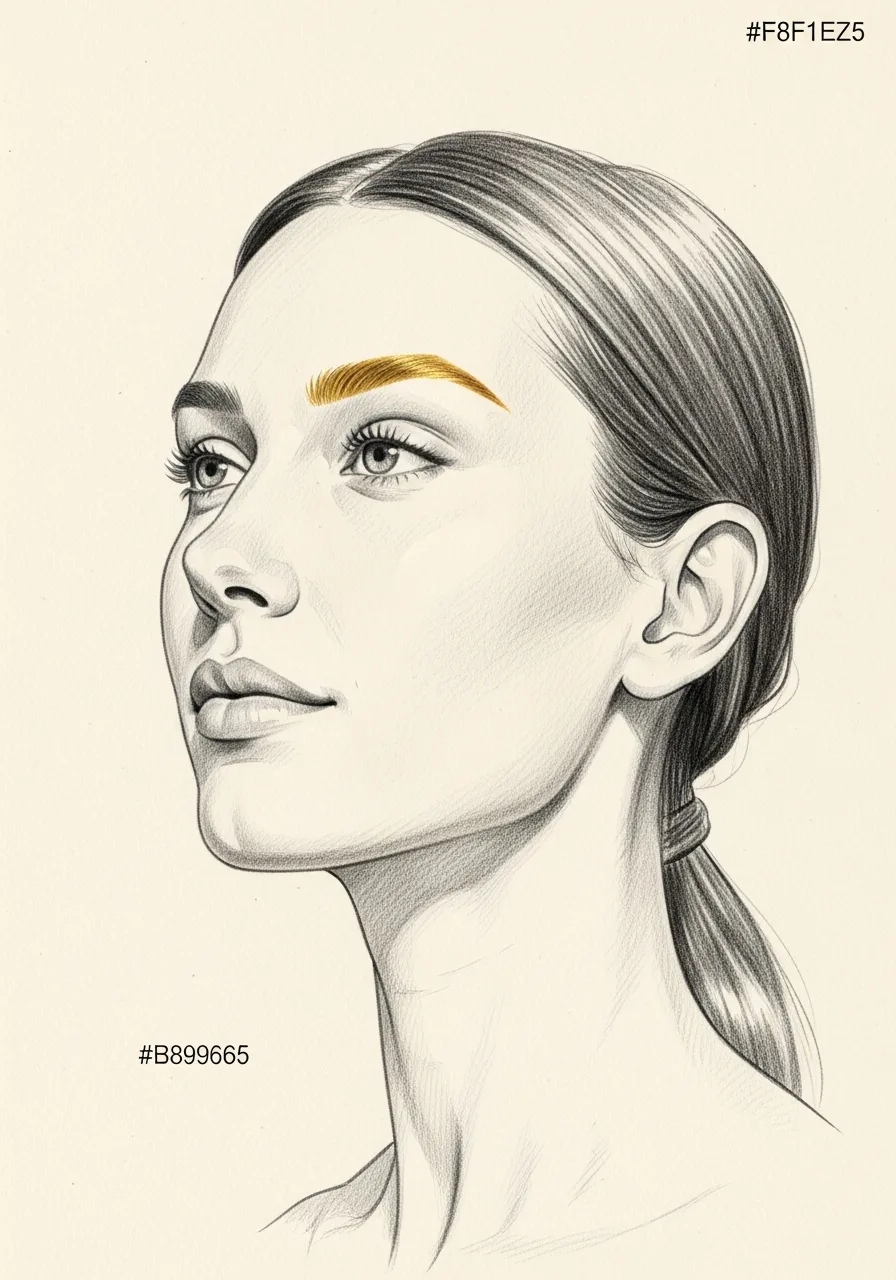
In Consultation
"A brow lift should make a person look less tired — never surprised."

A Note from Dr. Mourad
"Brow-lift planning should preserve expression and respect each patient's natural brow position."
— Dr. Moustafa Mourad, MD
Overview
Choosing the extent of a brow lift.
Brow-lift planning begins with the position and movement of the brow, not a fixed target height. Some patients notice outer-brow heaviness; others have a broader pattern of descent or asymmetry. The consultation also evaluates whether the upper eyelid skin or eyelid margin contributes to the complaint.
Endoscopic and temporal approaches address different patterns and have their own tradeoffs. Incision placement, hairline, forehead proportions, prior treatment, and the expression you want to retain all matter. The aim is a plan that explains what is being lifted and why—not an automatically higher or more arched brow.
For mild brow descent or early concerns, non-surgical alternatives may be discussed before surgery; they do not reproduce the repositioning of a lift.
Anatomy & planning
Brow, eyelid skin, or ptosis?
A low brow can crowd the upper eyelid. Redundant eyelid skin can exist with a normally positioned brow. True ptosis lowers the eyelid margin itself. These findings can occur alone or together, and treating the wrong structure can produce an incomplete or unnatural result.
The consultation should document brow position, eyelid margin, forehead recruitment, asymmetry, hairline, and the amount of skin that can be removed without compromising closure.
Anatomy & planning
Endoscopic brow lift
Small scalp incisions and endoscopic visualization allow broader release and repositioning without a long coronal incision. It may suit selected patients when the hairline and forehead anatomy support the approach.
Anatomy & planning
Temporal or lateral brow lift
A more focused approach may address lateral brow descent with a smaller scope. It does not necessarily correct central brow position or every pattern of forehead aging.
Anatomy & planning
Other approaches
Direct, pretrichial, coronal, or combined approaches may be considered in selected anatomy, prior surgery, hairline patterns, or functional indications. The page should not imply that one incision pattern is appropriate for everyone.
Anatomy & planning
Shape and identity
The goal is not a universally high or arched brow. Brow shape varies with sex, identity, facial proportions, baseline anatomy, and preference. A conservative plan respects asymmetry and expression rather than reproducing a template.
An Established Academic Authority
Double board certification. Fellowship director. Published author. A surgeon's surgeon.
ABFPRS
Board Certified
American Board of Facial Plastic & Reconstructive Surgery
ABOto
Board Certified
American Board of Otolaryngology — Head & Neck Surgery
NYMC
Clinical Assistant Professor
Otolaryngology · Clinician Scholar Pathway
AAFPRS
Fellowship Director
American Academy of Facial Plastic and Reconstructive Surgery
Textbook
Published Author
Contributions to the academic literature of facial plastic surgery
Dual board certification in both Facial Plastic & Reconstructive Surgery and Otolaryngology — Head & Neck Surgery.
01 · Why Dr. Mourad
A surgeon trusted by surgeons for this operation.
Dr. Moustafa Mourad is double board-certified by the American Board of Facial Plastic & Reconstructive Surgery and the American Board of Otolaryngology — Head & Neck Surgery, and serves as an AAFPRS Fellowship Director.
The practice concentrates on the operations of the face, nose, and sinuses — and on the patients other surgeons have found challenging.
Every consultation is unhurried, every plan is individual, and no operation is recommended unless it is the right one.
02 · Ideal Candidates
Who benefits most from this operation.
Candidacy is determined together at consultation. The most satisfied patients share three things in common.
I
Lateral Brow Descent
The outer third of the brow has dropped, creating a heavy upper lid and an unintended look of tiredness or sternness.
II
Forehead & Glabellar Lines
Deepening transverse forehead lines or vertical glabellar lines that no longer fully respond to neuromodulator treatment alone.
III
Companion to Blepharoplasty
Many patients benefit more from a brow lift combined with upper eyelid surgery than from blepharoplasty alone — the two are often planned together.
Before & After
Real results, real patients.
Every case is unique — tailored to individual anatomy and goals. Browse representative outcomes from the Manhattan practice.
If this describes you, the next step is a quiet, unhurried conversation — not a sales call.
An Honest Note
When this operation may not be right for you.
Patients whose primary complaint is upper-eyelid skin excess may be served by blepharoplasty alone without elevating the brow.
An already high or surgically over-elevated brow is not a candidate — restraint is essential to avoid a startled appearance.
Active hair loss or a very high natural hairline affects the choice of incision and is reviewed in detail at consultation.
Patients seeking dramatic forehead-line erasure may be better served initially by non-surgical resurfacing or neuromodulators.
03 · Approaches
The full range of options.
A brow lift is rarely a single technique. The right plan combines the surgical vector that suits the patient's brow anatomy with the companion procedures that round out the upper face.
1 of 6 · Endoscopic Brow Lift
04 · Technique
Endoscopic vs temporal brow lift.
Modern brow lifts are minimally invasive. The choice between endoscopic and temporal approach is dictated by the pattern of descent.
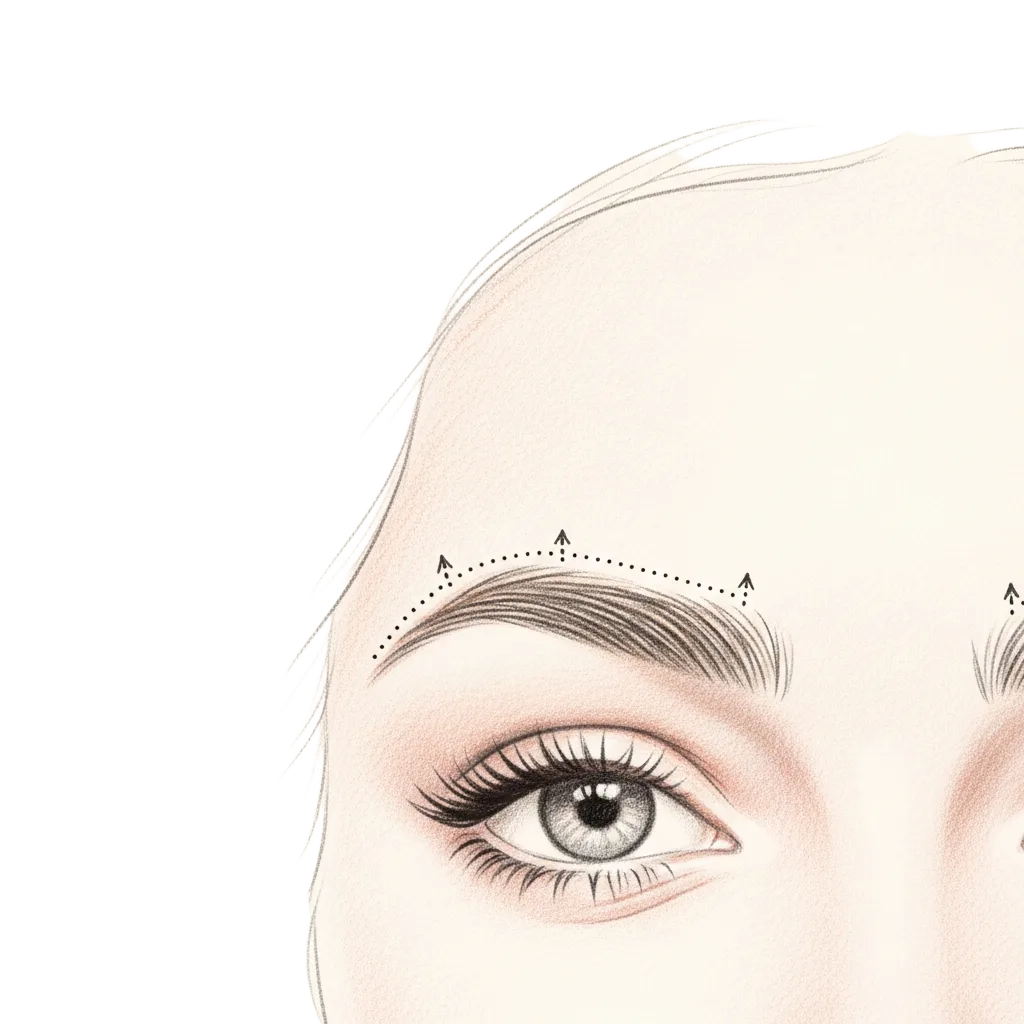
Endoscopic
Full Brow Elevation
Several short incisions are hidden within the scalp behind the hairline. A camera and specialized instruments elevate the entire brow and forehead complex from above.
This approach is well-suited to global brow descent and produces a natural, even elevation without a visible scar.
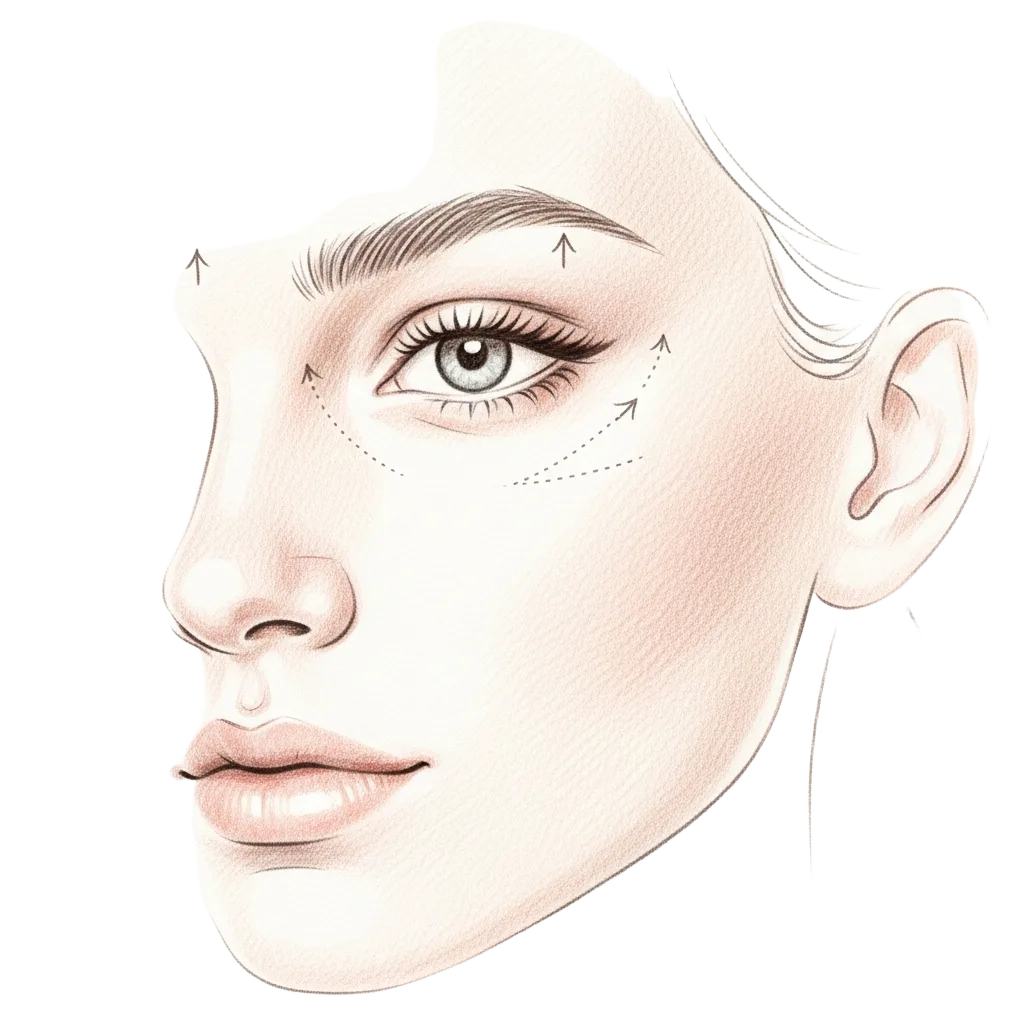
Temporal
Lateral Brow Only
A focused temporal lift addresses descent of the lateral third of the brow through small incisions in the temporal hair-bearing scalp.
It is an excellent procedure for the patient whose central brow is well-positioned but whose lateral brow has dropped — and often pairs naturally with a facelift.
The right approach restores the original brow position — never higher.
Begin the conversation
Refresh the upper face without altering its character.
Cost & Insurance
How Much Does a Brow Lift Cost in NYC?
A brow lift, including an endoscopic brow lift, starts at $15,000. Cost depends on the technique selected, the degree of brow descent, whether it is combined with eyelid surgery or other facial procedures, the type of anesthesia, and the surgical setting.
A brow lift is cosmetic and typically self-pay. After consultation, our office provides a personalized estimate. Payment is arranged directly with the practice. Payment terms and any required deposit are reviewed when surgery is scheduled.
| Operation | Typical surgical investment |
|---|---|
| Brow lift / endoscopic brow lift | $15,000+ |
What May Affect Cost
- Brow lift technique used
- Degree of brow descent
- Whether combined with eyelid surgery
- Type of anesthesia
- Surgical setting
- Whether the goal is brow elevation alone or combined upper-face rejuvenation
The prices listed are provided as general estimates of typical surgical investment and are not guaranteed quotes. Surgical fees vary based on the patient's anatomy, the complexity of the procedure, previous surgery, operative time, anesthesia and facility requirements, implants or hardware, virtual surgical planning when applicable, and whether multiple procedures are performed together. An exact surgical fee is provided following consultation and development of an individualized treatment plan.
06 · Recovery
What healing actually looks like.
Stage 01
First 24 Hours
Light dressings and head elevation through the first day. Discomfort is generally mild and well controlled with non-narcotic medications.
Stage 02
Week 1
Through the first week, bruising and swelling are concentrated around the brow and upper face. Sutures within the scalp are absorbed or removed as appropriate.
Stage 03
Weeks 2 – 4
Through weeks two to four, residual swelling resolves and the brow position settles into its final place. Social return is comfortable by two to three weeks.
Stage 04
Months 1 – 12
The final result is appreciated through three to six months as scar tissue matures and the soft tissues fully adapt to their new position.
Have a specific question?
Send a brief note describing your anatomy or concerns — the office will route it directly to Dr. Mourad for review.

Before You Arrive
Your consultation, prepared.
Bring photographs of your face from your 20s and 30s if available.
Note any previous facial surgery, injectables, or scalp procedures.
List current medications and supplements.
Be prepared to discuss whether eyelid surgery should be considered concurrently.
Allow 45 minutes for a focused upper-face evaluation.
Bring questions about scarring, hair-pattern considerations, and downtime.
In Their Words
From patients of the practice.
I didn't realize how heavy my brows looked until after they were lifted. My eyes look more open, but I don't look surprised or overdone. It's a small change that made my whole face look brighter.
I was worried a brow lift would make me look different. It didn't. I just look less tired, especially around my eyes.
The change is subtle, but I notice it every morning. Makeup goes on easier, and my eyes don't look as weighed down. I still look completely like myself.
I wanted something refined, not obvious. The result gave my face a little lift without changing my expression. That was important to me.
Individual experiences. Results and recovery vary by patient. Testimonials shared with written consent.
Frequently Asked
Patient questions, honestly answered.
The brow is assessed relative to the orbital rim, eyelid skin, forehead muscle activity, hairline, asymmetry, and the patient’s baseline photographs when available. A single measurement does not determine candidacy.
Sometimes brow repositioning reduces apparent lid heaviness, but excess eyelid skin may remain. Conversely, some patients need eyelid surgery without a brow lift. The two procedures treat different structures.
Clinical references
This page draws on published clinical practice guidelines and public-health references. These sources inform general patient education and do not replace an individual evaluation with Dr. Mourad.
- 01Endoscopic brow-lift long-term stability meta-analysis PubMed PMID: 39542644
- 02Brow position after upper blepharoplasty meta-analysis PubMed PMID: 36890345
- 03Functional and cosmetic brow-lift review PubMed PMID: 40603240
Explore Further
Related procedures & resources
Brow position is evaluated in the context of the eyelids and the upper face. These pages explain the related options.
blepharoplasty
eyelid distinction
Read moreFacelift
For patients also addressing the lower face and neck.
Read moreBefore & After Gallery
Representative facial rejuvenation cases, photographed with written consent on file.
Read morePatient Reviews
Read experiences from patients of the practice.
Read moreRequest a Consultation
Begin with an unhurried clinical evaluation.
Read moreThe Most Important Step
Your expert consultation.
A brow lift consultation is a careful upper-face evaluation — examining the brow position, the relationship to the upper eyelids, and whether a brow lift, blepharoplasty, or both is the right operation.