Double Board Certified · Functional Nasal Surgery
Septoplasty NYC — deviated septum surgery for clearer breathing.
Deviated septum repair in NYC for blocked nasal breathing, evaluated through the septum, nasal valves, turbinates, and full airway.
A quiet internal operation that returns the breath — designed to correct a deviated septum, improve nasal airflow, and preserve the external shape of the nose.
ABFPRS
Facial Plastic & Reconstructive Surgery
ABOto
Otolaryngology — Head & Neck Surgery
AAFPRS
Fellowship Director
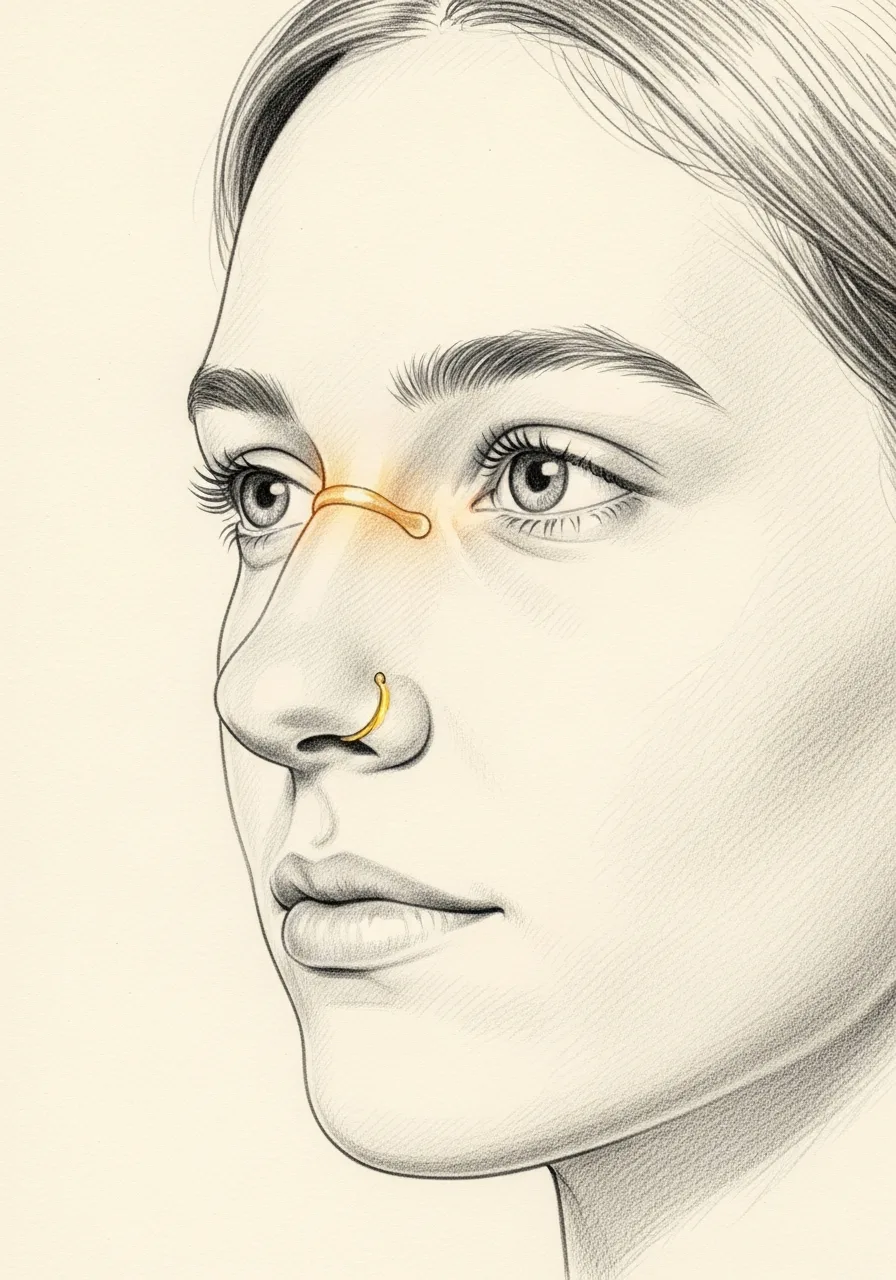
In Consultation
"Most patients tell me they did not realise how restricted their breathing had been until it was corrected."

A Note from Dr. Mourad
"Septoplasty is one of the most rewarding operations in functional nasal surgery. The change is internal — the architecture of the airway is rebuilt — but the impact on sleep, exercise, and daily energy is often profound."
— Dr. Moustafa Mourad, MD
Medically reviewed by Moustafa Mourad, MD, FACS — dual board-certified in Facial Plastic & Reconstructive Surgery and Otolaryngology–Head & Neck Surgery; Clinical Assistant Professor of Otolaryngology at New York Medical College; AAFPRS Fellowship Director. The medical review identifies the anatomy, evidence, limits, and questions patients should understand before choosing a procedure.
Last reviewed: June 2026
Is this the right page for you?
- Your main problem is breathing — persistent blockage on one or both sides, often worse at night or with exercise.
- A deviated septum has been identified as the cause of your nasal obstruction.
- You want to improve the airway without changing how your nose looks.
You may be looking for
- If you also want to change the appearance of your nose, see septorhinoplasty.
- If collapse of the nasal sidewall on breathing in is the issue, see nasal valve collapse treatment.
Key takeaways
- Septoplasty straightens the nasal septum, the wall of cartilage and bone between the nostrils.
- It is performed entirely through the nostrils, with no external incisions.
- It is a purely functional operation aimed at improving breathing, not appearance.
- It is considered when a deviated septum causes obstruction unrelieved by medical therapy.
- When the nose's shape is also a concern, it can be combined as septorhinoplasty.
Overview
What is septoplasty?
Septoplasty is a functional surgical procedure that straightens the nasal septum — the wall of cartilage and bone that divides the two nasal passages. The operation is performed entirely through the nostrils, with no external incisions, and removes or repositions the deviated portion while preserving structural support for the nose.
It is considered when a deviated septum produces nasal obstruction, recurrent infections, post-nasal drip, sleep disruption, or recurrent nosebleeds that have not responded to medical therapy. Diagnosis is made on examination, often supported by nasal endoscopy and, when indicated, imaging. Patients should also review the septoplasty recovery timeline and why a nose whistles when breathing.
Septoplasty is a purely functional operation. When the external shape of the nose is also a concern, septoplasty can be combined with rhinoplasty (septorhinoplasty) so both problems are addressed in a single recovery rather than across two operations.
Does septoplasty change the appearance of the nose?
Septoplasty is internal and usually does not change external appearance. If both breathing and appearance are concerns, septoplasty may be combined with rhinoplasty as septorhinoplasty.
SeptorhinoplastyWhy can breathing still feel blocked after septoplasty?
The septum is only one part of the airway. Turbinate enlargement, nasal valve collapse, allergies, chronic rhinitis, or sinus disease may also contribute to obstruction and require separate evaluation.
Nasal Valve Collapse TreatmentTerminology
Deviated Septum Repair in NYC
Deviated septum repair is another way patients describe septoplasty — surgery to straighten the wall of cartilage and bone between the nasal passages when it blocks airflow. Dr. Mourad evaluates the septum together with the nasal valves, inferior turbinates, mucosa, allergy or rhinitis patterns, prior trauma, prior surgery, and sinus history, because septal deviation is not the only possible cause of nasal obstruction. Depending on the examination, the plan may also involve nasal valve collapse treatment, turbinate reduction, or septorhinoplasty when appearance and breathing both need correction.
Choosing the Right Page
Septoplasty vs septorhinoplasty: which page is right for you?
Septoplasty is internal functional surgery for a deviated septum and nasal obstruction. It does not intentionally change the outside shape of the nose. Septorhinoplasty combines septal and airway work with cosmetic or structural changes to the external nose.
| Main concern | Septoplasty | Septorhinoplasty |
|---|---|---|
| What it treats | Deviated septum and nasal obstruction | Septum, airway, and external nasal shape together |
| External appearance change | Not intended | Yes — planned cosmetic or structural change |
| Breathing goal | Primary goal of the operation | Addressed alongside appearance goals |
| Best page | septoplasty surgery in NYC | septorhinoplasty in NYC |
If appearance alone is the concern, without a breathing problem, the right starting point is rhinoplasty NYC.
Meet Dr. Mourad
A septoplasty surgeon in NYC who evaluates the entire nasal airway — not just the septum.
Dr. Moustafa Mourad approaches septoplasty as functional nasal-airway surgery, not simply as straightening a piece of cartilage. A deviated septum can be an important cause of obstruction, but it is not the only one. Enlarged turbinates, nasal valve collapse, allergies, prior trauma, and sinus disease can all contribute to the way a patient breathes. The right operation depends on identifying the actual anatomic problem.
Dr. Mourad is dual board-certified in Facial Plastic and Reconstructive Surgery and Otolaryngology–Head and Neck Surgery. In septoplasty consultations, he evaluates the septum, nasal valves, turbinates, mucosa, prior trauma, prior surgery, and symptoms such as nighttime obstruction, exercise limitation, mouth breathing, and recurrent infections. When needed, nasal endoscopy or CT imaging helps clarify whether sinus disease or complex anatomy is also involved.
His philosophy is to avoid incomplete airway surgery. If the septum is the only meaningful problem, septoplasty alone may be appropriate. If nasal valve collapse, turbinate hypertrophy, or external nasal deformity also contributes, he explains why septoplasty alone may not fully solve the obstruction and whether septorhinoplasty, turbinate reduction, or nasal valve support should be considered. Patients should understand which part of the airway is being treated, which symptoms are expected to improve, and which symptoms may require medical therapy instead of surgery.
- Dual board-certified facial plastic surgeon and otolaryngologist
- Evaluates septum, valves, turbinates, mucosa, and sinus disease together
- Functional surgery philosophy focused on the true source of obstruction
- Practice focused on nasal airway, sinus, facial, and reconstructive surgery
An Established Academic Authority
Double board certification. Fellowship director. Published author. A surgeon's surgeon.
ABFPRS
Board Certified
American Board of Facial Plastic & Reconstructive Surgery
ABOto
Board Certified
American Board of Otolaryngology — Head & Neck Surgery
NYMC
Clinical Assistant Professor
Otolaryngology · Clinician Scholar Pathway
AAFPRS
Fellowship Director
American Academy of Facial Plastic and Reconstructive Surgery
Textbook
Published Author
Contributions to the academic literature of facial plastic surgery
Dual board certification in both Facial Plastic & Reconstructive Surgery and Otolaryngology — Head & Neck Surgery.
01 · Why Dr. Mourad
A surgeon trusted by surgeons for this operation.
Dr. Moustafa Mourad is double board-certified by the American Board of Facial Plastic & Reconstructive Surgery and the American Board of Otolaryngology — Head & Neck Surgery. He is a Clinical Assistant Professor of Otolaryngology at New York Medical College and serves as an AAFPRS Fellowship Director.
The practice concentrates on the operations of the face, nose, and sinuses — and on the patients other surgeons have found challenging.
Every consultation is unhurried, every plan is individual, and no operation is recommended unless it is the right one.
02 · Ideal Candidates
Who benefits most from this operation.
Candidacy is determined together at consultation. The most satisfied patients share three things in common.
I
Persistent Nasal Obstruction
One- or two-sided difficulty breathing through the nose that does not resolve with medical therapy — sprays, irrigations, or allergy treatment.
II
Sleep & Exercise Impact
Mouth breathing at night, snoring, dry mouth on waking, or a clear reduction in aerobic capacity that traces to the airway, not the lungs or heart.
III
Documented Deviation
A deviated septum confirmed on examination, with nasal endoscopy or imaging used when clinically appropriate, that is the structural cause of the obstruction — not allergic mucosal swelling alone.
Anatomy · Illustrated
What deviated septum repair changes internally.
Septoplasty changes the internal airway, not the external appearance of the nose. These educational illustrations — not patient photographs — show how a deviated septum can narrow one nasal passage and how straightening the septum can improve the internal airflow pathway. The actual surgical plan depends on examination and whether the valves, turbinates, rhinitis, or sinus disease also contribute.
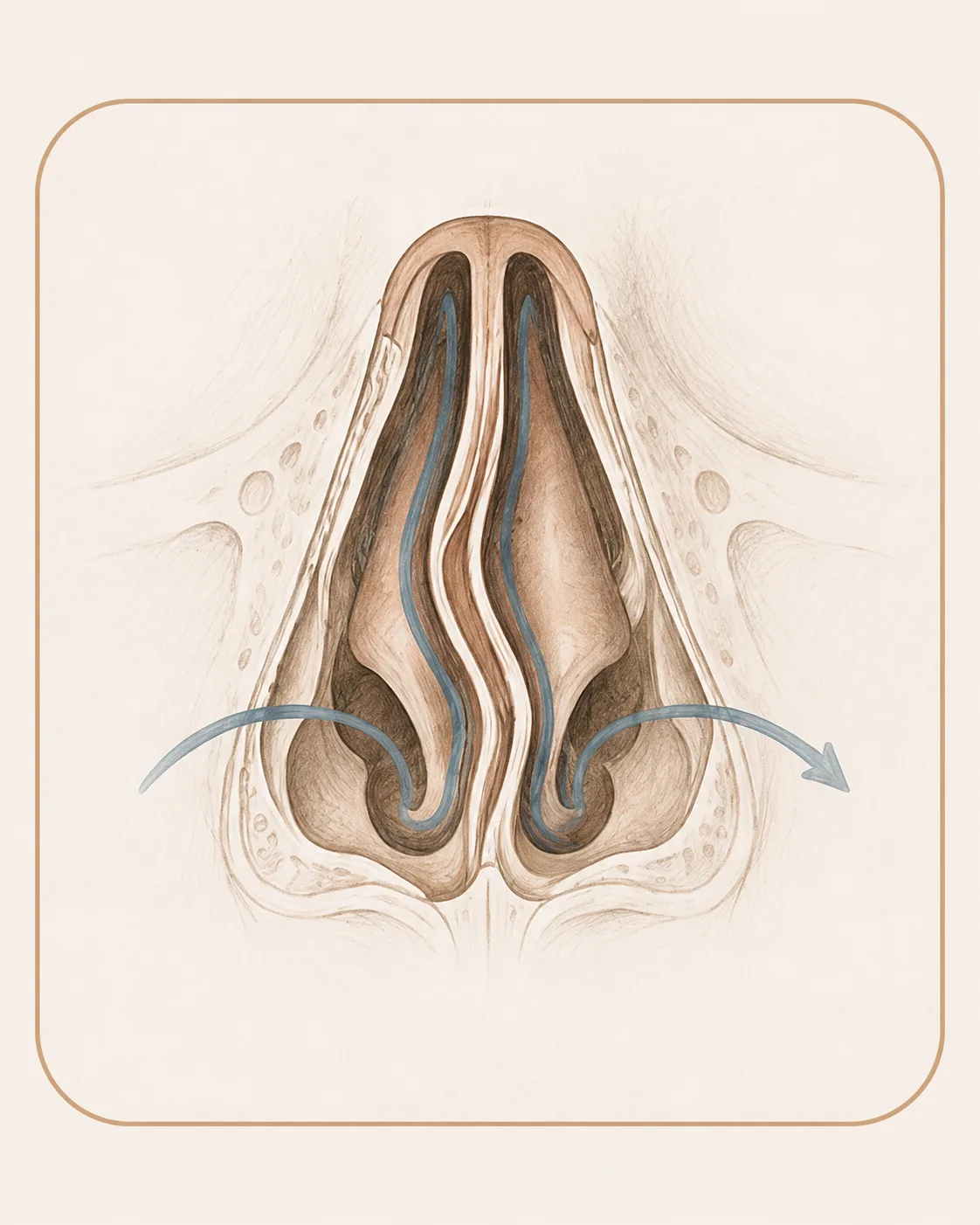
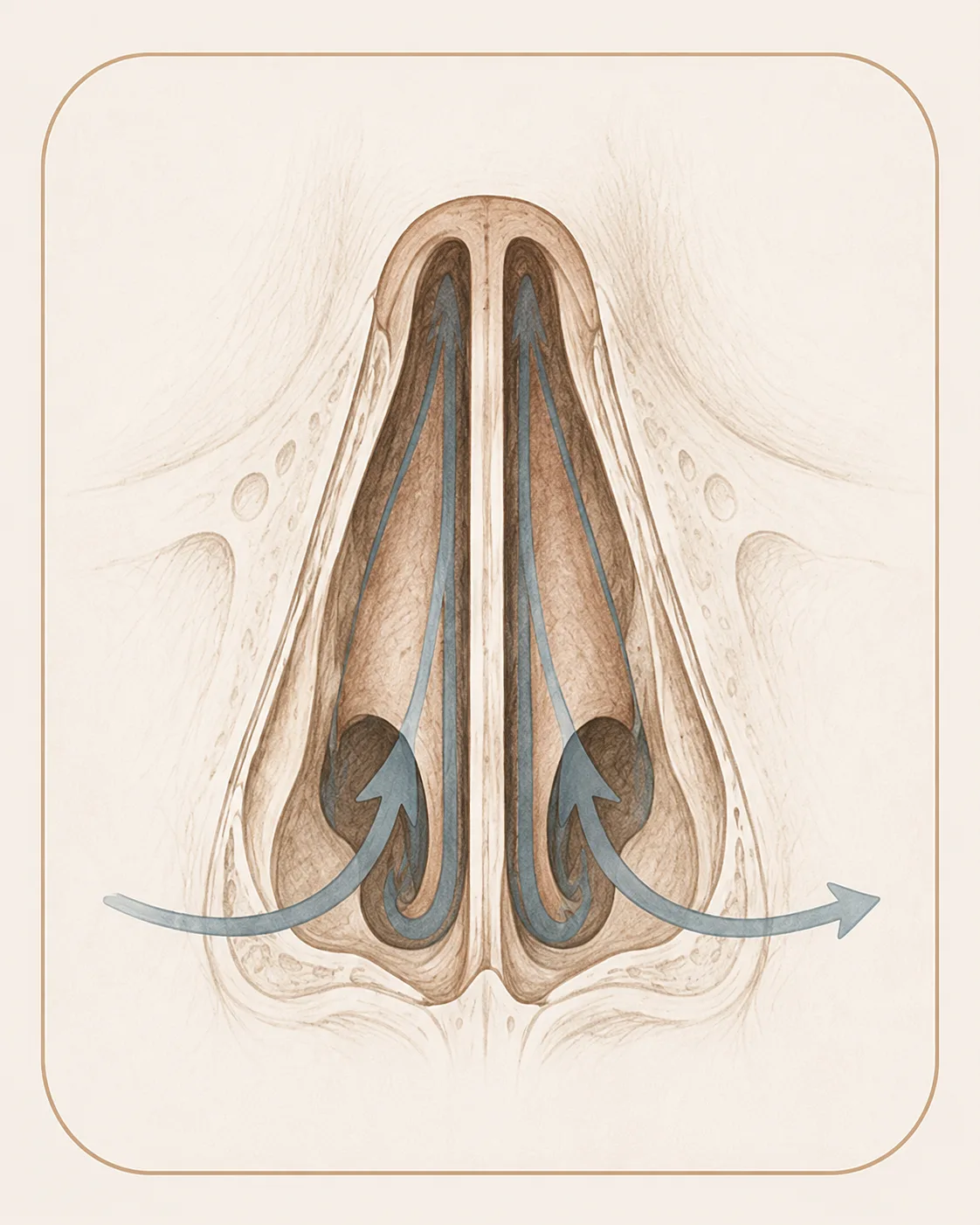
Basal anatomical view · Illustrative diagram · Not to scale
If this describes you, the next step is a quiet, unhurried conversation — not a sales call.
An Honest Note
When this operation may not be right for you.
If your symptoms are driven primarily by allergies or chronic rhinitis, medical therapy or turbinate-directed treatment may resolve the issue without operating on the septum.
Active inflammatory sinus disease is treated first; septoplasty is rarely performed on an infected airway.
Smokers and patients on certain blood thinners require a planned medical optimization window before any nasal surgery.
Cosmetic complaints about the external nose are not addressed by a septoplasty alone — that conversation belongs to rhinoplasty or septorhinoplasty.
03 · Approaches
The full range of options.
Septoplasty is rarely a stand-alone operation. The right plan considers companion procedures — turbinate, valve, sinus — and accounts for whether prior surgery has already shaped the anatomy.
1 of 6 · Standard Septoplasty
Compare your options
Surgery for a blocked nose, side by side
Different structures cause nasal obstruction, and each has a different operation. Select any two options to compare them directly, or open the full table below. The right choice is determined on examination.
What it addresses
Septoplasty: A deviated septum — the wall between the nostrils.
Turbinate Reduction: Enlarged inferior turbinates reducing airway space.
Changes appearance?
Septoplasty: No — purely functional.
Turbinate Reduction: No — internal only.
Incisions
Septoplasty: Hidden, inside the nostril. No external scar.
Turbinate Reduction: Inside the nose, tissue-preserving.
Typical anesthesia
Septoplasty: General or sedation, individualized.
Turbinate Reduction: Often combined with another nasal procedure.
General downtime
Septoplasty: Most desk work resumes within a few days.
Turbinate Reduction: Minimal; frequently done alongside septoplasty.
Insurance
Septoplasty: May be submitted for insurance review when medically necessary and when the patient's plan includes applicable out-of-network benefits.
Turbinate Reduction: May be submitted for insurance review when medically necessary and when the patient's plan includes applicable out-of-network benefits.
View full comparison table
| Attribute | Septoplasty | Turbinate Reduction | Nasal Valve Repair | Septorhinoplasty |
|---|---|---|---|---|
| What it addresses | A deviated septum — the wall between the nostrils. | Enlarged inferior turbinates reducing airway space. | Collapse or narrowing of the nasal valve (sidewall). | The septum and the external shape, together. |
| Changes appearance? | No — purely functional. | No — internal only. | Usually not; focus is structural support. | Yes — functional and cosmetic in one operation. |
| Incisions | Hidden, inside the nostril. No external scar. | Inside the nose, tissue-preserving. | Approach depends on the technique used. | Endonasal or a small columellar incision. |
| Typical anesthesia | General or sedation, individualized. | Often combined with another nasal procedure. | General or sedation, individualized. | General anesthesia, individualized. |
| General downtime | Most desk work resumes within a few days. | Minimal; frequently done alongside septoplasty. | Varies with the technique; discussed at consultation. | A splint for about a week; bruising settles over weeks. |
| Insurance | May be submitted for insurance review when medically necessary and when the patient's plan includes applicable out-of-network benefits. | May be submitted for insurance review when medically necessary and when the patient's plan includes applicable out-of-network benefits. | May be submitted for insurance review when medically necessary and when the patient's plan includes applicable out-of-network benefits. | The functional portion may be submitted for insurance review when medically necessary and when the plan includes out-of-network benefits; the cosmetic portion is self-pay. |
General information only. Anesthesia, downtime, and insurance vary by patient and plan and are determined individually at consultation.
04 · Technique
Endoscopic vs open septoplasty.
Most modern septoplasties are performed entirely through the nostrils with endoscopic visualization. An open approach is reserved for the small subset of patients whose anatomy requires it.
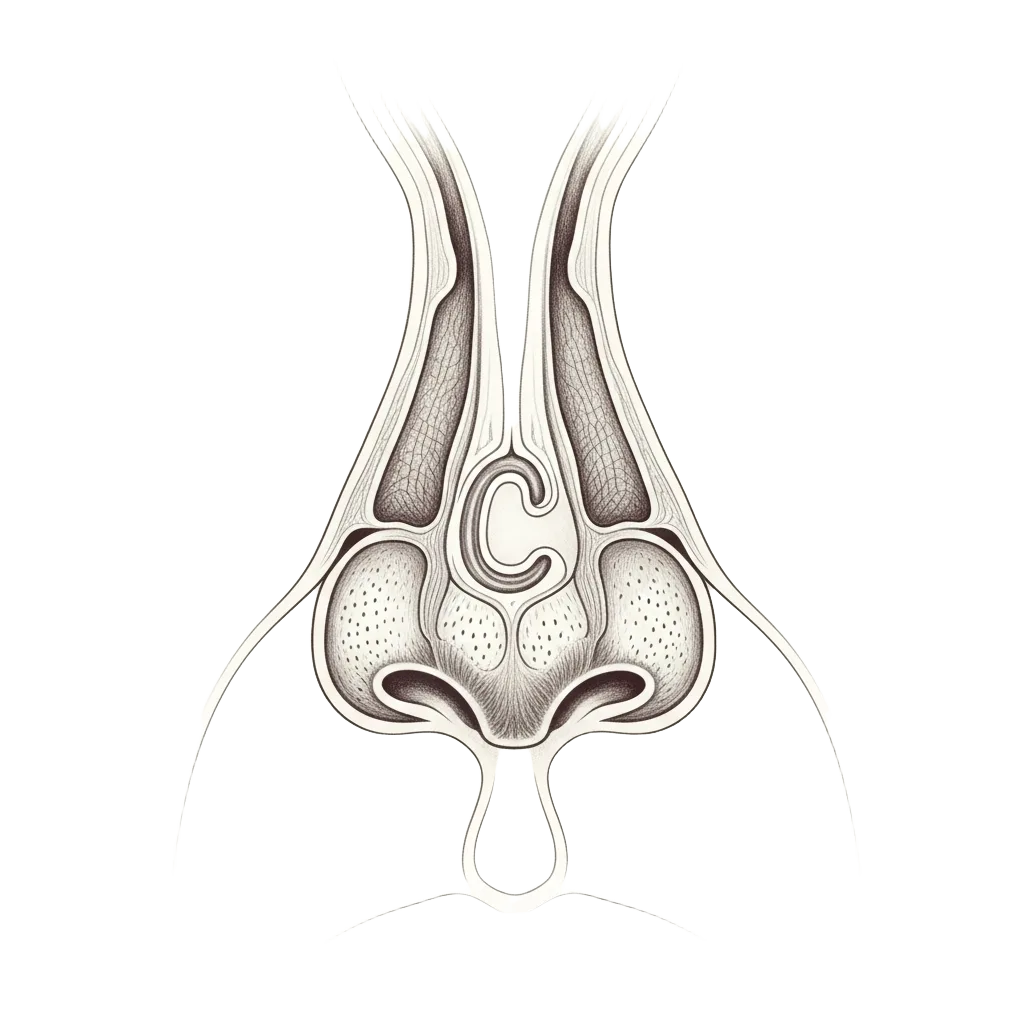
Endoscopic
Endonasal
An incision is made inside the nostril, and the deviated portions of the cartilage and bone are conservatively removed or repositioned. The mucosal lining is preserved on both sides of the septum.
There are no external scars. Recovery is straightforward, and the airway change is typically appreciated as swelling resolves over the following weeks.
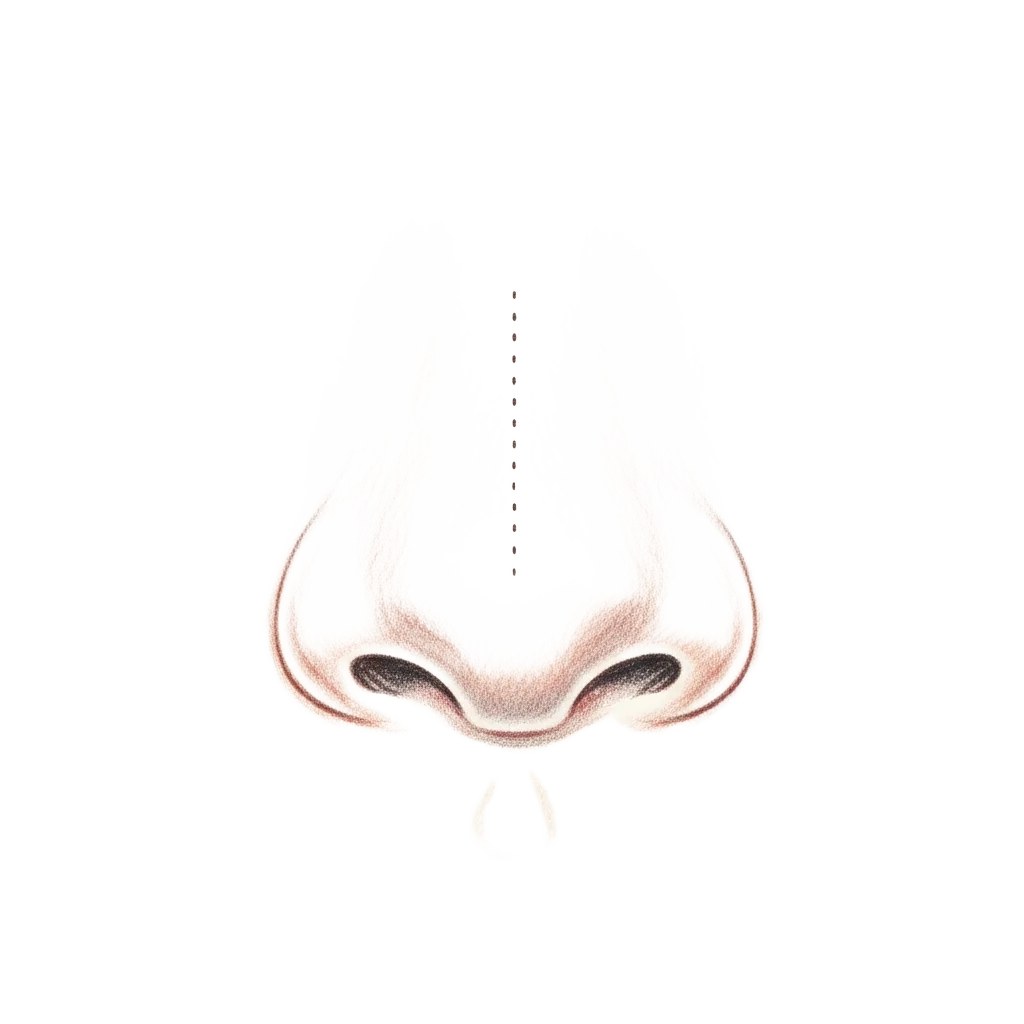
Open
Septorhinoplasty Access
When the septum is severely deviated, especially in revision cases, an open approach through a small columellar incision provides the exposure required to rebuild the septum with cartilage grafts.
This is the standard approach when functional septoplasty is being performed alongside cosmetic rhinoplasty as a single operation.
Illustrative diagrams. The appropriate approach is determined individually at consultation.
Begin the conversation
Functional nasal evaluation. A real conversation about your breathing.
Cost & Insurance
Septoplasty Cost & Insurance in NYC
Septoplasty cost depends on the complexity of the septal deviation, whether turbinate reduction is performed at the same time, the type of anesthesia, and the surgical facility. Each plan is individualized after a nasal airway evaluation.
MouradNYC is an out-of-network practice. Eligible medically necessary functional components may be submitted to insurance when the patient's plan includes applicable out-of-network benefits and plan requirements are met. Coverage, authorization, deductibles, coinsurance, allowed amounts, and patient responsibility vary by plan and are not guaranteed. Verification and authorization do not guarantee payment. Our office can help review benefits and guide patients through preauthorization when appropriate.
What May Affect Cost
- Severity of septal deviation
- Whether turbinate reduction is included
- Type of anesthesia
- Surgical facility
- Prior nasal surgery
- Insurance plan requirements
The prices listed are provided as general estimates of typical surgical investment and are not guaranteed quotes. Surgical fees vary based on the patient's anatomy, the complexity of the procedure, previous surgery, operative time, anesthesia and facility requirements, implants or hardware, virtual surgical planning when applicable, and whether multiple procedures are performed together. An exact surgical fee is provided following consultation and development of an individualized treatment plan.
Clinical Septoplasty Atlas
The structures that shape how you breathe
Septoplasty is a functional operation performed inside the nose to straighten the septum and open a narrowed airway. These stylized surgical plates show the internal and surface anatomy involved. Switch between the views, then select any numbered structure — tap it directly on the illustration or choose it from the list — to read what it is and why it matters.
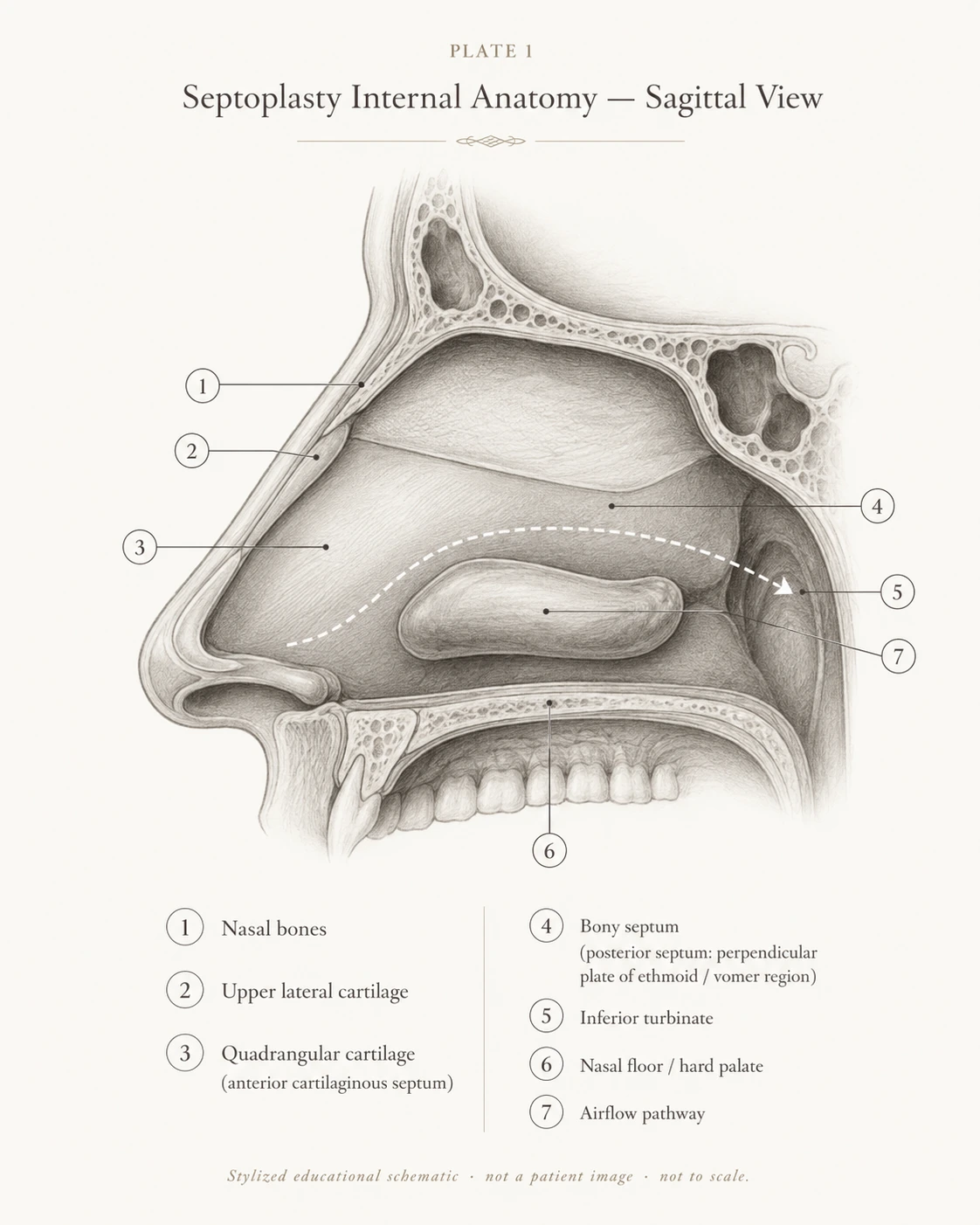
Stylized educational schematic · not a patient image · not to scale
Internal Septal Anatomy — Sagittal View
This view shows the septum dividing the nasal airway from front to back, along with the inferior turbinate, nasal floor, bony septum, and the pathway air follows through the nose. Septoplasty is focused on improving internal airflow while preserving the support needed to maintain nasal shape.
Explore the labeled structures
1. Nasal bones
The paired bones that form the bony upper third of the nose and give the bridge its shape and support.
2. Upper lateral cartilage
Cartilage in the middle third of the nose that helps support the internal nasal valve, the narrowest part of the airway.
3. Quadrangular cartilage (anterior cartilaginous septum)
The front cartilage portion of the septum. When it is bent or displaced it is a common cause of a blocked nasal airway and a frequent focus of septoplasty.
4. Bony septum (perpendicular plate of ethmoid / vomer region)
The bony back portion of the septum. Deviations here sit deeper in the nose and can also narrow the airway.
5. Inferior turbinate
A curved, shelf-like structure on the side wall of the nose that warms and humidifies air. When enlarged it can add to a sense of blockage alongside a deviated septum.
6. Nasal floor / hard palate
The floor of the nasal cavity, which separates the nose from the roof of the mouth.
7. Airflow pathway
The route air travels through the nose. Septoplasty aims to open this pathway when a deviated septum narrows it.
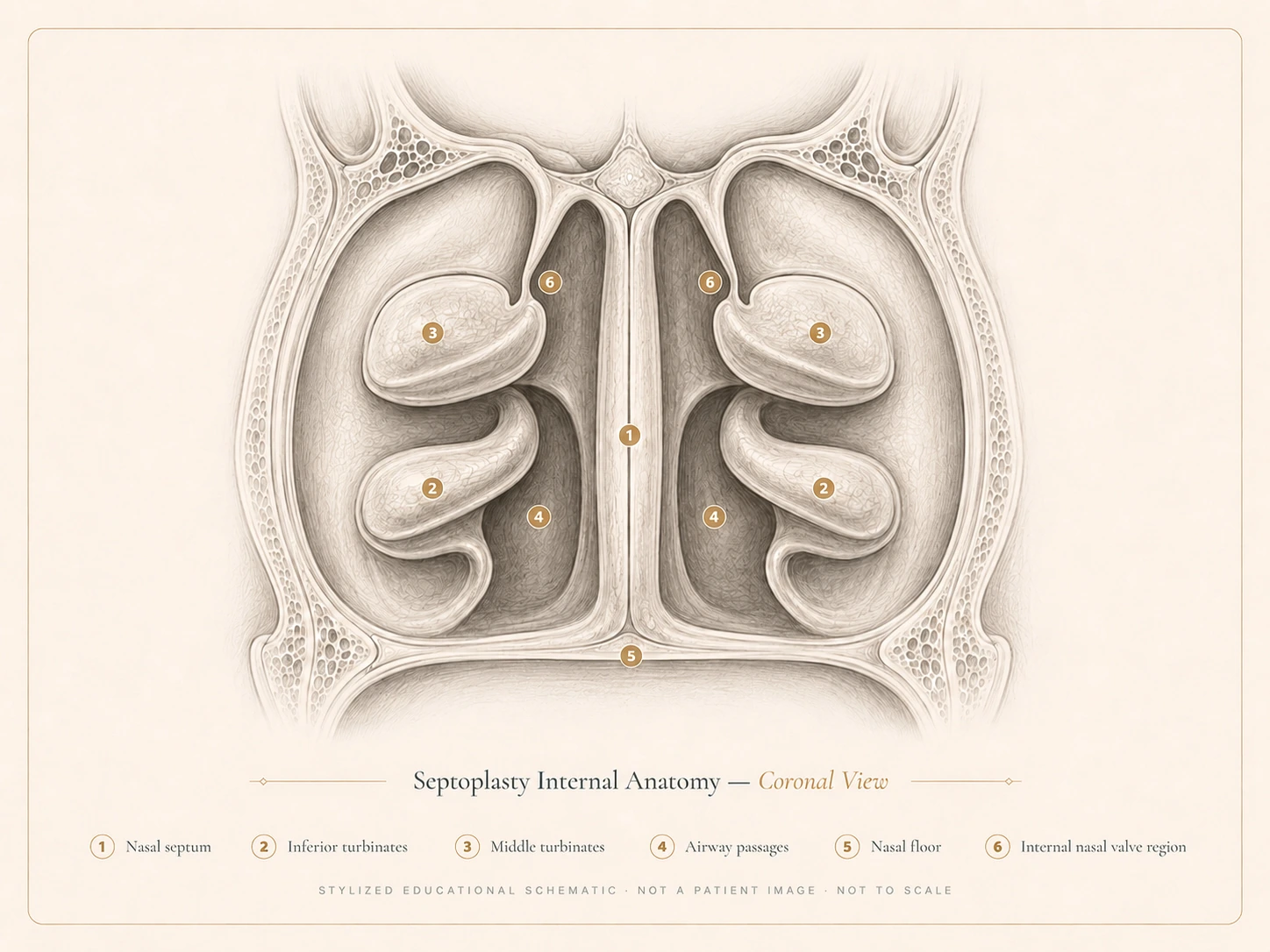
Stylized educational schematic · not a patient image · not to scale
Internal Anatomy — Coronal View
This view shows the nasal passages from the front, including the septum, inferior turbinates, middle turbinates, internal valve region, nasal floor, and airway spaces. It helps explain why obstruction may come from more than one structure.
Explore the labeled structures
1. Nasal septum
The central wall of cartilage and bone that divides the nose into two passages. A deviation to one side can narrow one or both airways.
2. Inferior turbinates
The lower, largest turbinates. Enlargement can contribute to nasal obstruction, sometimes together with a deviated septum.
3. Middle turbinates
The turbinates positioned above the inferior turbinates along the side wall of the nose.
4. Airway passages
The open spaces on each side of the septum through which air flows.
5. Nasal floor
The base of the nasal cavity beneath the passages.
6. Internal nasal valve region
The narrowest part of the nasal airway, where small changes in width have a large effect on breathing.
Stylized educational schematic · not a patient image · not to scale
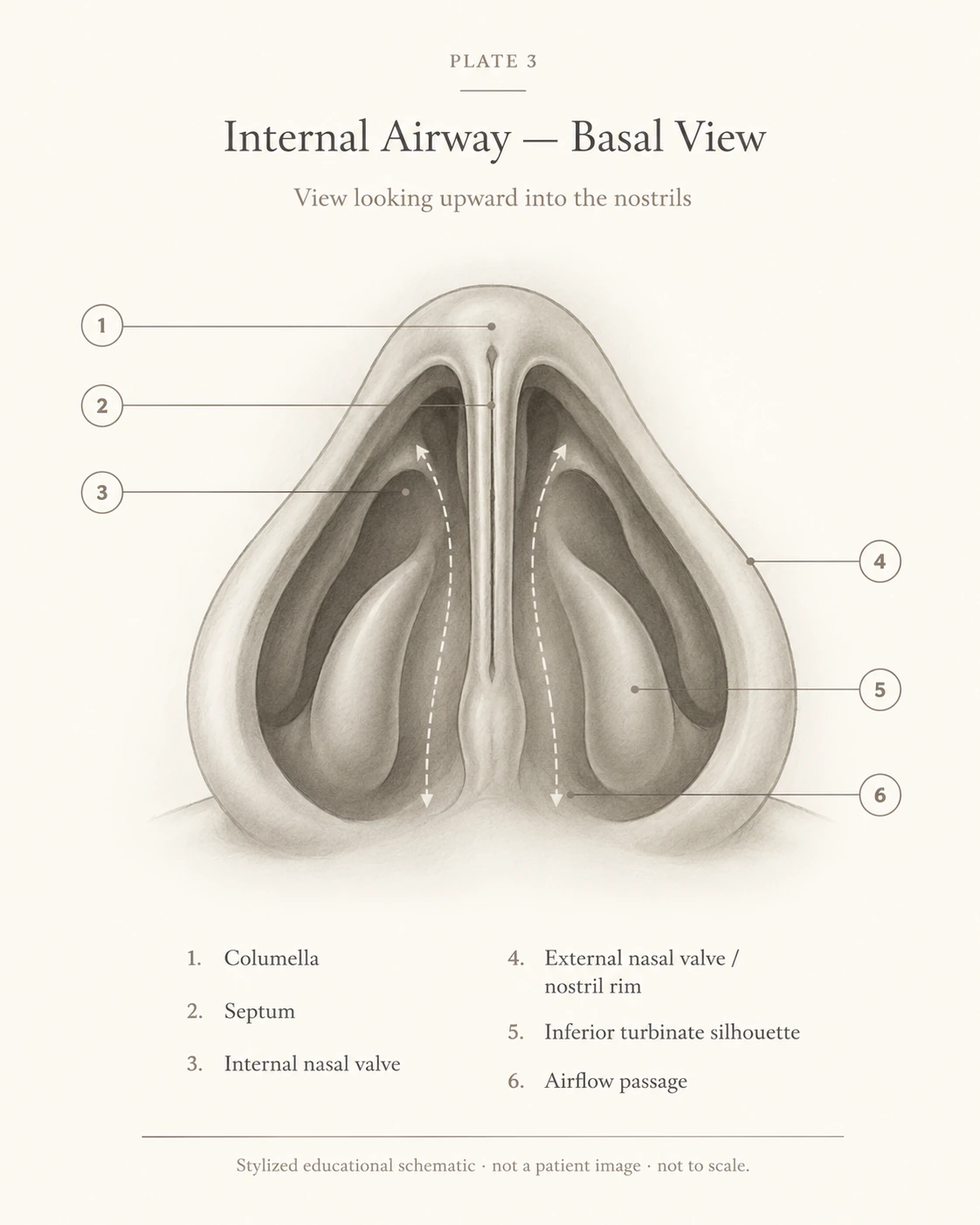
Internal Airway — Basal View
This view looks upward into the nostril openings and demonstrates the relationship between the septum, turbinates, nasal valves, and airway passages. It is useful for explaining why a deviated septum, turbinate enlargement, or valve narrowing may create similar breathing symptoms.
Explore the labeled structures
1. Columella
The strip of tissue between the nostrils at the base of the nose, supported by cartilage.
2. Septum
The dividing wall seen here from below. Its position influences how open each nostril is.
3. Internal nasal valve
The narrowest internal segment of the airway; narrowing here is a common cause of breathing difficulty.
4. External nasal valve / nostril rim
The nostril opening and its rim. Weakness or narrowing here can limit airflow, especially with deep breathing.
5. Inferior turbinate silhouette
The outline of the inferior turbinate seen through the airway from this angle.
6. Airflow passage
The path air follows into each nostril.
Stylized educational schematic · not a patient image · not to scale
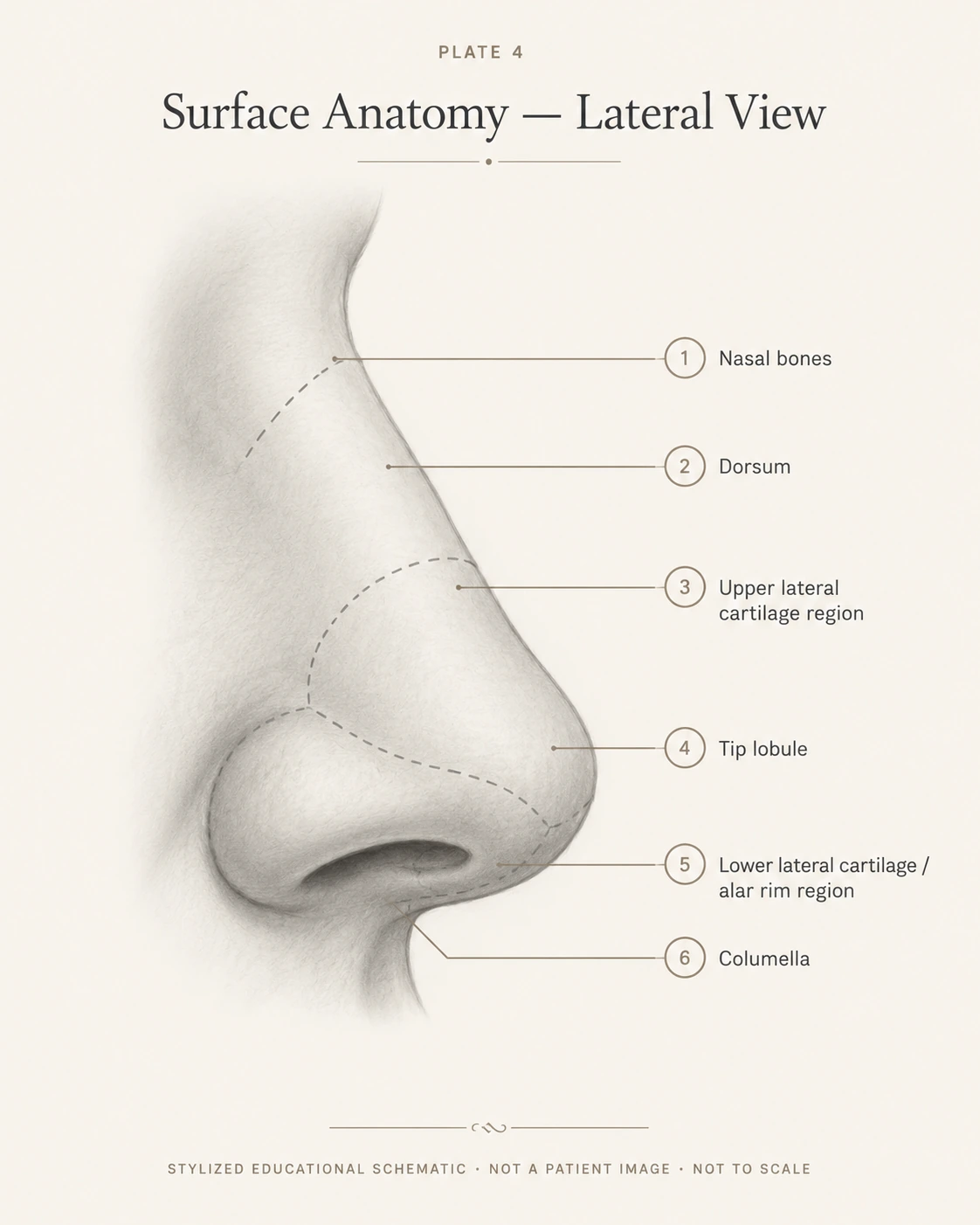
Surface Anatomy — Lateral View
This surface view orients the external nasal structures that can influence both appearance and airflow, including the nasal bones, dorsum, upper and lower lateral cartilage, tip, alar rim, and columella.
Explore the labeled structures
1. Nasal bones
The bony upper third of the nose that forms the bridge.
2. Dorsum
The bridge line running from between the eyes to the tip.
3. Upper lateral cartilage region
The middle third of the nose, which contributes to both the profile and the internal valve.
4. Tip lobule
The rounded tip of the nose, shaped mainly by the lower cartilages.
5. Lower lateral cartilage / alar rim region
The cartilage that shapes the tip and nostril rim; it also supports the external valve.
6. Columella
The external strip of tissue between the nostrils.
Related
Stylized educational schematic · not a patient image · not to scale
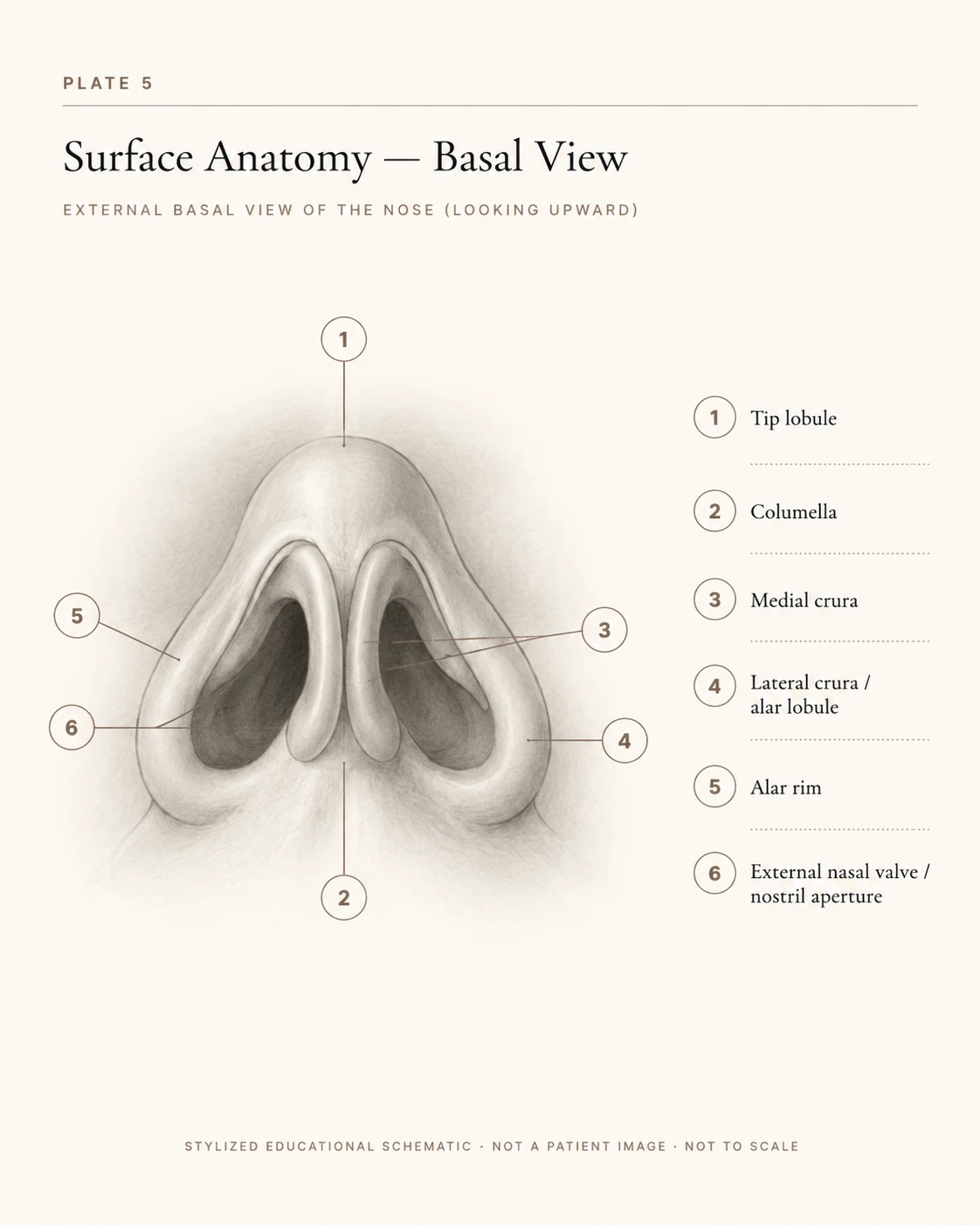
Surface Anatomy — Basal View
This basal view shows the nostril shape, columella, medial and lateral crura, alar rim, and external nasal valve. These structures matter when obstruction involves the nostril rim or external valve, rather than the septum alone.
Explore the labeled structures
1. Tip lobule
The rounded front of the nasal tip seen from below.
2. Columella
The central pillar between the nostrils.
3. Medial crura
The paired inner portions of the lower cartilages that support the columella and tip.
4. Lateral crura / alar lobule
The outer portions of the lower cartilages that shape and support the nostril walls.
5. Alar rim
The curved rim of each nostril.
6. External nasal valve / nostril aperture
The nostril opening; its shape and support affect how easily air enters the nose.
05 · In Dr. Mourad's Words
Educational videos.
Short educational films and patient perspectives from the Manhattan practice.
Dr. Mourad in Practice
An overview of the practice and philosophy.
Patient Perspective
A patient discusses her experience before, during, and after surgery.
Inside the Consultation
How Dr. Mourad evaluates anatomy, goals, and candidacy.
06 · Recovery
What healing actually looks like.
Stage 01
First 24 Hours
Internal splints, when used, are removed at the first post-operative visit around day seven. There is no external dressing. Mild congestion is expected as the lining heals.
Stage 02
Week 1
Through the first week, light activity is encouraged. Heavy lifting and exercise are deferred. Most patients return to office work within a few days.
Stage 03
Weeks 2 – 4
Through weeks two to four, congestion progressively clears. Saline irrigation is continued. The airway improvement becomes increasingly evident.
Stage 04
Months 1 – 12
From one month onward, scar tissue settles and the final airway is appreciated. Long-term, the corrected septum is stable.
What healing looks like
Septoplasty recovery, stage by stage
Recovery is gradual, and the airway improvement becomes clearer as internal swelling settles. Select a stage to see what to expect. Timelines are general and vary from person to person.
Rest, mild congestion, and a sense of fullness are expected.
- There is no external dressing. Internal splints, when used, stay in place until the first visit.
- Mild congestion and a blocked feeling are normal as the lining begins to heal — this is not the final airway.
- Keep the head elevated and follow the specific after-care instructions you are given.
Light activity is encouraged; most desk work resumes within a few days.
- Internal splints, if placed, are typically removed at the first post-operative visit around day seven.
- Heavy lifting and strenuous exercise are deferred. Saline irrigation is usually started as directed.
- Some crusting and intermittent congestion are common during this week.
Congestion progressively clears and breathing steadily improves.
- As swelling resolves, the airway change becomes increasingly noticeable.
- Saline irrigation is continued. Exercise is reintroduced gradually per your surgeon's guidance.
- Any residual stuffiness generally continues to improve week over week.
Scar tissue settles and the final airway is appreciated.
- From about one month, the internal healing matures and the corrected septum is stable long-term.
- Follow-up confirms healing and airflow. Most restrictions have lifted by this point.
When to contact the office
- Heavy or persistent bleeding that does not stop with gentle pressure.
- A fever, spreading redness, or increasing pain rather than steady improvement.
- Sudden changes in vision, severe headache, or clear fluid dripping from the nose.
- Any symptom that worries you — it is always appropriate to call.
General guidance, not medical advice. Follow the specific instructions provided by your surgical team, and seek urgent care for any severe or worsening symptom.
Have a specific question?
Send a brief note describing your anatomy or concerns — the office will route it directly to Dr. Mourad for review.

Before You Arrive
Your consultation, prepared.
Bring any prior CT scans of the nose or sinuses if available.
Note any prior nasal surgery, trauma, or septal injuries.
List allergy medications, decongestants, and nasal sprays you currently use.
Stop blood-thinning medications and supplements per the timeline you will receive.
Allow 60 minutes for a focused functional nasal examination.
No surgical decisions are made at the first visit — that is intentional.
Patient Reviews
Septoplasty and Nasal Airway Patient Experiences
Selected public patient reviews. Individual experiences vary.
“I can now say I can breathe better than I ever have”
Real patient experiences
Selected public reviews from patients of the practice.
Your privacy matters
We never share personal health information.
Board-certified expertise
Dual board-certified facial plastic and reconstructive surgeon.
Individual results vary. Reviews reflect individual experiences and are not a guarantee of outcome.
At a Glance
Septoplasty fact snapshot.
- Treats
- Nasal obstruction caused by a deviated septum — the wall of cartilage and bone dividing the two nasal passages.
- Does not treat
- The outside shape of the nose, nasal valve collapse, turbinate enlargement, allergies, or sinus disease on their own — though several of these can be addressed in the same operation.
- Evaluation
- Internal examination of the septum, valves, and turbinates, endoscopy when needed, and imaging when sinus disease is suspected.
- Related conditions
- Deviated septum, nasal valve collapse, turbinate hypertrophy, chronic sinusitis.
- Possible combined procedures
- Nasal valve repair, turbinate reduction, functional septorhinoplasty, sinus surgery.
- Recovery summary
- Most patients return to desk work within about a week; congestion from internal swelling settles over the following weeks.
- Insurance / functional distinction
- Septoplasty is a functional procedure and may be submitted for insurance review — coverage is never guaranteed. This out-of-network practice provides documentation for reimbursement.
- When to seek evaluation
- When one or both sides of the nose stay blocked despite sprays and medical therapy, or obstruction affects sleep and exercise.
A Complete Airway Evaluation
Why Dr. Mourad evaluates more than the septum.
Nasal obstruction is rarely a one-structure problem. Operating on the septum alone, when other contributors are present, leaves breathing incompletely corrected. Every septoplasty evaluation at the practice therefore examines the airway as a system:
- The septum — cartilaginous and bony deviation
- The nasal valves — internal and external sidewall support
- The turbinates — compensatory or allergic enlargement
- The mucosa — allergy and chronic rhinitis contribution
- The sinuses — coexisting sinus disease
- Prior trauma or prior nasal surgery
Clinical Documentation
How functional nasal obstruction is documented.
Consistent with AAO-HNS clinical indicators for septoplasty, Dr. Mourad documents functional nasal obstruction through a structured evaluation rather than a single test:
- Symptom history — obstruction, mouth breathing, snoring, congestion, sleep disruption
- Obstruction that persists despite appropriate medical therapy, when relevant
- Complete intranasal examination
- Assessment of septal deviation
- Evaluation for turbinate hypertrophy
- Evaluation for nasal valve compromise
- Screening for nasal polyps or sinus disease when suspected
- Nasal endoscopy when clinically helpful
- CT imaging only when clinically indicated — not routine for every septoplasty
Visiting the Practice
Septoplasty in Manhattan and the Upper East Side.
MouradNYC sees patients for septoplasty and functional nasal airway evaluation at 923 Fifth Avenue in Manhattan. Patients commonly seek evaluation for deviated septum, nasal obstruction, nighttime mouth breathing, exercise-related blockage, and combined septoplasty or septorhinoplasty planning.
Find your starting point
Which nasal breathing path fits your situation?
Answer three short questions to see which page explains the evaluation most relevant to you. This is educational orientation, not a diagnosis — a clinical examination is how the cause of nasal obstruction is actually determined.
Select an option for each question to see which page fits your situation.
This guide is general educational information, not medical advice or a diagnosis. Only an in-person examination can determine the cause of nasal obstruction and the appropriate treatment.
See all pathways
A combined revision evaluation likely fits
When both breathing and appearance are concerns after previous surgery, the anatomy is already altered and rebuilding structural support is often part of the plan. A revision evaluation looks at what the prior operation changed before anything is recommended.
A revision rhinoplasty conversation likely fits
Changing the appearance of a nose that has already had surgery is a different undertaking from a first operation, because scar tissue and prior changes shape what is possible. A revision evaluation is the right starting point.
A deviated-septum evaluation likely fits
Persistent, constant blockage that does not resolve with sprays or allergy treatment is often related to a deviated septum. Septoplasty is the functional operation that straightens the septum. If you have had prior nasal surgery, revision considerations also apply.
A nasal valve evaluation likely fits
When the side of the nose draws inward on hard inspiration, the nasal valve — the narrowest part of the airway — may be the contributor rather than the septum alone. This is assessed directly on examination.
A turbinate and sinus evaluation likely fits
Congestion that fluctuates with colds, allergies, or facial pressure often involves swollen turbinates or the sinuses rather than the septum by itself. The evaluation looks at the whole airway before any procedure is considered.
A septorhinoplasty conversation likely fits
When breathing and appearance are both concerns, they can often be addressed together in a single planned operation — straightening the septum while refining the external shape — so there is one recovery rather than two.
A rhinoplasty conversation likely fits
When the concern is the shape of the nose, rhinoplasty is the operation that refines it. A consultation focuses on your goals and whether the underlying anatomy supports them.
A revision evaluation likely fits
After previous nasal surgery, a fresh structural evaluation is the right starting point because the anatomy has already been changed once.
Start with a functional nasal evaluation
Your answers point to more than one possible contributor, which is common. A functional nasal examination is how the cause is identified before any treatment is considered.
Why patients trust this practice
Care led by a double board-certified specialist
Double board certified
American Board of Facial Plastic & Reconstructive Surgery and American Board of Otolaryngology — Head & Neck Surgery.
AAFPRS Fellowship Director
Trains fellows through the American Academy of Facial Plastic and Reconstructive Surgery.
Published author
Contributions to the academic literature of facial plastic surgery.
Face, nose & sinus focus
A practice concentrated above the clavicles, including complex revision evaluations.
Frequently Asked
Patient questions, honestly answered.
Yes. Patients often use "deviated septum repair" to describe septoplasty — the internal functional operation that straightens the septum when it blocks nasal airflow. The evaluation also considers the nasal valves, turbinates, and sinus history, because the septum is not the only possible cause of obstruction.
Many patients notice partial improvement within days as packing or crusting resolves. Meaningful airway change usually evolves over 2–6 weeks as mucosal swelling subsides. Healing and functional refinement can continue for three to six months. Individual timelines vary and are reviewed during follow‑up visits.
Clinical references
This page draws on published clinical practice guidelines and public-health references. These sources inform general patient education and do not replace an individual evaluation with Dr. Mourad.
- 01American Academy of Otolaryngology–Head and Neck Surgery. Clinical Indicators: Septoplasty. AAO-HNS clinical indicators
- 02American Academy of Otolaryngology–Head and Neck Surgery. Position Statement: Nasal Valve Repair. AAO-HNS position statement
- 03American Academy of Otolaryngology–Head and Neck Surgery Foundation. Clinical Consensus Statement: Septoplasty with or without Inferior Turbinate Reduction. Otolaryngology–Head and Neck Surgery. 2015;153(5):708–720. AAO-HNSF consensus
- 04Stewart MG, Witsell DL, Smith TL, et al. Development and validation of the Nasal Obstruction Symptom Evaluation (NOSE) scale. Otolaryngology–Head and Neck Surgery. 2004;130(2):157–163. NOSE scale validation study
- 05U.S. National Library of Medicine (MedlinePlus). Nose Injuries and Disorders. MedlinePlus
Explore Further
Related conditions & procedures
Septoplasty is often part of a broader functional nasal evaluation. These pages explain the related conditions and procedures.
Read the full septoplasty patient guide
A physician-written, illustrated guide to septal anatomy, surgery, recovery, risks, and common questions.
Read moreDeviated Septum
The condition septoplasty is designed to correct.
Read moreTurbinate Reduction
Frequently combined with septoplasty when enlarged turbinates also obstruct airflow.
Read moreNasal Valve Collapse
Repair of the nasal sidewall when it contributes to obstruction.
Read moreSeptorhinoplasty
When the septum and the external nasal shape are addressed together.
Read moreSinus Surgery
For patients whose obstruction is compounded by sinus disease.
Read moreSeptal Perforation Repair
A true septal perforation is different from a deviated septum and may require specialized septal perforation repair rather than septoplasty alone.
Read moreRequest a Consultation
Begin with an unhurried clinical evaluation.
Read moreThe Most Important Step
Your expert consultation.
A septoplasty consultation is a careful functional evaluation — examination, often endoscopy, and a discussion of whether structural correction will meaningfully change your breathing. Consultations are performed in Manhattan for patients seeking septoplasty in NYC, deviated septum surgery, and functional nasal airway evaluation.