Double Board Certified · Facial Contouring
Buccal Fat Removal — restraint, contour, balance.
Buccal fat removal is a permanent reduction of a deep cheek-fat compartment and should be considered only after confirming that buccal fat—not muscle, superficial fat, bone width, skin laxity, swelling, or normal youthful facial volume—is responsible for the concern. In selected patients, a conservative reduction can refine the lower cheek; in others, the safest recommendation is no surgery.
ABFPRS
Facial Plastic & Reconstructive Surgery
ABOto
Otolaryngology — Head & Neck Surgery
AAFPRS
Fellowship Director

In Consultation
"A small operation. A permanent decision. It must be planned for the face you will have at fifty, not the face you have today."

A Note from Dr. Mourad
"Buccal fat removal is one of the most over-prescribed procedures of the last decade. Done in the right patient — modest in volume, conservative in technique — it sharpens the lower cheek without hollowing. Done casually in the wrong patient, it carries a real risk of aging poorly."
— Dr. Moustafa Mourad, MD
Overview
What is buccal fat removal?
Buccal fat removal — also called buccal lipectomy — is a procedure that reduces a portion of the buccal fat pad, a discrete pocket of fat in the lower cheek. The fat is approached through a small incision inside the mouth, near the second upper molar; a measured amount is removed and the incision is closed. There are no external scars.
Patients consider it when the lower cheeks have a persistent fullness that gives the face a rounded appearance even at a normal weight, and when that fullness is anatomically due to the buccal pad rather than overall facial fat or thick masseter muscle. Examination is what distinguishes the two — and dictates whether the procedure is appropriate.
Buccal fat removal is a careful, conservative procedure. Removing too much can produce a gaunt, aged appearance years later, because the face loses fat naturally over time. The aim is selective contouring, not aggressive hollowing.
Differential Diagnosis
Is the fullness actually buccal fat?
Lower-cheek fullness has several possible anatomic causes, and only one of them is treated by buccal fat reduction. The examination distinguishes the true buccal pad from look-alikes — because removing buccal fat in a patient whose fullness comes from somewhere else is unlikely to change the contour, while still spending the long-term fat reserve of the face.
Superficial (subcutaneous) fat
Diffuse facial fat under the skin changes with weight and is not addressed by removing the deeper buccal pad. Weight history and pinch examination help separate the two.
Masseter hypertrophy
An enlarged chewing muscle widens the lower face at the jaw angle. It is assessed by palpation while clenching, and is managed differently — buccal fat removal does not slim a muscular jawline.
Weak chin or cheek projection
An under-projected chin or flat cheekbone can make normal cheek volume read as fullness. In these patients, augmentation of the deficient structure balances the face better than removing fat.
Facial descent with age
Softening of the jawline from tissue descent is a lifting problem, not a volume problem. Removing buccal fat in a descending face can deepen the folds it sits behind.
Submental fullness
Fullness under the chin and along the neck is a separate compartment, addressed with neck contouring rather than the cheek.
Salivary gland prominence
Prominence of the parotid or other salivary tissue can mimic cheek fullness and warrants its own evaluation before any cosmetic plan.
Operative Anatomy
How conservative buccal fat reduction is performed.
The buccal fat pad is a deep, encapsulated fat compartment with several extensions. The portion relevant to cheek contour is the buccal extension — the part that projects into the lower cheek. A conservative reduction addresses only a limited amount of this extension; the deeper body and the other extensions are left undisturbed.
Through a short incision inside the mouth near the second upper molar, the capsule is opened and gentle pressure allows the buccal extension to present itself. Only the fat that delivers easily, with minimal traction, is reduced. Pulling firmly on the pad is avoided — traction can draw in deeper fat that should remain, and it increases the risk to nearby structures.
Two structures define the safety of this operation: the parotid duct, which crosses the cheek and opens opposite the second upper molar, and the buccal branches of the facial nerve, which run near the pad. Respecting the capsule, working under direct vision, and limiting traction protect both. Temporary tightness with mouth opening (trismus), swelling, and bruising are expected in the first days; infection, asymmetry, salivary injury, nerve irritation, and the delayed hollowing associated with over-resection are the risks reviewed at consent.
The incision is closed with dissolving sutures and heals inside the mouth without a visible scar.
Anatomy & planning
Is it actually buccal fat?
Lower-cheek fullness can come from the buccal fat pad, superficial facial fat, masseter muscle, wide cheek or jaw bones, skin and soft-tissue laxity, weight fluctuation, edema, or facial proportions. These structures respond to different treatments. Removing buccal fat will not narrow bone, reduce a large masseter, lift lax tissue, or correct every round face.
Anatomy & planning
Reasons to be cautious or decline surgery
The procedure is elective. “No surgery” is an appropriate outcome of consultation when the predicted long-term tradeoff outweighs the likely benefit.
- —a naturally narrow or already hollow face;
- —significant weight instability;
- —prominent age-related volume loss;
- —unclear source of fullness;
- —unrealistic expectation of a sharply sculpted result;
- —a concern better explained by bone, muscle, skin, or superficial fat;
- —inability to accept permanent change and limited long-term evidence.
Anatomy & planning
Long-term evidence
Current reviews report high satisfaction in selected published series, but long-term aging outcomes are incompletely reported and study quality is limited. The face normally loses volume with age, so a reduction that looks appropriate early may appear more hollow later. The page should present that uncertainty directly rather than promise that conservative removal eliminates long-term risk.
Anatomy & planning
Alternatives by diagnosis
Alternatives depend on the cause: masseter treatment for selected muscle prominence, weight and medical evaluation for generalized or fluctuating fullness, skin or lifting procedures for laxity, skeletal evaluation for bone width, and no treatment when facial volume is proportionate. Filler should not be used automatically to compensate for an overly aggressive fat-removal plan.
An Established Academic Authority
Double board certification. Fellowship director. Published author. A surgeon's surgeon.
ABFPRS
Board Certified
American Board of Facial Plastic & Reconstructive Surgery
ABOto
Board Certified
American Board of Otolaryngology — Head & Neck Surgery
NYMC
Clinical Assistant Professor
Otolaryngology · Clinician Scholar Pathway
AAFPRS
Fellowship Director
American Academy of Facial Plastic and Reconstructive Surgery
Textbook
Published Author
Contributions to the academic literature of facial plastic surgery
Dual board certification in both Facial Plastic & Reconstructive Surgery and Otolaryngology — Head & Neck Surgery.
01 · Why Dr. Mourad
Diagnosis first, then a plan that fits.
Dr. Mourad evaluates buccal fat removal with skepticism in patients under thirty, especially those with naturally thin mid-face fat.
When indicated, the operation is conservative — partial reduction, not aggressive removal — and performed through a small intra-oral incision.
Patients are screened for facial aging trajectory; the goal is a result that ages well, not one that looks dramatic at 27 and gaunt at 47.
02 · Ideal Candidates
Who benefits most from this operation.
Candidacy is determined together at consultation. The most satisfied patients share three things in common.
I
Full Lower Cheeks
Patients with persistent fullness in the lower cheek below the zygomatic arch that does not change with weight loss.
II
Mature Facial Structure
Generally late twenties or older, with stable adult facial proportions and a clear understanding of how the face will continue to thin with age.
III
Modest Expectations
Patients seeking refinement of contour — not dramatic transformation. The most satisfied patients want a slightly more defined cheekbone, not a sculpted hollow.
If this describes you, the next step is a quiet, unhurried conversation — not a sales call.
An Honest Note
When this operation may not be right for you.
Patients under 25 with naturally thin mid-face fat — because facial fat tends to diminish with age, removal in this group carries a higher risk of an aged, hollowed look developing later. Long-term outcome data over decades remain limited, which argues for caution, not confidence.
Patients seeking dramatic transformation are usually better served by lateral cheek augmentation or a comprehensive contouring plan.
Patients with body-image driven dissatisfaction benefit from a longer evaluation before any irreversible facial procedure.
Patients who have lost significant weight recently should wait until weight is stable before considering removal.
03 · Approaches
Three paths to mid-face refinement.
Buccal fat removal is a conservative, irreversible operation. The right plan depends on whether the goal is isolated cheek hollow refinement or part of a broader lower-face contour change.
1 of 3 · Standard Buccal Reduction
04 · Technique
Conservative vs aggressive removal.
The same incision can be used to remove very different volumes of fat. The volume removed is the single decision that most determines how the result ages.
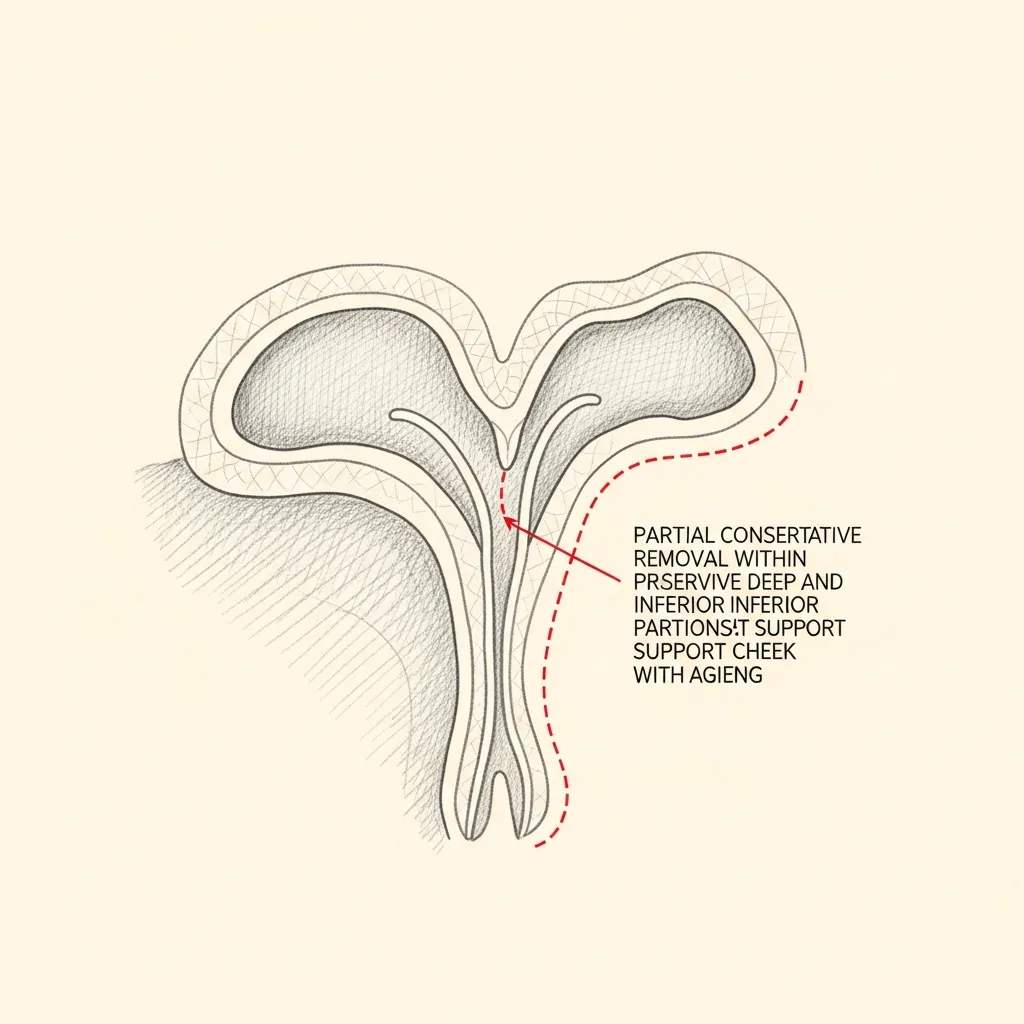
Conservative
Partial reduction, age-friendly
A measured partial reduction — a limited reduction of the buccal extension of the fat pad, delivered with gentle exposure and minimal traction — refines the lower cheek while preserving the deeper portions that support the mid-face.
This is the approach used in the great majority of cases. The change is modest in the mirror, and a conservative reduction is designed to lower the risk of late hollowing — though long-term aging after any buccal fat reduction cannot be predicted with certainty.
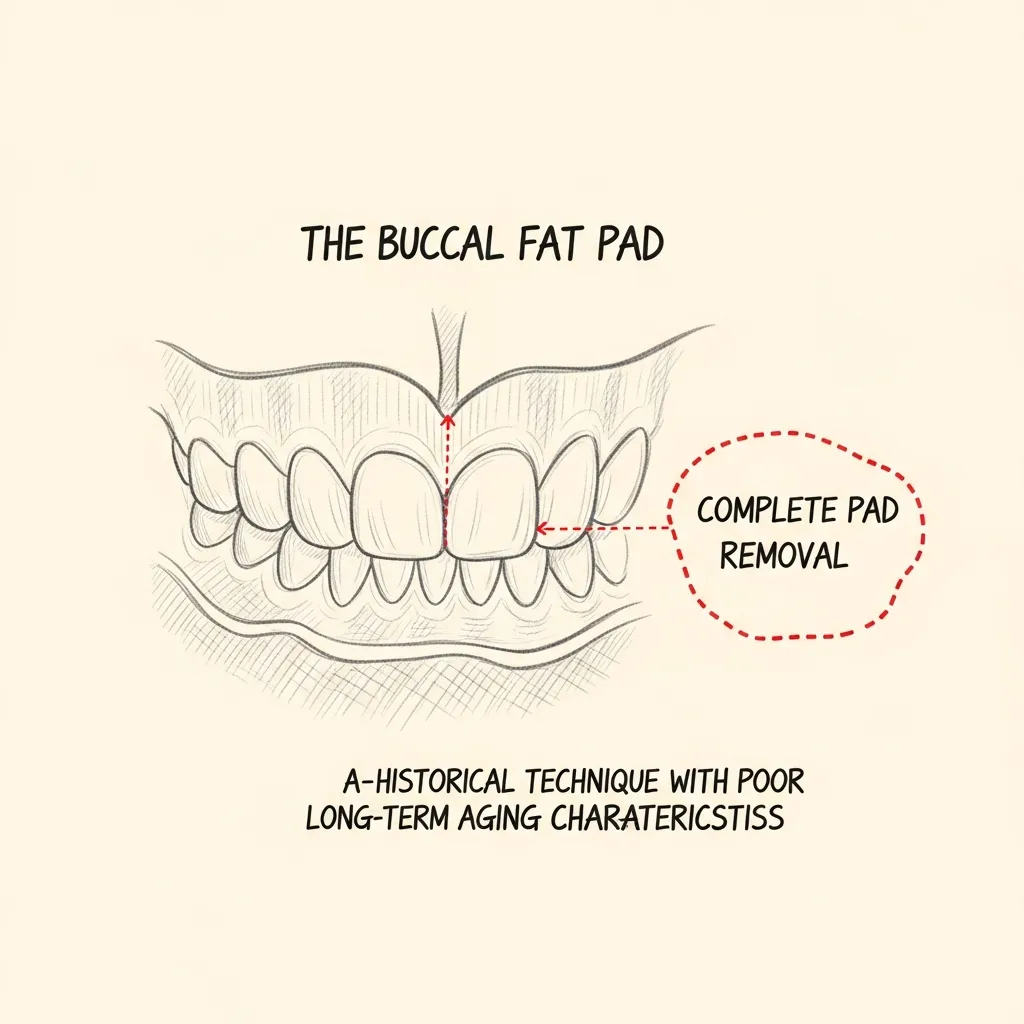
Aggressive
Why we no longer do this
Aggressive or complete buccal fat removal was performed more freely in the 1990s and 2000s. Published experience and long-term clinical observation suggest it can contribute to a gaunt, hollowed appearance as the face continues to thin with age — a risk that cannot be undone, because the pad does not regenerate.
This is not the approach used in this practice. Patients who request it are counseled candidly about the long-term trajectory.
Illustrative diagrams. The volume reduced is decided case by case based on starting anatomy and projected facial aging.
Begin the conversation
A careful, honest evaluation is the right first step.
Cost & Insurance
How Much Does Buccal Fat Removal Cost in NYC?
Buccal fat reduction typically ranges from $6,000 to $9,000+. Cost depends on whether one or both sides are treated, whether asymmetry needs correcting, anesthesia and facility requirements, and whether the procedure is combined with other facial contouring.
Buccal fat removal is a cosmetic procedure and is typically self-pay. After consultation, our office provides a personalized estimate based on the recommended plan. Payment is arranged directly with the practice. Payment terms and any required deposit are reviewed when surgery is scheduled.
| Operation | Typical surgical investment |
|---|---|
| Buccal fat reduction | $6,000–$9,000+ |
What May Affect Cost
- Whether performed alone or combined
- Facial anatomy and goals
- Type of anesthesia
- Surgical setting
- Postoperative care
- Whether revision work is involved
The prices listed are provided as general estimates of typical surgical investment and are not guaranteed quotes. Surgical fees vary based on the patient's anatomy, the complexity of the procedure, previous surgery, operative time, anesthesia and facility requirements, implants or hardware, virtual surgical planning when applicable, and whether multiple procedures are performed together. An exact surgical fee is provided following consultation and development of an individualized treatment plan.
06 · Recovery
What healing actually looks like.
Stage 01
First 24 Hours
Because the incisions are inside the mouth, early care centers on oral hygiene: gentle salt-water or prescribed rinses after meals, a soft diet, and avoiding very hot food while the mucosa is numb or tender. Mild tightness with wide mouth opening is common and settles as swelling recedes.
Stage 02
Week 1
Cheek swelling peaks in the first several days — the face often looks fuller, not slimmer, during this window. The dissolving intra-oral sutures need no removal. Most patients return to desk work within a few days and are presentable for casual social activity by the end of week two.
Stage 03
Weeks 2 – 4
Through weeks two to four the swelling recedes and chewing and mouth opening return to normal. Light cardio resumes around three weeks; contact activities are deferred per the operative plan.
Stage 04
Months 1 – 6
The true contour change emerges slowly — buccal swelling can mask the result for two to three months, and the refined contour continues to define itself over the first six months. Follow-up visits are scheduled across the first year.
Have a specific question?
Send a brief note describing your anatomy or concerns — the office will route it directly to Dr. Mourad for review.

Before You Arrive
Your consultation, prepared.
Bring photographs relevant to your concern, when available.
Bring records from any prior surgery, when available.
List current medications, supplements, and blood-thinning agents.
Note any prior anesthesia issues or chronic medical conditions.
Allow 60 minutes for the first consultation.
Bring questions; no decisions are made at the first visit.
Frequently Asked
Patient questions, honestly answered.
The surgeon evaluates the location of fullness, bone shape, masseter size, superficial fat, skin, weight history, and facial proportions. Photographs alone cannot reliably identify the compartment.
Removed fat does not regenerate in a predictable way, but weight change and other facial compartments can alter contour. The operation should be treated as a permanent decision.
Clinical references
This page draws on published clinical practice guidelines and public-health references. These sources inform general patient education and do not replace an individual evaluation with Dr. Mourad.
- 01Buccal fat removal systematic review PubMed PMID: 42235535
- 02Buccal fat removal complications systematic review/meta-analysis PubMed PMID: 39809616
- 03Stuzin JM, Wagstrom L, Kawamoto HK, Baker TJ, Wolfe SA. The anatomy and clinical applications of the buccal fat pad. Plastic and Reconstructive Surgery. 1990;85(1):29–37. Plast Reconstr Surg (buccal fat pad anatomy)
- 04Matarasso A. Buccal fat pad excision: aesthetic improvement of the midface. Annals of Plastic Surgery. 1991;26(5):413–418. Ann Plast Surg (buccal fat pad excision)
- 05Traboulsi-Garet B, Camps-Font O, Traboulsi-Garet M, Gay-Escoda C. Buccal fat pad excision for cheek refinement: A systematic review. Medicina Oral, Patología Oral y Cirugía Bucal. 2021;26(4):e474–e481. Med Oral Patol Oral Cir Bucal (systematic review)
The Most Important Step
Your expert consultation.
A careful evaluation by a double board-certified physician is the right first step. The conversation is unhurried, the diagnosis is honest, and the operative plan is built around what your anatomy can sustain and what you actually want.