Double Board Certified · Minimally Invasive Facelift
Endoscopic Mid-Face Lift — minimally invasive, anatomically honest.
The public URL retains the historical phrase “incisionless facelift,” but no true surgical facelift is incisionless. The procedure described here uses small incisions in concealed locations. The page uses “endoscopic midface lift” as the visible medical term throughout.
Endoscopic midface lifting uses small, hidden incisions, an endoscope, and controlled release to elevate selected cheek tissues and improve the lid-cheek transition. It is minimally invasive relative to a comprehensive facelift, but it is not incisionless and it does not directly treat established jowling or neck laxity.
ABFPRS
Facial Plastic & Reconstructive Surgery
ABOto
Otolaryngology — Head & Neck Surgery
AAFPRS
Fellowship Director
In Consultation
"The word "incisionless" gets misused. A truly incisionless lift does not exist. What exists are very small, very well-hidden incisions — and an honest conversation about what each technique can and cannot do."

A Note from Dr. Mourad
"Endoscopic mid-face lifting is a real, technique-defined operation: small incisions inside the hairline and mouth, an endoscope, and precise repositioning of the mid-face tissues. It is not a substitute for a full facelift, and it is not for every patient."
— Dr. Moustafa Mourad, MD
Overview
What is an endoscopic mid-face lift?
An endoscopic mid-face lift is a minimally invasive surgical procedure that repositions the soft tissues of the cheek and lower eyelid through small incisions hidden inside the hairline and the mouth, with the operation guided by a small camera (endoscope). There are no visible facial incisions.
It addresses the descent of the mid-face that produces flat or hollow cheeks, a deepened nasolabial fold, a lengthened lower eyelid, and a tired appearance to the eyes. The cheek pad is lifted vertically and resuspended to its original anatomic position rather than pulled obliquely.
Midface-lift planning addresses selected changes in the cheek region and its relationship to the lower eyelid. It is not automatically the right treatment for jowls, neck laxity, or every cause of cheek hollowing.
The consultation should distinguish tissue descent from volume change and discuss the lower eyelid’s support and previous treatments. An endoscopic approach still involves incisions and surgical recovery; it should not be described as incisionless.
Anatomy & planning
Why the historical URL remains
The public URL retains the historical phrase “incisionless facelift,” but no true surgical facelift is incisionless. The procedure described here uses small incisions in concealed locations. The page should use “endoscopic midface lift” as the visible medical term throughout.
Anatomy & planning
What an endoscopic midface lift treats
The operation may elevate descended malar soft tissue, improve selected cheek flattening, and soften the transition between the lower eyelid and cheek. It is best considered when the principal concern is the midface and tissue can be mobilized through the planned vectors.
Anatomy & planning
What it does not replace
It does not substitute for a lower-face facelift when jowls are established; a neck lift when platysmal bands or neck skin are the main issue; blepharoplasty when eyelid skin, fat prolapse, or lower-lid laxity are responsible; or cheek augmentation when the primary limitation is skeletal projection rather than descent.
Anatomy & planning
Approach and risk
Incision location and fixation depend on the technique and hairline. Risks may include swelling, bruising, asymmetry, numbness, scalp symptoms, hair loss around incisions, eyelid-shape change, nerve injury, infection, fixation problems, recurrent descent, or need for revision. The page should not promise a scar-free or risk-free result.
An Established Academic Authority
Double board certification. Fellowship director. Published author. A surgeon's surgeon.
ABFPRS
Board Certified
American Board of Facial Plastic & Reconstructive Surgery
ABOto
Board Certified
American Board of Otolaryngology — Head & Neck Surgery
NYMC
Clinical Assistant Professor
Otolaryngology · Clinician Scholar Pathway
AAFPRS
Fellowship Director
American Academy of Facial Plastic and Reconstructive Surgery
Textbook
Published Author
Contributions to the academic literature of facial plastic surgery
Dual board certification in both Facial Plastic & Reconstructive Surgery and Otolaryngology — Head & Neck Surgery.
01 · Why Dr. Mourad
Diagnosis first, then a plan that fits.
Dr. Mourad does not market techniques that do not exist. The endoscopic mid-face lift is offered when it is the right answer — not when a flashy name will sell.
Patient selection is rigorous: the right candidate has mid-face descent without significant neck or jawline change.
When fuller facial rejuvenation is needed, a deep-plane facelift is recommended candidly — even when the patient came in asking for the smaller operation.
02 · Ideal Candidates
Who benefits most from this operation.
Candidacy is determined together at consultation. The most satisfied patients share three things in common.
I
Isolated Mid-Face Descent
Patients in their forties or early fifties with descent of the cheek and mid-face but a still-defined jawline and neck.
II
Early Aging Anatomy
Patients seeking modest, natural-looking rejuvenation through a smaller operation with a shorter recovery.
III
Honest Expectations
Patients who understand this is a smaller operation than a deep-plane facelift, with a smaller — and earlier — result.
If this describes you, the next step is a quiet, unhurried conversation — not a sales call.
An Honest Note
When this operation may not be right for you.
Patients with significant jowling, neck banding, or platysmal laxity will not get a satisfactory result from a mid-face-only operation.
Patients seeking the result of a deep-plane facelift through a smaller operation will be disappointed.
Patients in their sixties and beyond with multi-zone aging are typically better served by a comprehensive lift.
Patients whose concerns are primarily skin texture or pigment, not laxity, benefit from a non-surgical resurfacing plan first.
03 · Approaches
Three paths to mid-face rejuvenation.
The endoscopic mid-face lift is an early-intervention option. The right plan depends on whether the rest of the face has aged in parallel, or whether the mid-face is genuinely the only concern.
1 of 3 · Endoscopic Mid-Face Lift
04 · Technique
Endoscopic vs deep-plane facelift.
Two very different operations addressing different anatomic problems. The choice between them is the most important conversation at consultation.
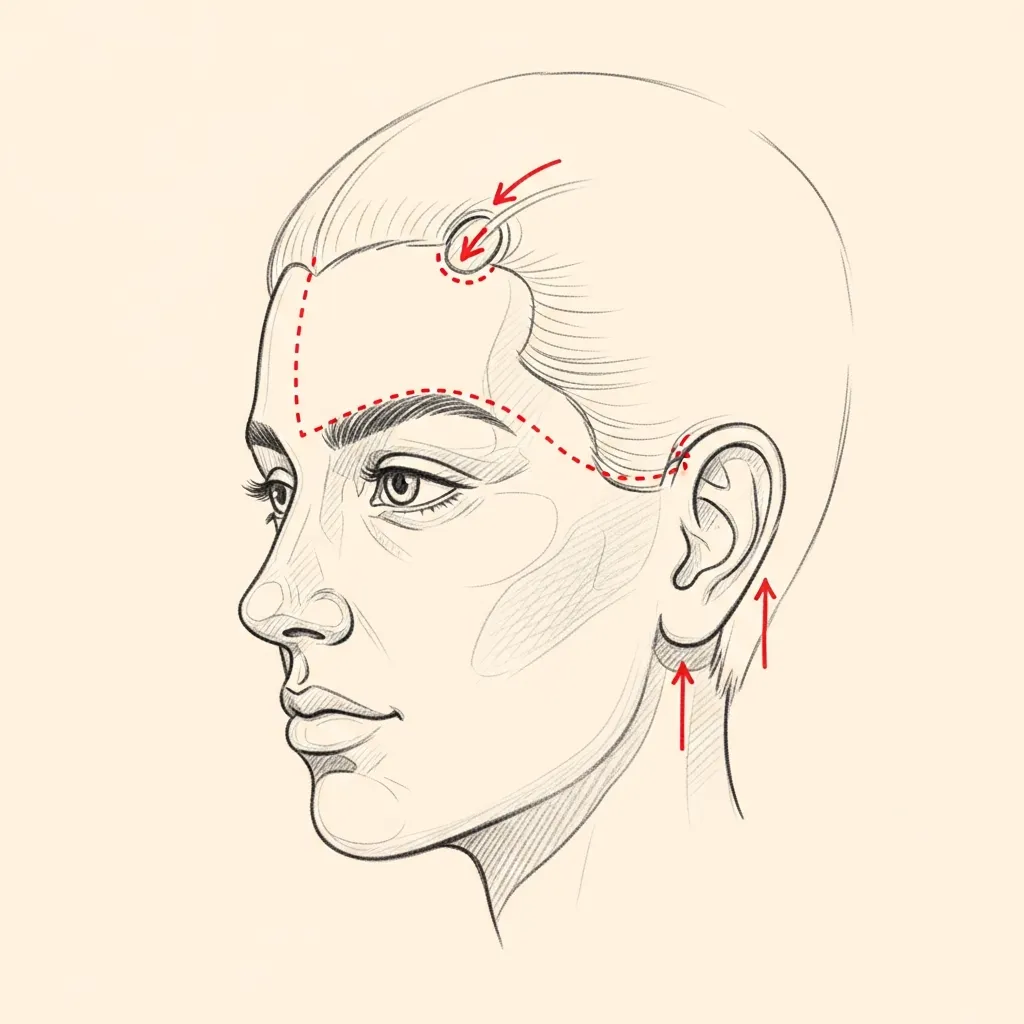
Endoscopic
Mid-face only, smaller recovery
Two small incisions are made inside the temporal hairline and one inside the mouth. An endoscope visualises the deeper tissues and the malar fat pad is repositioned vertically.
Recovery is shorter than a full facelift — typically one week of meaningful downtime — and the scars are essentially invisible. The result is real but limited to the mid-face.
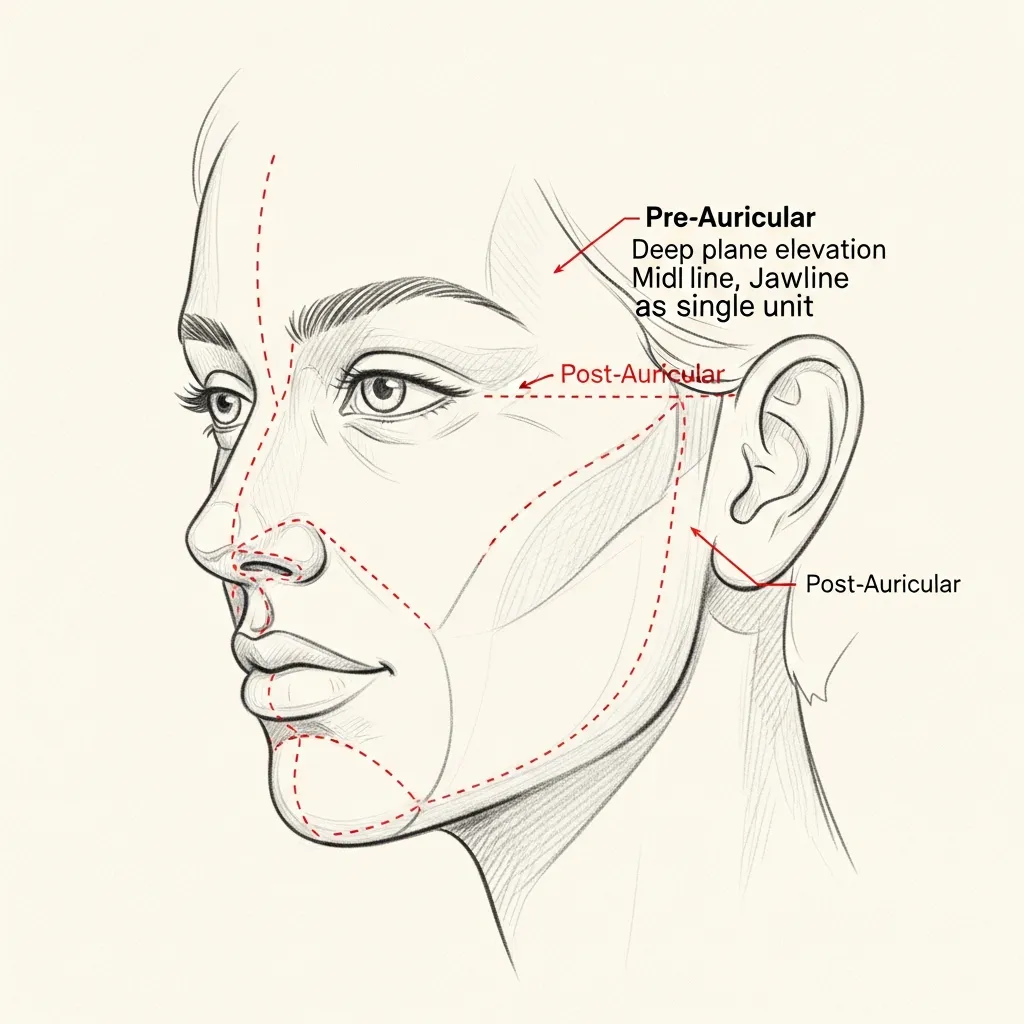
Deep-Plane
Comprehensive mid-face, jawline, neck
A deep-plane facelift addresses the mid-face, jawline, and neck through pre- and post-auricular incisions hidden along the ear. It produces a far more comprehensive — and durable — result.
When the anatomy calls for it, a deep-plane lift is the right operation. A smaller operation in the wrong patient is not a kindness.
Illustrative diagrams. The right operation is determined by the anatomy presented at consultation.
Begin the conversation
A careful, honest evaluation is the right first step.
Cost & Insurance
How Much Does an Endoscopic Mid-Face Lift Cost in NYC?
Pricing for this operation is provided after consultation.
The exact amount depends on the areas being treated, the extent of lifting required, whether it is combined with other facial procedures, the type of anesthesia, and the surgical setting. Each plan is individualized after facial evaluation.
A cosmetic surgical consultation is $500. The full fee is credited toward surgery when you proceed and book within 60 days. It is an extended physician visit: your concerns and goals, a detailed facial analysis, relevant medical and surgical history, review of any prior procedures, the surgical and nonsurgical options, anticipated recovery, risks and benefits, and an individualized plan. Payment is arranged directly with the practice. Payment terms and any required deposit are reviewed when surgery is scheduled.
What May Affect Cost
- Areas being treated
- Extent of lifting required
- Whether combined with other procedures
- Type of anesthesia
- Surgical setting
- Postoperative care
The prices listed are provided as general estimates of typical surgical investment and are not guaranteed quotes. Surgical fees vary based on the patient's anatomy, the complexity of the procedure, previous surgery, operative time, anesthesia and facility requirements, implants or hardware, virtual surgical planning when applicable, and whether multiple procedures are performed together. An exact surgical fee is provided following consultation and development of an individualized treatment plan.
06 · Recovery
What healing actually looks like.
Stage 01
First 24 Hours
Initial recovery focuses on rest, hydration, and following all post-operative instructions exactly. Pain is managed with multi-modal non-narcotic protocols where appropriate.
Stage 02
Week 1
Swelling and bruising peak in the first few days and improve steadily through the first week. Most patients are presentable for casual social activity by the end of week two.
Stage 03
Weeks 2 – 4
Through weeks two to four the early result begins to settle. Light cardio resumes around three weeks; vigorous exertion and contact activities are deferred per the operative plan.
Stage 04
Months 1 – 6
The final refined result emerges progressively over the following months as residual swelling continues to resolve. Follow-up visits are scheduled across the first year.
Have a specific question?
Send a brief note describing your anatomy or concerns — the office will route it directly to Dr. Mourad for review.

Before You Arrive
Your consultation, prepared.
Bring photographs relevant to your concern, when available.
Bring records from any prior surgery, when available.
List current medications, supplements, and blood-thinning agents.
Note any prior anesthesia issues or chronic medical conditions.
Allow 60 minutes for the first consultation.
Bring questions; no decisions are made at the first visit.
Frequently Asked
Patient questions, honestly answered.
No. It uses small, hidden incisions and an endoscope. “Incisionless” is a misleading shorthand and should not be used as the visible medical description.
Not reliably when jowling is established. The procedure is centered on the midface. Lower-face descent may require a facelift.
Clinical references
This page draws on published clinical practice guidelines and public-health references. These sources inform general patient education and do not replace an individual evaluation with Dr. Mourad.
- 01Endoscopic/deep-plane classified approach PubMed PMID: 40576459
- 02Comparative deep-plane and SMAS systematic review and meta-analysis PubMed PMID: 40600822
Continue Reading
Related care & resources
The Most Important Step
Your expert consultation.
A careful evaluation by a double board-certified physician is the right first step. The conversation is unhurried, the diagnosis is honest, and the operative plan is built around what your anatomy can sustain and what you actually want.