Double Board Certified · Male Aesthetics
Male Chin Implant — projection, balance, definition.
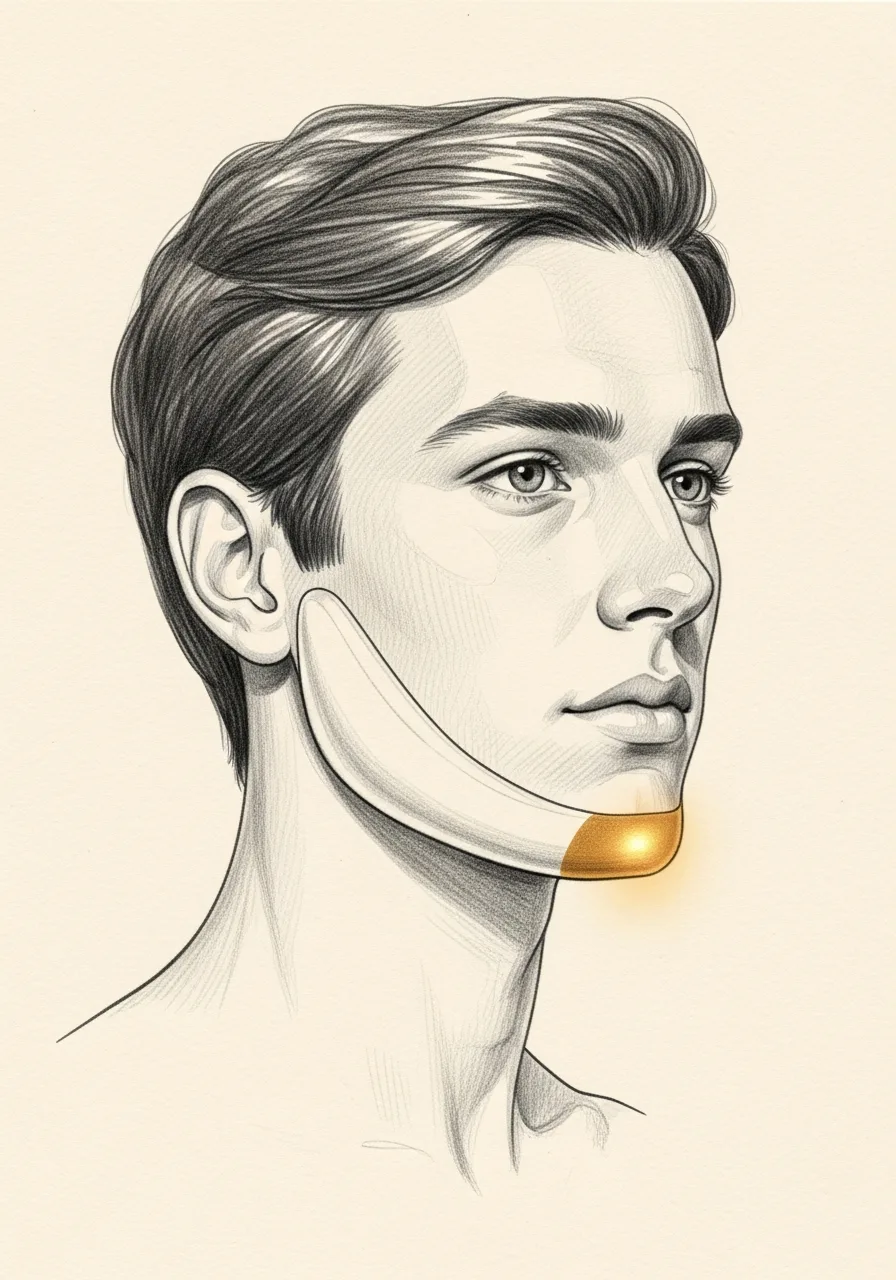
A male chin implant can increase projection, width, or definition in selected patients whose bite is stable and whose goal can be achieved with an implant placed over the native bone. The plan is individualized to facial proportions and preference; not every male patient wants or benefits from a broad, square, or highly projected chin.
ABFPRS
Facial Plastic & Reconstructive Surgery
ABOto
Otolaryngology — Head & Neck Surgery
AAFPRS
Fellowship Director
In Consultation
"A well-projected chin is the single most underrated feature of the masculine profile. When it is right, every other feature looks better."

A Note from Dr. Mourad
"Chin augmentation in men is often the most cost-effective and high-impact procedure available. A small implant, placed precisely, transforms the lower face and the entire profile."
— Dr. Moustafa Mourad, MD
Overview
What is a male chin implant?
A male chin implant is an anatomically shaped silicone or porous polyethylene implant placed over the chin bone, through a small incision typically hidden under the chin or inside the lower lip, to increase chin projection and width. In men, the implant style is selected to broaden and square the chin rather than narrow it.
It is considered when the chin is short or recessed relative to the rest of the face, when a weak chin makes the nose look larger or the neck look fuller, or when the jawline lacks the angular definition that balances a stronger nose and brow. It is often combined with rhinoplasty or neck contouring as part of a balanced plan.
Chin-implant planning considers profile, height, width, asymmetry, and the relationship with the nose and jawline. The desired change should be discussed in your own terms rather than assuming every man wants the same size or shape.
The consultation also considers whether an implant is the appropriate tool, whether moving the chin bone better addresses the concern, or whether a bite or jaw issue needs separate evaluation.
As planning guides rather than rigid targets, chin width is assessed against the alar base and intercanthal distance, the gonial angle is considered from the front and profile, and the lower facial third is evaluated as approximately one of three facial vertical thirds. Individual anatomy matters more than any single ratio.
Anatomy & planning
Individualized goals
“Masculine” is not one measurement. Some patients want stronger forward projection, others want more lateral width, better jawline continuity, or correction of asymmetry, and some want only a subtle improvement. Sex assigned at birth, gender identity, ethnicity, beard pattern, and facial shape do not determine one required endpoint.
Anatomy & planning
Implant
Adds a selected shape over the bone and may be appropriate for moderate projection or contour change.
Anatomy & planning
Sliding genioplasty
Moves the chin bone itself and may be better for vertical change, asymmetry, larger movement, or a preference to avoid a permanent implant.
Anatomy & planning
Filler
Provides temporary contour but does not reproduce every implant shape and does not correct the bite or skeletal relationship.
Anatomy & planning
Beard, scar, and soft-tissue planning
Incision choice, beard-bearing skin, dental health, mentalis handling, lower-lip competence, chin-pad thickness, and the mental nerve are part of planning. The page should not describe the operation as universally “high impact” or “cost-effective”; value and degree of change are individual.
An Established Academic Authority
Double board certification. Fellowship director. Published author. A surgeon's surgeon.
ABFPRS
Board Certified
American Board of Facial Plastic & Reconstructive Surgery
ABOto
Board Certified
American Board of Otolaryngology — Head & Neck Surgery
NYMC
Clinical Assistant Professor
Otolaryngology · Clinician Scholar Pathway
AAFPRS
Fellowship Director
American Academy of Facial Plastic and Reconstructive Surgery
Textbook
Published Author
Contributions to the academic literature of facial plastic surgery
Dual board certification in both Facial Plastic & Reconstructive Surgery and Otolaryngology — Head & Neck Surgery.
01 · Why Dr. Mourad
Diagnosis first, then a plan that fits.
Dr. Mourad evaluates the chin in the context of the whole profile — nose, lips, neck — never in isolation.
Implant size and shape are selected based on the underlying bone, the soft-tissue envelope, and the projected aging of the lower face.
The implant is placed through a hidden submental incision with precise sub-periosteal pocket dissection.
02 · Ideal Candidates
Who benefits most from this operation.
Candidacy is determined together at consultation. The most satisfied patients share three things in common.
I
Receding or Weak Chin
Men with chin projection that sits behind the lower lip on profile, producing a less-defined jawline.
II
Profile Imbalance
Men whose nose appears larger or more prominent than it is because the chin under-projects.
III
Mature Facial Structure
Generally late teens or older, with stable adult facial proportions.
If this describes you, the next step is a quiet, unhurried conversation — not a sales call.
An Honest Note
When this operation may not be right for you.
Men with significant dental occlusion issues should be evaluated for orthognathic surgery first — an implant is not a substitute for a jaw operation.
Men with active dental infection or unhealthy mucosa should defer until those are addressed.
Smokers and patients on certain medications need a planned optimization window.
Men with unrealistic expectations of how a single procedure will transform the whole face benefit from a longer consultation.
03 · Approaches
Three paths to masculine projection.
A male chin implant is not the only way to improve chin projection. The right plan depends on how much movement is needed and whether bone repositioning is the better answer.
1 of 3 · Silicone Chin Implant
04 · Technique
Implant vs sliding genioplasty.
Two definitive paths to a more projected chin. Implants are right for most patients; genioplasty is the right answer for specific anatomic problems.
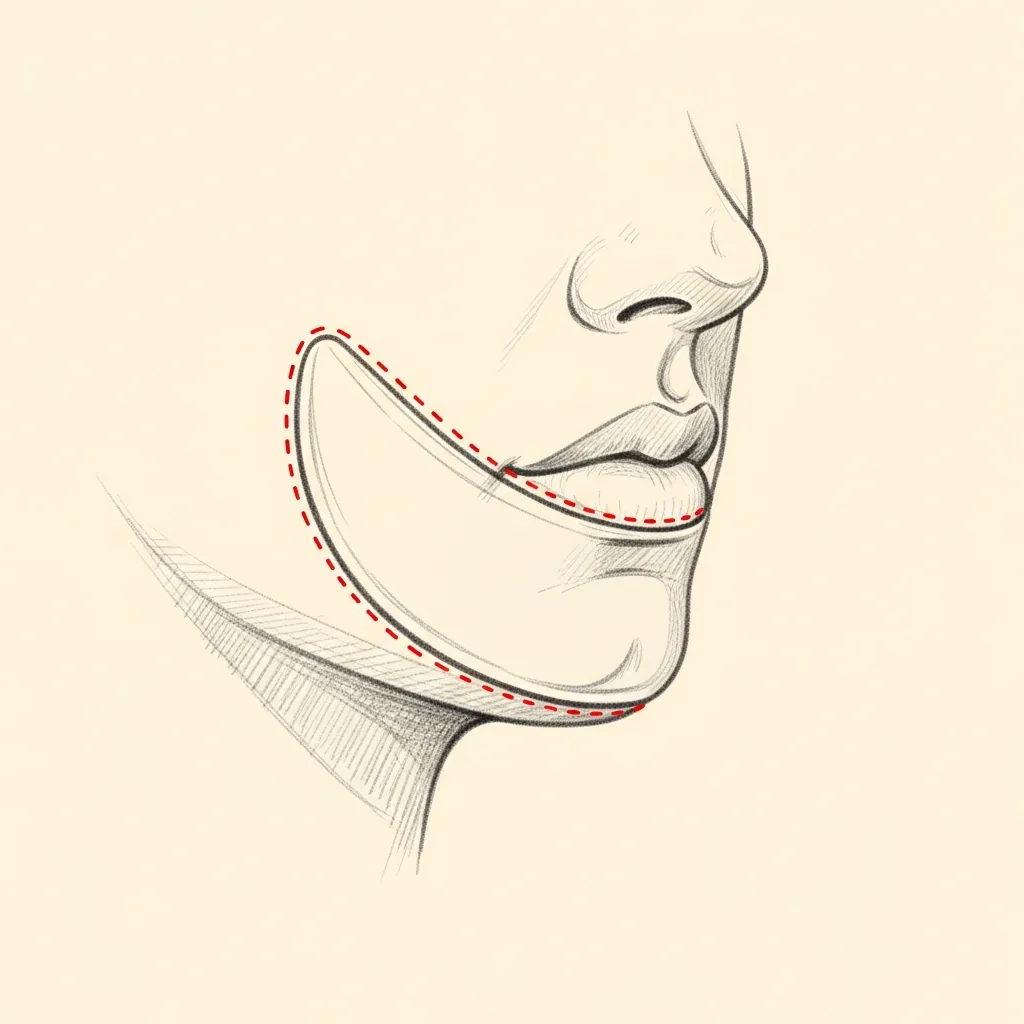
Implant
Standard, customisable, removable
A silicone implant in a precisely-dissected sub-periosteal pocket adds projection to the chin in any direction needed. The operation is shorter, the recovery is faster, and the result is reversible.
Sizing is done with calibrated implants at the time of surgery and confirmed against the patient's profile before final placement.
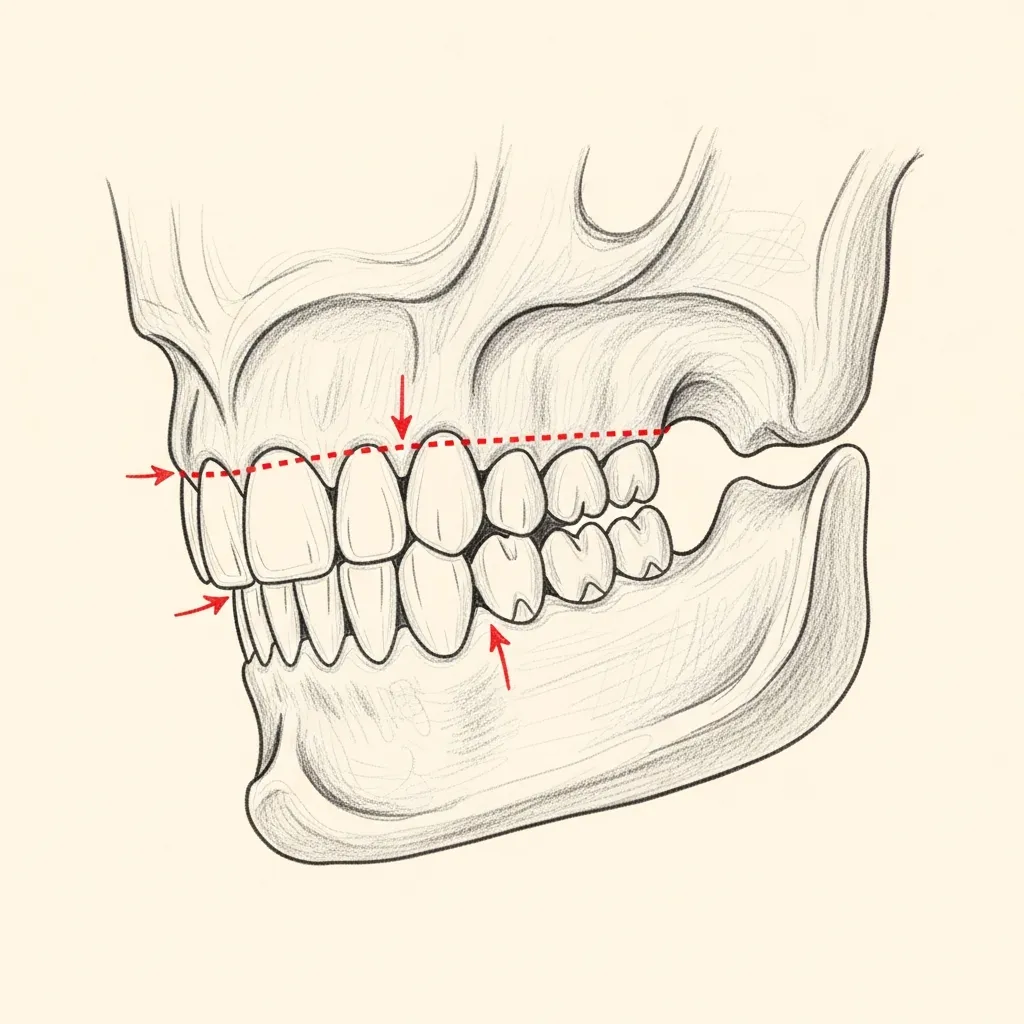
Genioplasty
Bone-moving for specific anatomy
A sliding genioplasty cuts and repositions the chin bone itself. It is the right answer for vertical-height problems or for patients who prefer a non-implant solution.
The operation is longer, the recovery slower, and the change is permanent. It is uncommonly the first choice — but is exactly the right choice in the cases it suits.
Illustrative diagrams. The right operation is determined by the anatomic problem, not by patient preference for surgical technique.
Begin the conversation
A careful, honest evaluation is the right first step.
Cost & Insurance
How Much Does a Male Chin Implant Cost in NYC?
Chin augmentation with an implant typically ranges from $10,000 to $14,000+. There is no male surcharge — the operation performed determines the fee. A sliding genioplasty, which moves bone rather than placing an implant, typically ranges from $30,000 to $55,000+.
A chin implant is generally considered cosmetic and is typically self-pay. After consultation, our office provides a personalized estimate based on the recommended plan. Payment is arranged directly with the practice. Payment terms and any required deposit are reviewed when surgery is scheduled.
| Operation | Typical surgical investment |
|---|---|
| Chin augmentation with implant | $10,000–$14,000+ |
| Sliding genioplasty | $30,000–$55,000+ |
What May Affect Cost
- Implant type selected
- Surgical approach
- Whether combined with other procedures
- Type of anesthesia
- Surgical setting
- Postoperative care
The prices listed are provided as general estimates of typical surgical investment and are not guaranteed quotes. Surgical fees vary based on the patient's anatomy, the complexity of the procedure, previous surgery, operative time, anesthesia and facility requirements, implants or hardware, virtual surgical planning when applicable, and whether multiple procedures are performed together. An exact surgical fee is provided following consultation and development of an individualized treatment plan.
06 · Recovery
What healing actually looks like.
Stage 01
First 24 Hours
Initial recovery focuses on rest, hydration, and following all post-operative instructions exactly. Pain is managed with multi-modal non-narcotic protocols where appropriate.
Stage 02
Week 1
Swelling and bruising peak in the first few days and improve steadily through the first week. Most patients are presentable for casual social activity by the end of week two.
Stage 03
Weeks 2 – 4
Through weeks two to four the early result begins to settle. Light cardio resumes around three weeks; vigorous exertion and contact activities are deferred per the operative plan.
Stage 04
Months 1 – 6
The final refined result emerges progressively over the following months as residual swelling continues to resolve. Follow-up visits are scheduled across the first year.
Stage 05
For men, early swelling can temporarily blur the jawline and make the implant appear wider or more projected than intended. Shaving or beard styling may change how the chin reads during this period; the final assessment waits for swelling to settle rather than judging the contour in the first days.
Stage 06
A submental incision is placed with beard growth in mind. Shaving is usually deferred until the incision is closed and comfortable, often about one to two weeks; gym activity is resumed gradually after the surgeon's clearance, while contact sports are deferred longer. Early swelling can make a collar or tie feel tight, so formal neckwear is best reintroduced as comfort and swelling allow.
Have a specific question?
Send a brief note describing your anatomy or concerns — the office will route it directly to Dr. Mourad for review.

Before You Arrive
Your consultation, prepared.
Bring photographs relevant to your concern, when available.
Bring records from any prior surgery, when available.
List current medications, supplements, and blood-thinning agents.
Note any prior anesthesia issues or chronic medical conditions.
Allow 60 minutes for the first consultation.
Bring questions; no decisions are made at the first visit.
Frequently Asked
Patient questions, honestly answered.
Some implant designs add lateral width, while others primarily add projection. The shape and size are chosen for the patient’s anatomy and goals.
No. A natural result may be square, tapered, rounded, wide, or subtle depending on the face and the patient’s preference.
Clinical references
This page draws on published clinical practice guidelines and public-health references. These sources inform general patient education and do not replace an individual evaluation with Dr. Mourad.
- 01Chin implant versus osseous genioplasty systematic review PubMed PMID: 40666078
- 02Surgical versus nonsurgical chin augmentation systematic review PubMed PMID: 41714371
- 03Facial implant material systematic review PubMed PMID: 40225117
The Most Important Step
Your expert consultation.
A careful evaluation by a double board-certified physician is the right first step. The conversation is unhurried, the diagnosis is honest, and the operative plan is built around what your anatomy can sustain and what you actually want.