Double Board Certified · Osseous Chin Reshaping
Sliding Genioplasty — moving the chin bone itself, with precision.
Sliding genioplasty surgeon in NYC · double board-certified facial plastic surgeon · real before-and-after case examples
Sliding genioplasty is planned as a vector, not merely “forward” movement. The segment may be advanced, set back, lengthened, shortened, centered, or rotated to address asymmetry. The planned bony movement is evaluated against the lower lip, labiomental fold, mentalis, jawline, dental roots, mental nerves, facial midline, and bite.
ABFPRS
Facial Plastic & Reconstructive Surgery
ABOto
Otolaryngology — Head & Neck Surgery
AAFPRS
Fellowship Director

In Consultation
"When the change needed is large — or when a patient prefers their own bone to an implant — genioplasty is the honest answer."
Before & After
Chin and jawline results from the practice.
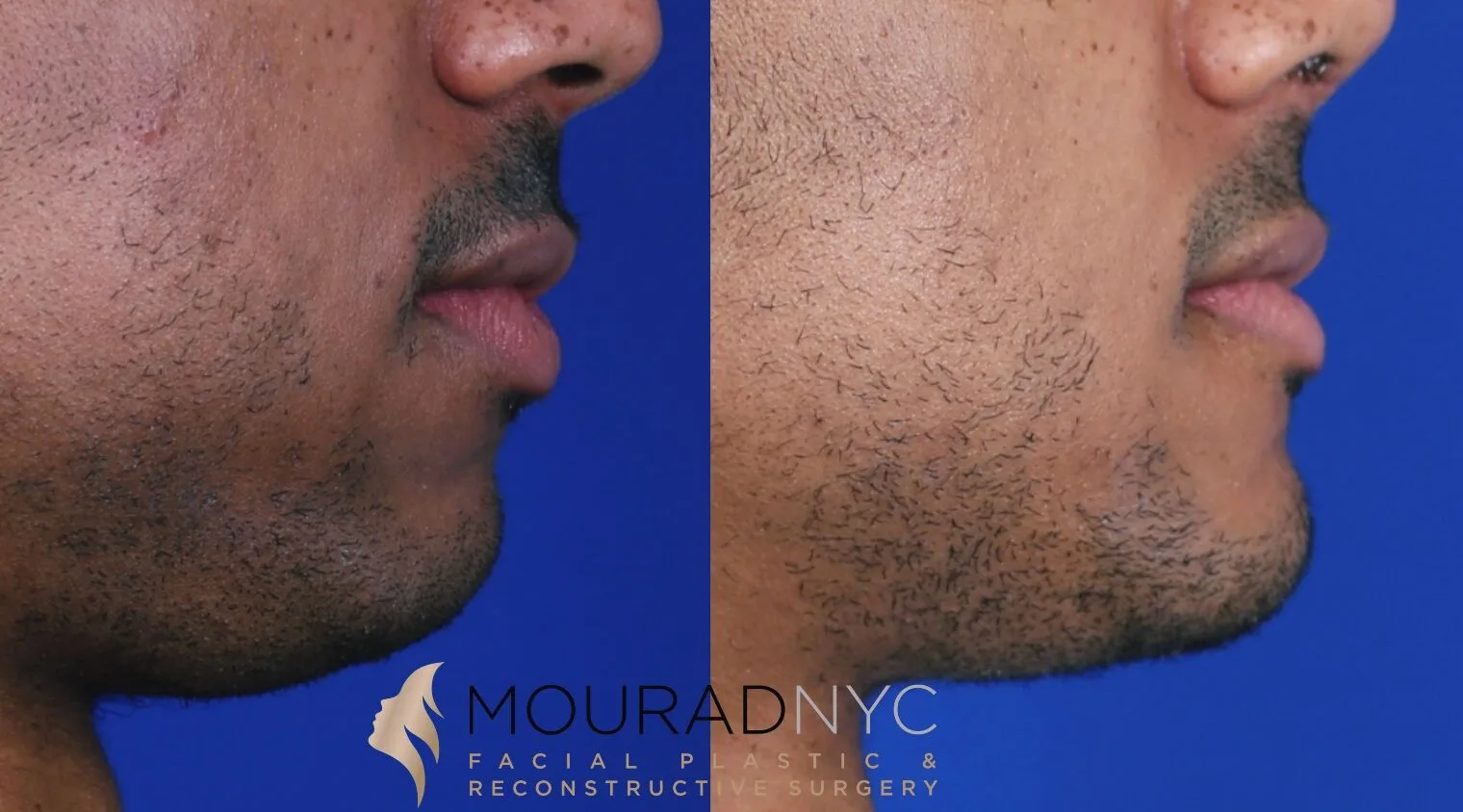
Sliding Genioplasty · 20s · Male
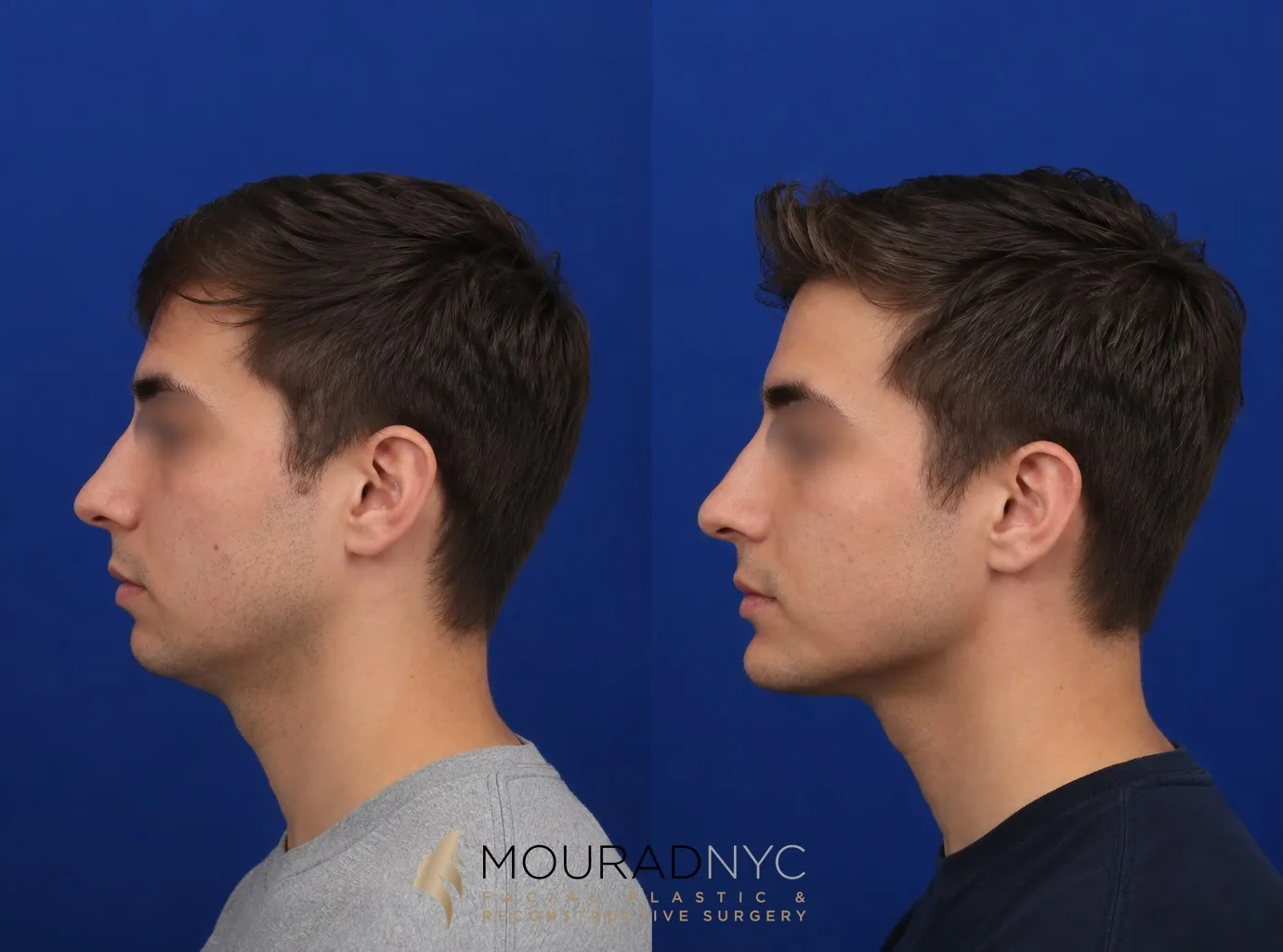
Sliding Genioplasty · 20s · Male
Chin Implant + Nasalift™ · 30s · Male
_1780437641639-Dk5cHxWi.jpeg)
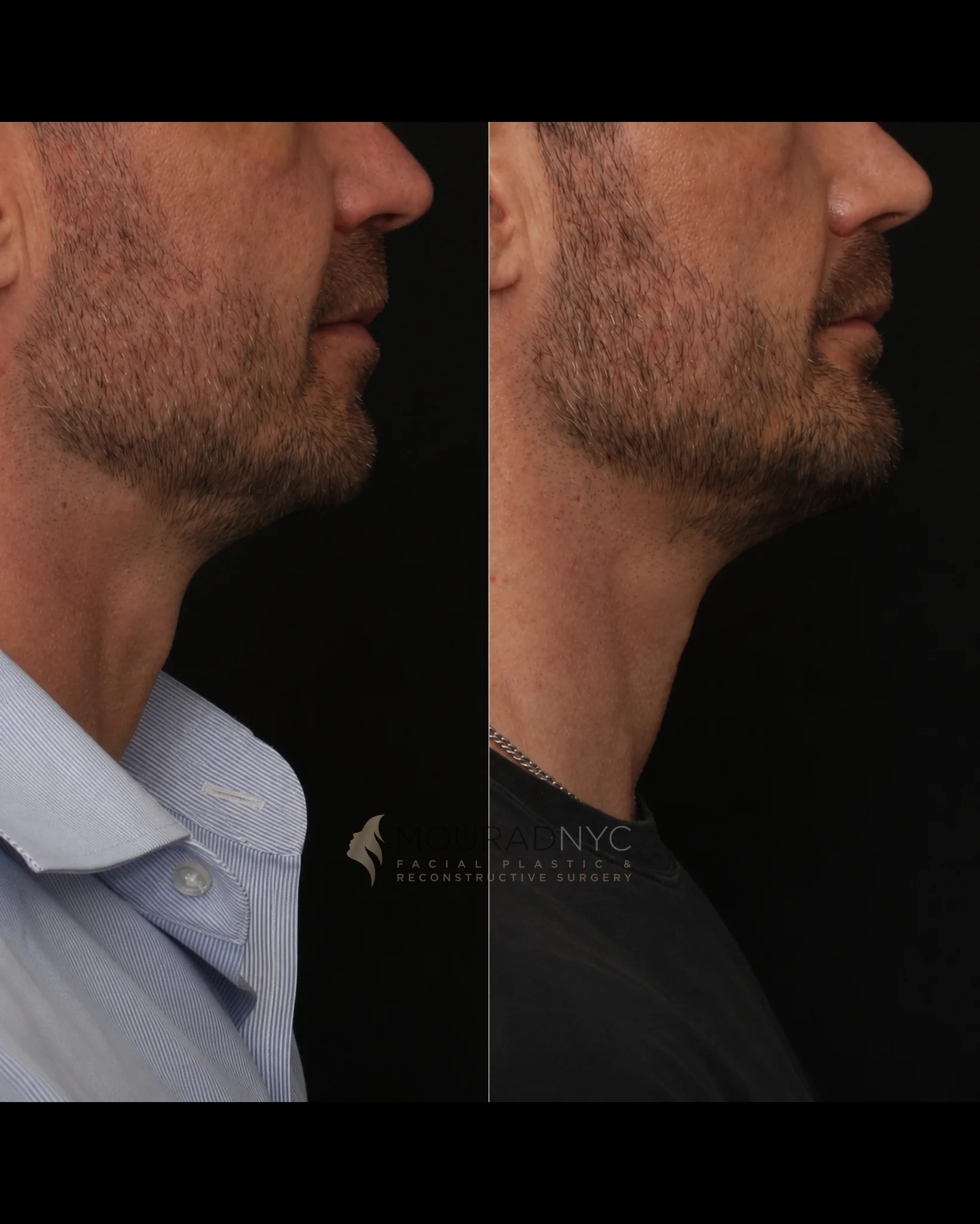
Chin Implant + Neck Lift · 20s · Female
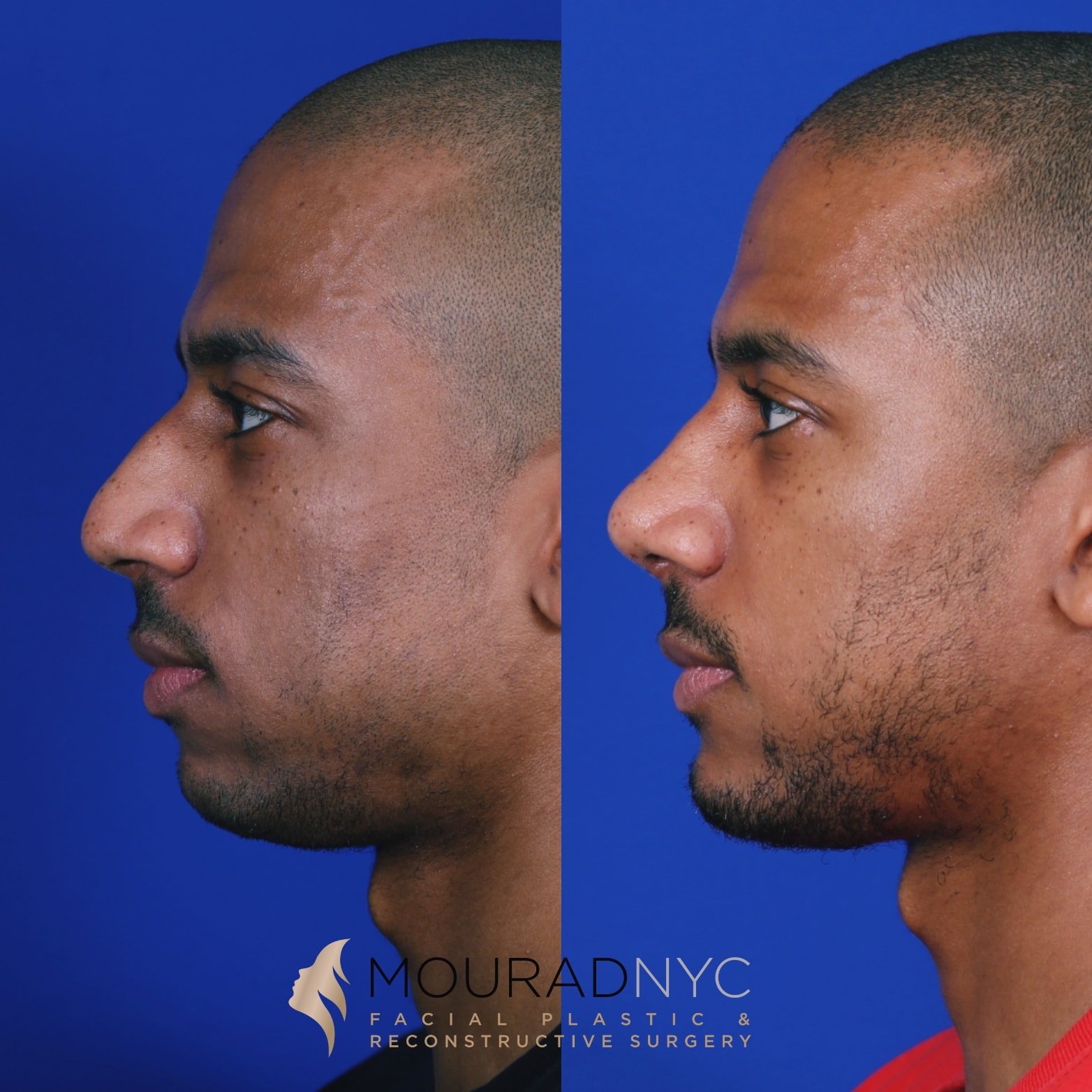
Rhinoplasty + Sliding Genioplasty · 20s · Male
Pre and post-operative comparison · Photographed in standardized studio conditions · Written consent on file · Individual results vary

A Note from Dr. Mourad
"A sliding genioplasty is precision bone surgery. The native chin bone is cut, repositioned in three dimensions, and fixed in its new place. The result is the patient's own anatomy — refined, never replaced."
— Dr. Moustafa Mourad, MD
Overview
What is a sliding genioplasty?
A sliding genioplasty is a bony procedure that repositions the chin segment of the lower jaw. Through an incision inside the lower lip, the lower portion of the mandible is cut, advanced (or set back, narrowed, or vertically adjusted), and fixed in its new position with small titanium plates and screws. The patient's own bone heals back into place over several weeks.
Unlike a chin implant, a sliding genioplasty changes the underlying bone, which allows for three-dimensional correction — projection forward or back, narrowing of a wide chin, vertical shortening or lengthening, and correction of mild chin asymmetry. No chin implant is placed. The repositioned bone is typically secured with low-profile titanium plates and screws, which are usually left in place unless they become symptomatic.
It is considered when the bony anatomy needs to be changed, when there has been a problem with a prior implant, or when significant correction in more than one dimension is required. The choice between implant and genioplasty is made after examining the bite, the bone, and the soft-tissue chin pad.
Anatomy & planning
The orthognathic boundary
Genioplasty changes the chin point; it does not move the entire lower jaw or correct the dental bite. When mandibular retrusion, asymmetry, airway, or malocclusion involves the jaw as a whole, orthodontic and orthognathic evaluation may be more appropriate than isolated genioplasty.
Anatomy & planning
Nerve, hardware, and mentalis considerations
Temporary lower-lip or chin numbness is common after manipulation near the mental nerves, and persistent sensory change is possible. Plates and screws hold the bone during healing and are usually left in place unless they cause a problem. Careful mentalis reapproximation and postoperative support help protect chin-pad position and lower-lip function.
Anatomy & planning
How to interpret before-and-after photographs
Before-and-after images should be interpreted with the planned vector in mind. A profile may show advancement, but frontal and oblique views are needed to assess width, symmetry, vertical height, and the relationship to the jawline. Follow-up interval and combined procedures should be displayed when documented.
Chin vs Jaw
Sliding genioplasty vs jaw surgery: is the problem the chin or the whole jaw?
Sliding genioplasty changes the position and shape of the chin segment without moving the tooth-bearing portion of the mandible. It is appropriate when the bite is acceptable and the primary imbalance is at the chin.
Orthognathic jaw surgery is different. It repositions the upper jaw, lower jaw, or both when the skeletal discrepancy affects dental occlusion, jaw relationship, facial height, or airway function.
A recessed chin can occur with a normally positioned jaw, but it can also be part of mandibular retrognathia, overbite, open bite, or another broader skeletal pattern. Dr. Mourad reviews the bite, dental midlines, facial proportions, and imaging before deciding whether isolated genioplasty, orthognathic evaluation, or a combined plan is appropriate.
The Operation
How sliding genioplasty is planned and performed.
The operation follows a deliberate sequence — each step protects a specific structure or secures a specific part of the result.
- —Skeletal and occlusal assessment — clinical photographs, bite evaluation, dental history, and imaging determine whether the concern is isolated to the chin or reflects a broader jaw discrepancy. CBCT, panoramic imaging, cephalometrics, or virtual planning may be used when clinically indicated.
- —Intraoral exposure and nerve protection — the incision is placed inside the lower lip. The mentalis muscle is carefully divided and preserved, and the mental nerves and dental roots are mapped so the osteotomy can be planned safely.
- —Osteotomy and movement vector — the chin segment is cut below the tooth roots and mental foramina, then moved according to the planned vector. Depending on the osteotomy design, the chin can be advanced, set back, lengthened, shortened, centered, rotated, or narrowed.
- —Fixation — the segment is secured with low-profile titanium plates and screws, which hold the planned position while bone union develops.
- —Mentalis closure — the mentalis muscle is precisely reapproximated before the intraoral incision is closed. This matters for lower-lip position, chin-pad support, and reducing the risk of postoperative chin ptosis.
An Established Academic Authority
Double board certification. Fellowship director. Published author. A surgeon's surgeon.
ABFPRS
Board Certified
American Board of Facial Plastic & Reconstructive Surgery
ABOto
Board Certified
American Board of Otolaryngology — Head & Neck Surgery
NYMC
Clinical Assistant Professor
Otolaryngology · Clinician Scholar Pathway
AAFPRS
Fellowship Director
American Academy of Facial Plastic and Reconstructive Surgery
Textbook
Published Author
Contributions to the academic literature of facial plastic surgery
Dual board certification in both Facial Plastic & Reconstructive Surgery and Otolaryngology — Head & Neck Surgery.
01 · Why Dr. Mourad
A surgeon trusted by surgeons for this operation.
Dr. Moustafa Mourad is double board-certified by the American Board of Facial Plastic & Reconstructive Surgery and the American Board of Otolaryngology — Head & Neck Surgery, and serves as an AAFPRS Fellowship Director.
The practice concentrates on the operations of the face, nose, and sinuses — and on the patients other surgeons have found challenging.
Every consultation is unhurried, every plan is individual, and no operation is recommended unless it is the right one.
02 · Ideal Candidates
Who benefits most from this operation.
Candidacy is determined together at consultation. The most satisfied patients share three things in common.
I
Large Advancements
Patients requiring substantial chin projection that would not be naturally achieved with an implant alone.
II
Vertical or Width Change
When the chin needs to be lengthened, shortened, or narrowed — movements an implant cannot reliably perform.
III
Native-Bone Preference
Patients who prefer their own bone over a permanent implant — for personal, biological, or longevity reasons.
From the Patient Gallery
Sliding Genioplasty Before & After Photos
Representative sliding genioplasty and chin augmentation before-and-after cases from Dr. Mourad's Manhattan practice. Photographs are published with written consent on file. Individual anatomy, healing, and results vary; these examples are educational and not predictive of any future patient's outcome.
Sliding Genioplasty · 20s · Male
Sliding genioplasty performed for a male patient in his 20s to advance the chin and balance the lower facial profile. Shown in a lateral profile comparison before and after surgery; photographed with written consent on file.
Sliding Genioplasty · 20s · Male
Sliding genioplasty performed for a male patient in his 20s to advance the chin and balance the lower facial profile. Documented in a close-up lateral view of the chin and lower lip before and after surgery; photographed with written consent on file.
Rhinoplasty + Sliding Genioplasty · 20s · Male
Primary rhinoplasty combined with a sliding genioplasty to balance the lower facial profile in a male patient in his 20s. Documented in a lateral view before and after surgery; photographed in standardized studio conditions with written consent on file.
Chin Implant + Nasalift™ · 30s · Male
Chin implant placed for a male patient in his 30s to strengthen chin projection and improve the balance of the lower facial profile, performed together with a Nasalift™ in-office tip elevation. Shown in a lateral profile comparison before and after; photographed with written consent on file. Results vary by patient; this case is representative, not predictive.
Chin Implant + Neck Lift · 20s · Female
Chin implant combined with a neck lift to strengthen the chin projection and refine the jawline and neck contour in a female patient in her 20s. Shown in a lateral profile comparison before and after surgery; photographed with written consent on file.
Individual results vary. Before-and-after photographs are shown with written consent and are not a guarantee of outcome.
If this describes you, the next step is a quiet, unhurried conversation — not a sales call.
An Honest Note
When this operation may not be right for you.
Patients with significant dental malocclusion may be better served by full orthognathic evaluation before a cosmetic genioplasty.
Active gum or periodontal infection is treated and cleared before any intraoral bone surgery.
Smokers face elevated risk of impaired bone healing and require a planned nicotine-free window.
Patients seeking a small change may be better served by an implant or, as a trial, jawline filler.
03 · Approaches
The full range of options.
Sliding genioplasty is the structural operation. The right plan compares it honestly to the alternatives, and pairs it with companion procedures when neighbouring features will benefit from being addressed at the same time.
1 of 5 · Chin Implant Alternative
04 · Technique
Genioplasty vs chin implant.
Both procedures augment the chin. Genioplasty moves the patient's own bone; an implant adds a precisely-shaped silicone form. Each has its place.

Genioplasty
Osseous Movement
Through a hidden intraoral incision, the chin bone is precisely cut, repositioned in three dimensions, and stabilised with low-profile titanium hardware that is usually left in place unless it becomes symptomatic.
This is the operation of choice for large advancements, vertical changes, narrowing, or any movement an implant cannot reliably reproduce.
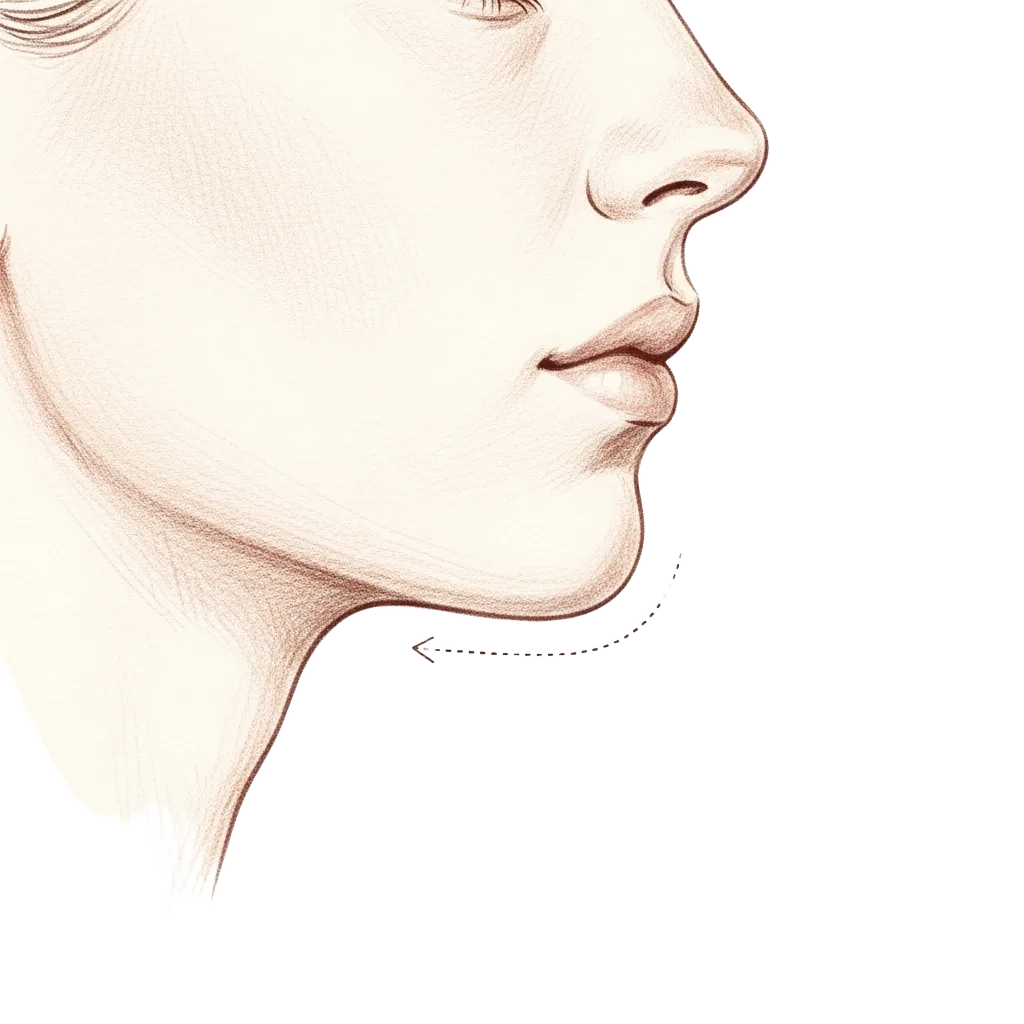
Implant
Silastic Anatomic
A pre-shaped silicone implant is placed over the chin bone through a small incision. Recovery is briefer, and the implant can usually be removed or exchanged — although scar tissue and long-term tissue adaptation mean removal is not always the same as returning precisely to the preoperative state.
For small to moderate advancements where the chin position is the only variable, an implant is often the simpler answer.
Both are well-established. The right choice is determined together at consultation.
Begin the conversation
Precision bone surgery — your own chin, refined.
Cost & Insurance
How Much Does Sliding Genioplasty Cost in NYC?
A sliding genioplasty typically ranges from $30,000 to $55,000+. It costs several times a chin implant because it is a different category of operation: the chin bone is cut, repositioned and fixed in its new position. The range reflects skeletal movement, operative time, fixation and hardware, and whether virtual surgical planning is required.
Sliding genioplasty is generally performed for cosmetic facial balance and is typically self-pay. After consultation, our office provides a personalized estimate based on the planned skeletal movement. Payment is arranged directly with the practice. Payment terms and any required deposit are reviewed when surgery is scheduled.
| Operation | Typical surgical investment |
|---|---|
| Sliding genioplasty | $30,000–$55,000+ |
What May Affect Cost
- Complexity of the chin movement
- Whether combined with other procedures
- Type of anesthesia
- Surgical facility
- Functional vs cosmetic goals
- Postoperative care
The prices listed are provided as general estimates of typical surgical investment and are not guaranteed quotes. Surgical fees vary based on the patient's anatomy, the complexity of the procedure, previous surgery, operative time, anesthesia and facility requirements, implants or hardware, virtual surgical planning when applicable, and whether multiple procedures are performed together. An exact surgical fee is provided following consultation and development of an individualized treatment plan.
06 · Recovery
What healing actually looks like.
Stage 01
First 24 Hours
Swelling, tightness, lower-lip stiffness, and discomfort are usually greatest during the first two to three days. Pain varies by patient and is managed with an individualized regimen. A soft diet and careful oral hygiene are followed initially.
Stage 02
Week 1
Through the first week, bruising and swelling around the chin and lower lip peak around day three, then begin to improve. Many patients resume remote or quiet desk work during this period; most return to public-facing office work within seven to fourteen days, depending on the movement performed and visible swelling.
Stage 03
Weeks 2 – 4
Through weeks two to four, swelling steadily resolves and the new chin position becomes clear. Normal diet is resumed as tolerated.
Stage 04
Months 1 – 12
The contour continues to refine as bone remodeling and soft-tissue adaptation progress over three to twelve months. Altered lower-lip or chin sensation may continue to improve for many months; persistent sensory change is possible. Long-term, the result is the patient's own bone in its new position.
Have a specific question?
Send a brief note describing your anatomy or concerns — the office will route it directly to Dr. Mourad for review.

Before You Arrive
Your consultation, prepared.
Bring frontal and profile photographs of your face.
Bring any panoramic dental imaging if available.
Note all prior dental work, implants, and orthodontic history.
List current medications and supplements.
Allow 60 minutes for a focused profile, dental, and skeletal evaluation.
Bring questions about hardware, healing, and revision options.
Frequently Asked
Patient questions, honestly answered.
Yes. The bone segment can be planned for vertical lengthening or shortening as well as forward, backward, or asymmetric movement.
Isolated genioplasty should not change the dental occlusion because it moves the chin segment rather than the tooth-bearing jaw. A bite problem may require orthognathic treatment.
Clinical references
This page draws on published clinical practice guidelines and public-health references. These sources inform general patient education and do not replace an individual evaluation with Dr. Mourad.
- 01Chin implant versus osseous genioplasty systematic review PubMed PMID: 40666078
- 02Genioplasty systematic review/cohort evidence PubMed PMID: 39797264
- 03Chang EW, Lam SM, Karen M, Donlevy JL. Sliding genioplasty for correction of chin abnormalities. Arch Facial Plast Surg. 2001;3(1):8–15. PubMed
- 04Ousterhout DK. Sliding genioplasty, avoiding mental nerve injuries. J Craniofac Surg. 1996;7(4):297–298. PubMed
- 05Chaushu G, Blinder D, Taicher S, Chaushu S. The effect of precise reattachment of the mentalis muscle on the soft tissue response to genioplasty. J Oral Maxillofac Surg. 2001;59(5):510–516. PubMed
- 06Bertossi D, et al. Osseous genioplasty: prevention of witch's chin deformity with no-degloving technique. J Craniofac Surg. 2021. PubMed
- 07San Miguel Moragas J, et al. Long-term hard and soft tissue response following isolated genioplasty: a systematic review. Int J Oral Maxillofac Surg. 2021. PubMed
- 08Customized genioplasty and advantages of 3D virtual planning: an updated literature review. 2024. PubMed
Continue Reading
Related care & resources
The Most Important Step
Your expert consultation.
A genioplasty consultation is a careful skeletal evaluation — measuring the chin in three dimensions, reviewing dental occlusion, and planning the precise movement required.