Education
Balloon Sinuplasty vs. Endoscopic Sinus Surgery (FESS)
Balloon sinuplasty widens a sinus opening; FESS removes diseased tissue. A side-by-side look at candidates, anesthesia, recovery and results.
ABFPRS
Facial Plastic & Reconstructive Surgery
ABOto
Otolaryngology — Head & Neck Surgery
AAFPRS
Fellowship Director

Overview
Balloon sinuplasty and endoscopic sinus surgery are both used to improve sinus drainage, but they are not interchangeable. The right option depends on your symptoms, CT findings, anatomy, prior treatment, and whether nasal polyps or more extensive disease are present.
Key takeaways
- Balloon sinuplasty and endoscopic sinus surgery both improve sinus drainage but are not interchangeable.
- Balloon sinuplasty widens a blocked sinus opening with a small balloon, without removing tissue.
- Endoscopic sinus surgery removes diseased tissue and suits nasal polyps or more extensive disease.
- The right choice depends on your symptoms, CT findings, anatomy, and prior treatment.
- In some cases the two approaches are combined in the same operation.
An Established Academic Authority
Double board certification. Fellowship director. Published author. A surgeon's surgeon.
ABFPRS
Board Certified
American Board of Facial Plastic & Reconstructive Surgery
ABOto
Board Certified
American Board of Otolaryngology — Head & Neck Surgery
AAFPRS
Fellowship Director
American Academy of Facial Plastic and Reconstructive Surgery
Textbook
Published Author
Contributions to the academic literature of facial plastic surgery
Dual board certification in both Facial Plastic & Reconstructive Surgery and Otolaryngology — Head & Neck Surgery.
Castle Connolly Top Doctor — Plastic Surgery, 2026Two tools for one goal: better sinus drainage
When sinus symptoms persist despite medication, two procedural options are often discussed: balloon sinuplasty and endoscopic sinus surgery, also called functional endoscopic sinus surgery, or FESS. Both are designed to restore the natural drainage and ventilation of the sinuses, but they work in different ways and suit different situations. Understanding how each one approaches the problem is the first step in deciding which may be appropriate for you.
The healthy sinuses are air-filled spaces in the cheeks, forehead, and deeper in the skull. Each sinus drains through a small natural opening into the nose. When those openings become narrowed or blocked by inflammation, infection, or anatomical factors, mucus can become trapped, pressure builds, and symptoms follow. Both procedures aim to reopen those drainage pathways so the sinuses can clear and ventilate normally again.
The important distinction is not which procedure is newer or simpler in the abstract, but which one matches your diagnosis. Balloon sinuplasty dilates selected sinus openings without removing tissue. Endoscopic sinus surgery can do more: it can remove obstructing or inflamed tissue, address nasal polyps, open multiple sinuses, and treat more complex or extensive disease. Neither is universally better. The right choice depends on what is actually causing your symptoms and what your imaging and examination show.
Quick comparison at a glance
Quick comparison at a glance
The summary below highlights the practical differences most patients ask about. It is a starting point for a conversation, not a substitute for an individualized evaluation.
- Main action — Balloon sinuplasty dilates selected sinus openings; endoscopic sinus surgery opens the sinuses and can remove obstructing tissue.
- Tissue removal — Balloon sinuplasty involves minimal tissue removal; endoscopic surgery may remove inflamed or obstructing tissue when needed.
- Nasal polyps — Balloon sinuplasty does not remove polyps; endoscopic surgery can remove them.
- Disease severity — Balloon sinuplasty is often used for limited, selective disease; endoscopic surgery can address more extensive disease.
- Setting — Balloon sinuplasty may be performed in the office or operating room depending on the case; endoscopic surgery is usually performed in the operating room, especially for more extensive cases.
- Recovery — Balloon sinuplasty often has a shorter recovery for selected cases; endoscopic surgery recovery depends on the extent of the procedure.
| Balloon sinuplasty | Endoscopic sinus surgery (FESS) | |
|---|---|---|
| Best for | Focal narrowing of the natural sinus openings; limited disease | Diffuse disease, polyps, fungal disease, or extensive involvement |
| Focal vs diffuse | Focal outflow obstruction | Diffuse, multi-sinus disease |
| Nasal polyps | Not addressed by dilation alone | Polyps can be removed during the procedure |
| Fungal disease | Not suitable on its own | Allows removal of fungal material and drainage |
| Revision disease | Limited role when scarring is present | Direct correction of scarring and altered anatomy |
| Tissue | Preserves the lining; no tissue removed | Removes inflamed or obstructing tissue as needed |
| Setting / anesthesia | Office under local, or operating room under general | Typically operating room under general anesthesia |
| Recovery | Often brief for focal in-office cases | Variable; depends on the extent of surgery |
| Cost / insurance | Coverage depends on documented disease and medical necessity | Coverage depends on documented disease and medical necessity |
| When combined | Can accompany septoplasty or turbinate reduction | Can include balloon dilation of selected sinuses |
What balloon sinuplasty is and how it works
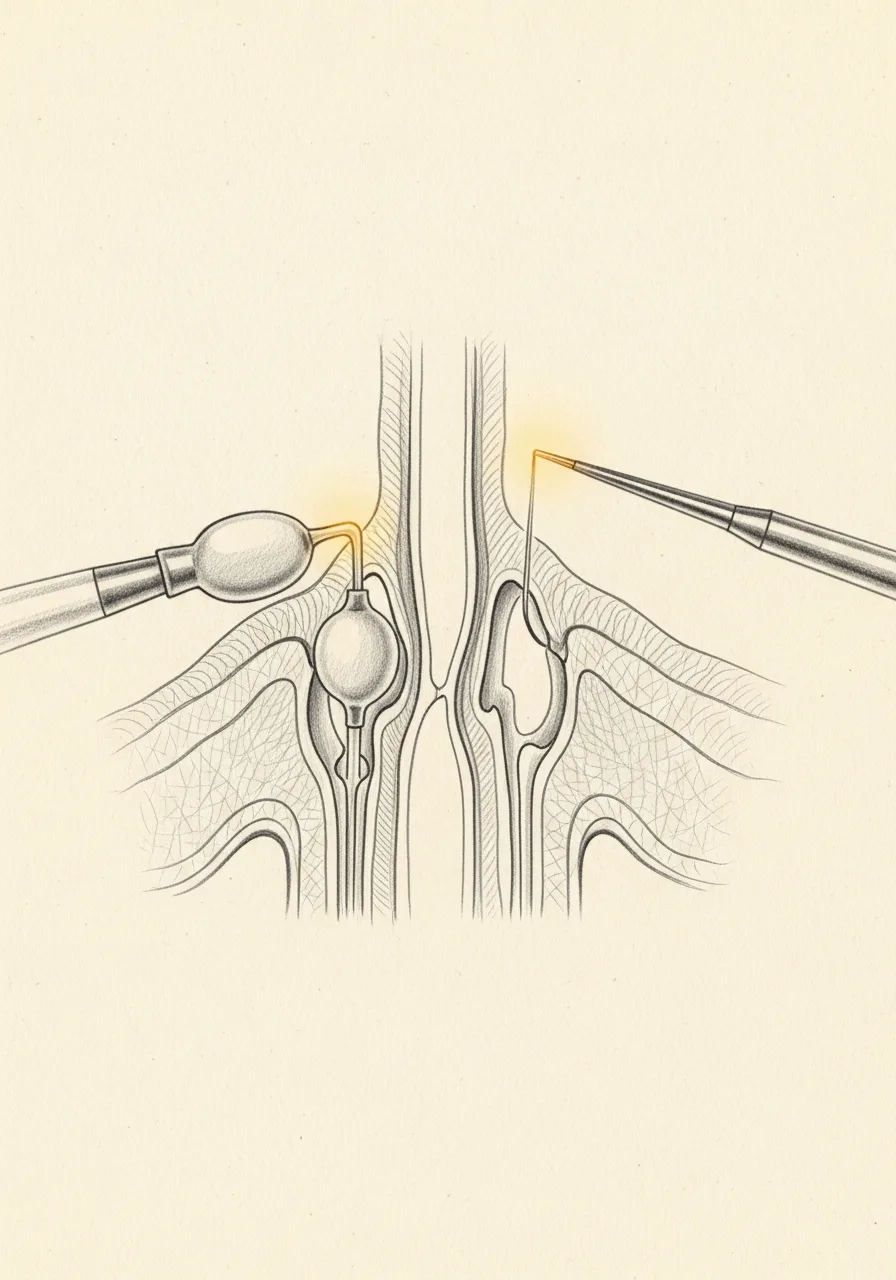
Balloon sinuplasty is a tissue-preserving technique. During the procedure, a small, flexible catheter with a balloon at its tip is guided into a blocked sinus opening. The balloon is gently inflated to widen the natural drainage pathway, then deflated and removed. The goal is to remodel the opening so the sinus can drain and ventilate more effectively, while leaving the surrounding lining largely intact.
Because it does not rely on cutting away tissue, balloon sinuplasty can sometimes be performed in an office setting under local anesthesia for appropriately selected patients, though some cases are still better managed in the operating room. It is most often considered for relatively limited disease affecting specific drainage pathways rather than widespread inflammation throughout many sinuses.
Balloon sinuplasty has real strengths, but it also has limits. It cannot remove nasal polyps, it cannot take out thickened or scarred tissue, and it is not designed to treat extensive disease that involves removing diseased bone or lining. Recognizing those boundaries is essential to choosing it for the right reasons. You can read more on the dedicated balloon sinuplasty in NYC page and learn about the healing process in what to expect after balloon sinuplasty.
What endoscopic sinus surgery is and how it works
Endoscopic sinus surgery, or FESS, uses a thin endoscope with a camera to visualize the inside of the nose and sinuses in detail. Through the nostrils, without external incisions, the surgeon can open blocked sinus pathways and remove tissue that is obstructing drainage. The term functional reflects the underlying philosophy: the goal is to restore normal sinus function while preserving as much healthy tissue as possible.
Endoscopic surgery is more versatile than balloon dilation. It can address several different problems in a single procedure, which is why it is often the better option when disease is more extensive or when multiple factors contribute to symptoms.
- Removing nasal polyps that block airflow and drainage
- Opening several sinuses that are involved at once
- Clearing thickened, scarred, or chronically inflamed tissue
- Addressing fungal debris or extensive infection
- Revising scarring or blockage from previous sinus surgery
Endoscopic surgery is most often performed in the operating room, frequently under general anesthesia, particularly for more involved cases. For patients with more advanced disease, this approach can accomplish what balloon dilation alone cannot. More detail is available on the endoscopic sinus surgery in NYC page.
When balloon sinuplasty may be appropriate
Balloon sinuplasty may be considered in carefully selected situations where the disease is limited and tissue removal is not required. It is not the right tool for every patient, and matching it to the correct diagnosis is what makes it useful. It may be appropriate when:
- Disease is limited to selected sinus drainage pathways rather than widespread
- No significant nasal polyps are present
- Symptoms and CT findings correspond to one another
- Medical therapy has been tried and has not been sufficient
- A tissue-preserving approach is suitable for the anatomy involved
For the right candidate, balloon sinuplasty can offer a less invasive path to improved drainage with a recovery that is often shorter. The key word is candidate: the procedure works most reliably when the underlying problem genuinely fits what dilation can accomplish.
When endoscopic sinus surgery may be the better choice
Endoscopic sinus surgery may be the more appropriate option when the disease is more extensive or when tissue actually needs to be removed. In these situations, balloon dilation alone is unlikely to address the underlying problem. Endoscopic surgery may be better when there are:
- Nasal polyps that obstruct the airway and drainage pathways
- Extensive chronic sinusitis affecting the sinus lining
- Multiple sinuses involved at the same time
- Obstructing tissue or scar that must be removed
- A need for revision after previous sinus surgery
- Complex anatomy that requires direct visualization and precise work
Patients living with chronic sinusitis or recurrent flare-ups often benefit from the broader capabilities of endoscopic surgery, particularly when polyps or thickened tissue are part of the picture. The goal is durable improvement in drainage, not simply a temporary widening of one opening.
Can both approaches be used together?
These are not always mutually exclusive choices. In selected cases, balloon dilation may be used as one part of a broader endoscopic sinus procedure. For example, a surgeon might dilate one drainage pathway with a balloon while using endoscopic instruments to address polyps or inflamed tissue elsewhere. This is sometimes described as a hybrid approach.
The tools are chosen based on what each part of the anatomy needs and on the overall surgical goals. The point is not to commit to a single technique in advance, but to tailor the plan to the specific pattern of disease found on examination and imaging.
How the right procedure is determined
Choosing between balloon sinuplasty and endoscopic sinus surgery is a clinical decision that follows a careful evaluation, not a preference selected from a menu. A thorough assessment typically includes:
- 01A detailed symptom history, including how long symptoms have lasted and how they affect daily life
- 02Nasal endoscopy to look directly at the nasal passages and sinus openings
- 03Review of a CT scan to assess the sinus anatomy and the extent of inflammation or obstruction
- 04Review of prior treatments, including medications and any previous procedures
- 05A discussion of expected recovery, benefits, and risks for each option
- 06Consideration of nasal airway issues such as a deviated septum or enlarged turbinates that may contribute to symptoms
This is also where it helps to evaluate the nose and sinuses together. Symptoms like congestion and pressure are not always caused by the sinuses alone; the nasal airway itself can be part of the problem. Addressing both, when appropriate, gives a more complete picture than treating either in isolation.
Recovery considerations for each procedure
Recovery varies by patient and by how much work was done. As a general pattern, balloon sinuplasty for limited disease often involves a shorter recovery, since little or no tissue is removed. Many patients return to light activities relatively quickly, though some congestion and drainage in the early days is normal.
Recovery after endoscopic sinus surgery depends on the extent of the procedure. When more tissue is addressed, the early healing period may include congestion, crusting, and drainage as the lining heals, and follow-up visits are an important part of care. Neither procedure offers a fixed timeline; your experience depends on your anatomy, the extent of disease, and your individual healing. A fuller overview is available in the sinus surgery recovery guide.
Why a combined nose and sinus evaluation matters
Dr. Moustafa Mourad is a dual board-certified facial plastic and reconstructive surgeon and otolaryngologist in New York City. His training allows him to evaluate sinus disease, nasal obstruction, and facial anatomy together, which is an important advantage for patients whose symptoms involve both breathing and nasal structure.
This matters because the decision between balloon sinuplasty and endoscopic surgery is rarely just about the sinuses in isolation. A deviated septum, enlarged turbinates, or nasal valve narrowing can contribute to the same congestion and pressure that bring patients in for sinus symptoms. Evaluating the whole airway helps ensure that the chosen procedure addresses the real source of the problem rather than only part of it.
Not every patient with sinus symptoms needs surgery. Many improve with medical therapy, allergy management, nasal steroid sprays, saline irrigation, or other non-surgical treatment. A procedure is considered when symptoms, examination findings, imaging, and the response to prior treatment together suggest that a procedural option may help. For an overview of how surgery fits among other options, see sinus surgery in NYC.
When to seek an evaluation
It can be reasonable to seek an evaluation when sinus symptoms are persistent, recurrent, or interfering with your breathing, sleep, exercise, or day-to-day comfort, especially when they have not responded to medical treatment. Common reasons patients come in include:
- Ongoing facial pressure or congestion that does not fully resolve
- Repeated sinus infections that keep returning after treatment
- Difficulty breathing through the nose along with sinus symptoms
- Symptoms that have not improved despite medications and nasal sprays
- A previous sinus procedure that did not provide lasting relief
An evaluation does not commit you to surgery. Its purpose is to identify what is actually causing your symptoms so that the most appropriate option, surgical or not, can be discussed honestly.
Side-by-side comparison
| Balloon sinuplasty | Endoscopic sinus surgery (FESS) | |
|---|---|---|
| How it works | A small balloon is inflated in a narrowed sinus opening to widen it | Instruments and a camera open the drainage pathways and remove obstructing tissue |
| Tissue removed | None | Polyps, diseased tissue, thin bony partitions as needed |
| Setting | Office (local anesthesia) or operating room | Operating room |
| Anesthesia | Local, or general if combined with other procedures | General |
| Time | Usually under an hour in the office | Typically 1–3 hours |
| Back to normal activity | Often 1–2 days | About 1 week |
| Which sinuses | Maxillary, frontal, sphenoid openings | All, including the ethmoid cells |
| Treats polyps | No | Yes |
| Treats fungal disease | No | Yes |
| Best suited to | Recurrent acute sinusitis or limited chronic sinusitis from a narrowed opening | Chronic sinusitis with polyps, extensive disease, fungal disease, revision cases |
| Follow-up cleanings | Usually minimal | Usually one or more in the first weeks |
When balloon sinuplasty is the better fit
- Your CT shows narrowing of specific sinus openings — typically the maxillary, frontal, or sphenoid — with limited inflammation.
- You have recurrent acute sinus infections that clear between episodes.
- You have no nasal polyps and no fungal disease.
- Medical therapy hasn't controlled your symptoms.
In a randomized trial of carefully selected adults with chronic sinusitis without polyps, balloon dilation produced symptom improvement comparable to conventional surgery, with a faster return to normal activity.
When endoscopic sinus surgery is the better fit
- You have nasal polyps.
- Your disease involves the ethmoid sinuses — the honeycomb of cells between the eyes, which a balloon can't reach.
- There is fungal material, thick allergic mucin, or bone changes.
- You've had sinus surgery before and scar or leftover cells are the problem.
- Disease is widespread across several sinuses.
In these situations, a balloon alone would leave the disease in place. Choosing it can mean persistent symptoms and a second procedure.
Using both: the hybrid approach
The choice isn't always either/or. A "hybrid" operation uses endoscopic surgery for the sinuses that need tissue removed — often the ethmoids — and balloon dilation for others with simple narrowing. The decision is made sinus by sinus from your CT.
Is the less invasive option always better?
Not if it can't treat the problem. Balloon sinuplasty's appeal — a quick office procedure and short recovery — is real, but only for the disease it's designed for. Professional guidelines are explicit that balloon dilation should not be used for symptoms without CT evidence of sinus disease, or for headache alone. A procedure that fits your anatomy is less burdensome in the long run than one that has to be repeated.
What about structural problems?
Neither procedure straightens a deviated septum or shrinks enlarged turbinates. When those contribute to blockage, septoplasty or turbinate reduction can be performed at the same time as either procedure.
Frequently Asked
Balloon Sinuplasty vs. Endoscopic Sinus Surgery (FESS) — patient questions, honestly answered.
For carefully selected patients — limited disease at specific sinus openings, without polyps — studies show comparable symptom improvement. For polyps, ethmoid disease, fungal disease, or revision cases, it isn't a substitute, because it can't remove tissue.
Balloon sinuplasty. After an in-office procedure, many people are back to normal activity within a day or two. After endoscopic surgery, most return to desk work in about a week.
Continue exploring
Related resources
Next step
Plans are individualized. The consultation is where that begins.
Reach the Manhattan office to schedule a private consultation with Dr. Mourad.