Double Board Certified · Functional Sinus Surgery
Endoscopic Sinus Surgery
Functional endoscopic sinus surgery (FESS) in NYC: what each step opens, image-guided and revision surgery, risks and recovery.
ABFPRS
Facial Plastic & Reconstructive Surgery
ABOto
Otolaryngology — Head & Neck Surgery
AAFPRS
Fellowship Director
In Consultation
"The word 'functional' captures the intent: restore the sinuses' own drainage and ventilation rather than simply strip tissue away."

A Note from Dr. Mourad
"The aim of FESS is straightforward and conservative: reopen the natural drainage pathways, restore airflow and ventilation, and make ongoing medical care more effective when symptoms have not responded to treatment alone."
— Dr. Moustafa Mourad, MD
Medically reviewed by Moustafa Mourad, MD, FACS — dual board-certified in Facial Plastic & Reconstructive Surgery and Otolaryngology–Head & Neck Surgery; Clinical Assistant Professor of Otolaryngology at New York Medical College; AAFPRS Fellowship Director. The medical review identifies the anatomy, evidence, limits, and questions patients should understand before choosing a procedure.
Last reviewed: June 2026
Start Here
This page focuses on the FESS operation itself
- What functional endoscopic sinus surgery opens, sinus by sinus
- How FESS compares with balloon sinuplasty, and when each fits
- Evaluation, preparation, recovery, and honest risk considerations
Looking for the full picture?
- For an overview of the full range of options — from observation and medical therapy through balloon dilation and combined nasal airway procedures — start with Sinus Surgery Options in NYC.
Key takeaways
- FESS is performed entirely through the nostrils with an endoscope — no external incisions and no change to the outside shape of the nose.
- The goal is functional: reopen the sinuses' natural drainage pathways so mucus can clear, air can circulate, and rinses and medications can reach the lining.
- Surgery is considered only when symptoms and objective findings — endoscopy and CT imaging — point to the anatomy, and after medical therapy has had a fair trial.
- The plan is tailored sinus by sinus to the areas that are actually involved, rather than treating every sinus by default.
- For patients with allergies, asthma, or polyp-forming disease, surgery is one part of a longer-term plan that continues to include medical care.
Overview
What is endoscopic sinus surgery?
Functional endoscopic sinus surgery uses a camera and instruments through the nostrils to open selected drainage pathways, remove inflammatory tissue or debris, revise scar, and obtain tissue when needed. The planned extent is tailored sinus by sinus to the documented disease.
FESS is considered when symptoms, endoscopy, CT, prior treatment, and the expected benefit support a direct endoscopic target. It may be appropriate for polyps, fungal material, allergic mucin, revision scar, osteitic change, complex anatomy, or disease that dilation alone cannot adequately treat.
Balloon dilation may contribute when selected outflow narrowing can be treated without tissue removal. It is not a substitute when direct exposure, removal, pathology, or scar revision is required. The goal is the least burdensome operation that adequately treats the supported problem.
Risks
FESS risks, in plain language.
Common and usually temporary: congestion, crusting, mild bleeding or drainage, pressure, reduced smell while swelling settles, and fatigue.
Less common: infection, persistent inflammation, scar bands that narrow an opening, ongoing symptoms, or the need for additional treatment.
Rare but serious: significant bleeding, injury near the eye, spinal-fluid leak, or a complication involving the skull base. Careful CT review, endoscopic technique, and follow-up are intended to keep these risks low.
How It Works
How your sinuses are supposed to work.
The sinuses are a connected set of air-filled spaces within the bones of the face and skull, grouped around the nose. They are lined with a thin, moist membrane that continuously produces mucus. That mucus is not a nuisance by design — it traps dust, allergens, and particles, and a layer of microscopic, hair-like cells called cilia steadily sweep it toward small natural openings, where it drains into the nose and is cleared down the back of the throat. This coordinated, self-cleaning system is what keeps healthy sinuses ventilated and comfortable.
The system depends on those natural openings staying open. Each sinus drains through a narrow channel, and several of the most important sinuses share a common, tight crossroads of drainage pathways deep within the nose. When the lining around these channels swells or when tissue obstructs them, the mucus that is meant to flow freely begins to stagnate. Stagnant secretions are more prone to infection, and infection produces more swelling — which narrows the openings further.
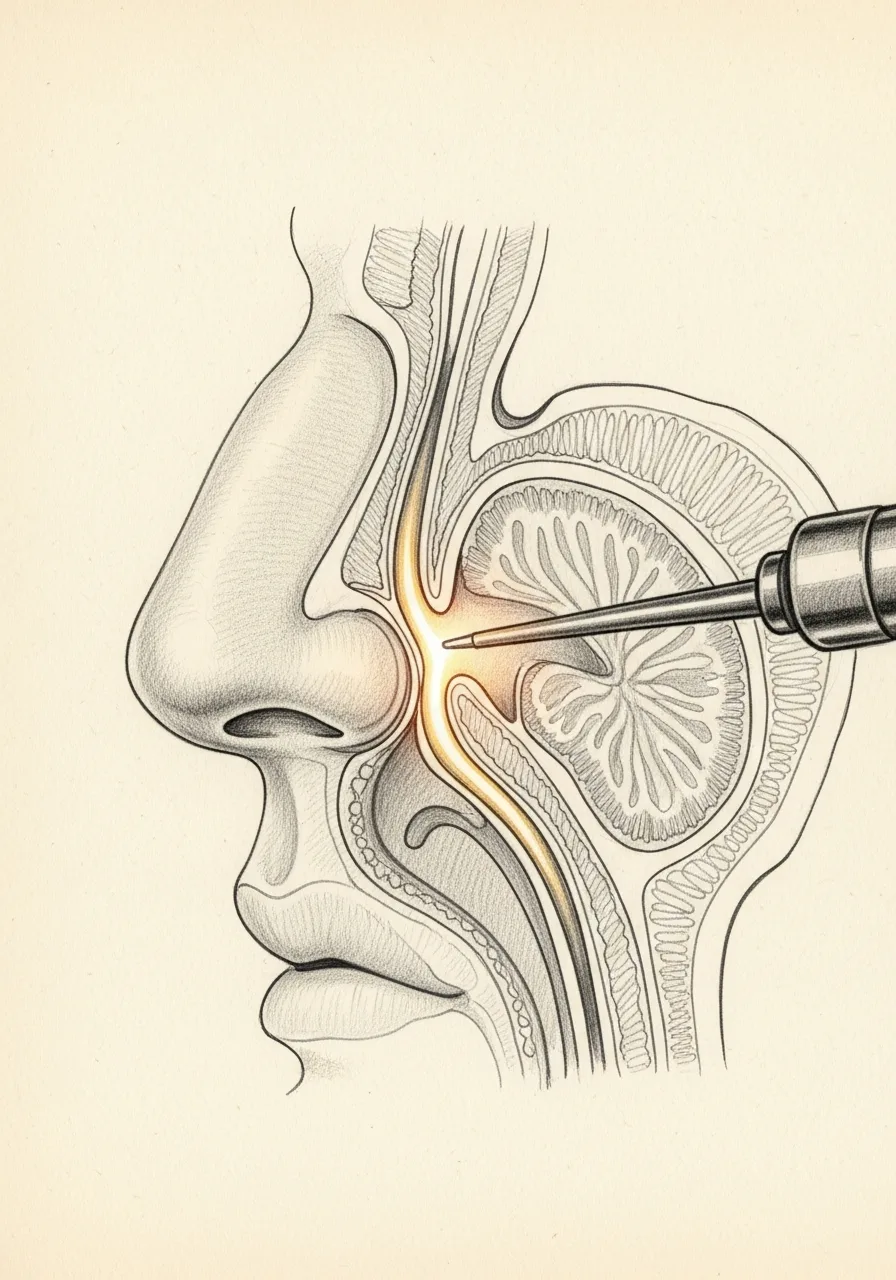
Functional endoscopic sinus surgery is built around this understanding. A thin telescope with a light and camera, the endoscope, is passed through the nostril to give a magnified, well-lit view of these deep drainage pathways. Working under direct visualization, the surgeon can identify exactly where the blockage lies and open only the natural channels that need to be opened. The word 'functional' captures the intent: to restore the sinuses' own drainage and ventilation rather than simply to strip tissue away.
The Operation
What endoscopic sinus surgery can address.
Endoscopic sinus surgery uses instruments and an endoscope through the nostrils to treat selected sinus disease. The exact scope depends on which sinuses and tissues are involved; FESS is not one fixed operation performed identically for every patient.
When polyps, fungal material, or other tissue disease needs treatment, opening a passage with a balloon alone may not be sufficient. Your plan should explain the areas being treated, whether tissue will be removed or sampled, and what postoperative care is expected.
Prior sinus surgery changes the planning discussion. Operative records, imaging, the pattern of persistent disease, and ongoing medical treatment help determine whether further surgery is appropriate.
FESS is typically performed under anesthesia as an outpatient procedure, meaning most patients go home the same day. In some cases, dissolvable material or thin spacers may be placed in the nose to support early healing; whether anything is placed, and what type, depends on the specifics of the surgery.
FESS treats the sinuses, not the cosmetic shape of the nose. If a structural nasal issue such as a deviated septum or enlarged turbinates is also limiting airflow or access to the sinuses, that can be discussed separately and, in appropriate candidates, addressed during the same operation.
Before and After
What surgery opens.
It can help to picture the difference the procedure is designed to make. Before surgery, a sinus opening that should be a clear channel may be reduced to a narrow slit by swollen lining, scar tissue, or polyps. Mucus that cannot escape collects behind the blockage, creating the cycle of pressure, congestion, and recurring infection that brings many patients in for evaluation.
After endoscopic surgery, that same drainage pathway is intended to be open and unobstructed, so secretions can move freely again and air can circulate as it should. A more open pathway also makes ongoing care more effective: saline rinses and topical sinus medications can finally reach the surfaces where they are needed, instead of being blocked at the entrance to the sinus.
It is important to set honest expectations. Opening the sinuses can meaningfully reduce symptom burden for appropriate candidates, but the underlying tendency toward inflammation — particularly in patients with allergies, asthma, or polyp-forming disease — does not simply disappear. For many patients, surgery is most helpful as one part of a longer-term plan that continues to include medical care.
- —Drainage — reopening the natural channels so trapped mucus can clear
- —Ventilation — allowing air to circulate through the sinuses again
- —Access — letting rinses and topical medications reach inflamed lining
- —A foundation for medical management — making long-term care more workable
Indications
When endoscopic sinus surgery is considered.
Endoscopic sinus surgery may be considered when symptoms and objective findings together suggest persistent sinus disease that has not responded to appropriate medical treatment. The key phrase is 'symptoms and objective findings together.' Surgery is a reasonable conversation when how you feel is supported by what the examination and imaging actually show — not by symptoms alone.
Equally important is recognizing when surgery is not the answer. If symptoms are driven mainly by allergies, by a non-sinus headache pattern, or by a problem that medical treatment has not yet been given a fair trial to address, a procedure may offer little benefit. A thoughtful evaluation is meant to sort this out before any surgical decision is made.
- —Chronic sinusitis that persists despite medical therapy
- —Recurrent sinus infections that keep returning
- —Nasal polyps obstructing the nasal passages or sinuses
- —Sinus obstruction or significant inflammation seen on a CT scan
- —Persistent drainage, pressure, or congestion clearly related to sinus disease
- —A need to improve access for topical or rinse-based sinus medications
- —Revision treatment when prior sinus surgery has not fully resolved the problem
Evaluation
How Dr. Mourad evaluates your sinuses.
A sound surgical decision begins with a thorough evaluation. Dr. Mourad's assessment is designed to confirm that sinus disease is genuinely the cause of your symptoms, to map exactly which areas are involved, and to determine whether non-surgical options have been given a fair opportunity. The evaluation generally brings together three sources of information.
A detailed symptom and treatment history — understanding how long symptoms have lasted, how often infections recur, what treatments have been tried, and how you have responded helps distinguish sinus disease from other causes of facial pressure and congestion. A history of allergies or asthma is particularly relevant, since these conditions influence how the sinus lining behaves.
Nasal endoscopy — using the same kind of thin endoscope employed in surgery, Dr. Mourad can examine the nasal passages and drainage areas directly in the office. This allows direct visualization of inflammation, polyps, drainage, and structural narrowing that a routine external examination cannot reveal.
CT imaging — a CT scan provides a detailed map of the sinus anatomy and shows where inflammation or obstruction is located. It is interpreted alongside symptoms and the endoscopic examination, not in isolation. Bringing these pieces together is what allows surgery — when it is recommended at all — to be specific, conservative, and matched to your anatomy.
Timing
When to seek an evaluation.
It is reasonable to seek a sinus evaluation when symptoms are persistent, recurring, or interfering with daily life. Consider scheduling an assessment if you experience any of the following.
An evaluation does not commit you to surgery. Its purpose is to identify what is actually causing your symptoms and to lay out the full range of options — from medical management to office-based treatment to surgery — so you can make a decision that fits your diagnosis, your anatomy, and your goals.
- —Sinus pressure or facial congestion that does not fully resolve
- —Sinus infections that keep returning despite treatment
- —Ongoing nasal blockage, drainage, or post-nasal drip
- —A reduced sense of smell along with congestion
- —Symptoms that disrupt your sleep, exercise, or concentration
- —Sinus symptoms that have not improved after a fair trial of medical care
Honest Considerations
Risks, candidly discussed.
All surgery carries risk, and endoscopic sinus surgery is no exception. Potential risks can include bleeding, infection, scarring or adhesions inside the nose, persistent or recurrent symptoms, regrowth of inflammation or polyps over time, a need for additional treatment or revision surgery, and, rarely, injury to nearby structures given the sinuses' proximity to the eye and the base of the skull. Working under endoscopic visualization and with careful preoperative planning is intended to keep these risks low, but no procedure is without them.
Dr. Mourad reviews the risks that are most relevant to your specific anatomy and planned procedure before surgery, so the decision is made with a clear understanding of both the potential benefits and the limitations. The honest framing is this: the goal is improvement in sinus drainage and a reduction in symptom burden — not a promise that sinus symptoms will never come back. For patients with allergies, asthma, or polyp-forming disease in particular, ongoing medical management often remains part of long-term care even after a successful operation.
03 · Sinus by Sinus
What endoscopic sinus surgery opens.
Because the sinuses are a connected system of air-filled spaces, the plan is tailored to the sinuses that imaging and examination show are actually involved. Each sinus drains through its own natural pathway, and the steps of surgery are named for the pathway being addressed.
Maxillary antrostomy
The maxillary sinuses sit behind the cheeks and are among the most commonly involved. A maxillary antrostomy widens the natural opening of the maxillary sinus so trapped secretions can drain and topical rinses can reach the lining.
Ethmoidectomy
The ethmoid sinuses are a honeycomb of small air cells between the eyes. An ethmoidectomy removes the thin bony partitions of diseased cells to open this region, which often sits at the center of sinus drainage.
Frontal sinusotomy
The frontal sinuses drain through a narrow, complex pathway above the eyes. A frontal sinusotomy carefully opens this outflow tract — one of the more delicate areas of sinus surgery, given its proximity to the eye and the base of the skull.
Sphenoidotomy
The sphenoid sinuses lie deep at the back of the nose. A sphenoidotomy opens the sphenoid sinus when imaging shows it is involved.
Image-guided navigation and revision FESS
For revision FESS — patients whose prior surgery elsewhere did not fully resolve symptoms — and for disease near the eye and skull base, image-guided navigation links the endoscopic view to the patient's own CT scan in real time. Revision cases are planned from the prior operative notes and fresh imaging, often addressing residual cells, scar tissue, or sinuses that were never opened.
Postoperative sinus debridement
After surgery, the newly opened pathways are monitored at follow-up visits and gently cleared of crusting — a routine, planned part of FESS aftercare that supports healing and helps keep the openings from narrowing again.
The extent of surgery is individualized — some patients need only one or two areas addressed; others with more widespread disease may need several sinuses opened during the same procedure.
An Established Academic Authority
Double board certification. Fellowship director. Published author. A surgeon's surgeon.
ABFPRS
Board Certified
American Board of Facial Plastic & Reconstructive Surgery
ABOto
Board Certified
American Board of Otolaryngology — Head & Neck Surgery
NYMC
Clinical Assistant Professor
Otolaryngology · Clinician Scholar Pathway
AAFPRS
Fellowship Director
American Academy of Facial Plastic and Reconstructive Surgery
Textbook
Published Author
Contributions to the academic literature of facial plastic surgery
Dual board certification in both Facial Plastic & Reconstructive Surgery and Otolaryngology — Head & Neck Surgery.
01 · Why Dr. Mourad
The nose and sinuses, evaluated together.
Sinus symptoms rarely exist in isolation from the rest of the nasal airway. A deviated septum, enlarged turbinates, or nasal valve narrowing can all contribute to congestion and can also limit access to the sinuses during treatment. Evaluating the sinuses without considering these structural factors risks treating only part of the problem.
Dr. Moustafa Mourad is a dual board-certified facial plastic and reconstructive surgeon and otolaryngologist in New York City. His training allows him to evaluate sinus disease, nasal obstruction, and facial anatomy together — an important advantage for patients whose symptoms involve both breathing and nasal structure. When a structural issue is contributing, it can be discussed and, in appropriate candidates, addressed alongside the sinus surgery, so the airway is treated as a whole rather than in fragments.
This integrated perspective is also valuable for revision cases. Patients who have had prior sinus surgery elsewhere and continue to struggle benefit from an assessment that considers scarring, previous surgical changes, and overall nasal structure, not just the sinuses in isolation.
02 · Conditions FESS Can Address
The problems this operation is designed for.
Endoscopic surgery may be considered when the diagnosis is established, symptoms and objective findings plausibly match, appropriate prior care has been reviewed, and direct access or tissue removal is needed to address a defined operative target.
I
Chronic Sinusitis
When the sinus lining stays inflamed for an extended period and drainage pathways narrow despite medication, FESS can open the blocked sinuses and improve drainage — which may also make continued medical management more effective.
II
Nasal Polyps
When soft, benign growths of swollen lining fill the nasal passages and block sinus openings, endoscopic surgery may remove the obstructing tissue and reopen the pathways. Because polyps can recur, surgery is usually paired with ongoing medical care.
III
Recurrent Sinus Infections
When infections resolve with treatment only to return again and again, and the anatomy itself contributes to poor drainage, endoscopic evaluation and surgery may help interrupt that pattern in appropriate candidates.
If this describes you, the next step is a quiet, unhurried conversation — not a sales call.
An Honest Note
Not every patient needs surgery.
Many patients improve with medical therapy, allergy management, nasal steroid sprays, saline irrigation, or other non-surgical treatment — and when these bring sufficient relief, surgery may simply not be necessary.
A reasonable medical approach is often tried first and may include saline rinses and nasal irrigation to flush and moisturize the nasal lining, topical nasal steroid sprays to reduce inflammation, allergy evaluation and management when allergies are a driving factor, treatment of infections when they are present, and attention to related conditions such as asthma that influence sinus inflammation.
If symptoms are driven mainly by allergies, by a non-sinus headache pattern, or by a problem that medical treatment has not yet been given a fair trial to address, a procedure may offer little benefit.
Surgery becomes a sensible part of the conversation when symptoms persist despite a fair trial of appropriate treatment and the imaging and examination support a structural cause.
04 · FESS vs Balloon Sinuplasty
Two tools, one decision made from your anatomy.
Both are minimally invasive, endoscope-guided approaches that aim to reopen blocked sinus drainage, and neither is universally better. The right choice depends on the diagnosis and the specific anatomy involved — and some treatment plans use both techniques in the same operation.
| Option | Often suited to | Limitation | Type |
|---|---|---|---|
| Balloon sinuplasty | Focal narrowing of selected sinus openings; more limited disease in certain sinuses. | Dilates without removing tissue — cannot address polyps or obstructing tissue that requires removal. | Tissue-preserving dilation |
| Endoscopic sinus surgery (FESS) | Extensive or long-standing chronic sinusitis, nasal polyps, multiple involved sinuses, prior surgery or complex anatomy. | A more involved operation with a longer early recovery than balloon dilation alone. | Tissue-removing endoscopic surgery |
The decision is made after evaluation rather than in advance. For a fuller side-by-side discussion, see the education guide on balloon sinuplasty vs endoscopic sinus surgery.
Begin the conversation
A careful, honest evaluation is the right first step.
Cost & Insurance
Endoscopic sinus surgery cost & insurance in NYC
The cost of endoscopic sinus surgery depends on the diagnosis, the number of sinuses involved, whether image guidance is used, whether septoplasty or turbinate reduction is included, the type of anesthesia, and the surgical facility.
When endoscopic sinus surgery is medically necessary for chronic sinusitis, recurrent infections, nasal polyps, or obstruction documented by examination and imaging, insurance may cover part or all of the procedure. Coverage depends on your specific plan, demonstrated medical necessity, and any prior authorization requirements your insurer applies.
MouradNYC is an out-of-network practice. Eligible medically necessary functional components of sinus surgery may be submitted to insurance when the patient's plan includes applicable out-of-network benefits and plan requirements are met. Coverage, authorization, deductibles, coinsurance, allowed amounts, and patient responsibility vary by plan and are not guaranteed. Our office can help review benefits and guide patients through the preauthorization process after your consultation.
What May Affect Cost
- Diagnosis and extent of sinus disease
- Number of sinuses involved
- Whether image-guided navigation is used
- Whether septoplasty or turbinate reduction is included
- Type of anesthesia and facility
- Insurance plan requirements
The prices listed are provided as general estimates of typical surgical investment and are not guaranteed quotes. Surgical fees vary based on the patient's anatomy, the complexity of the procedure, previous surgery, operative time, anesthesia and facility requirements, implants or hardware, virtual surgical planning when applicable, and whether multiple procedures are performed together. An exact surgical fee is provided following consultation and development of an individualized treatment plan.
05 · In Dr. Mourad's Words
Educational videos.
Short educational films and patient perspectives from the Manhattan practice.
Dr. Mourad in Practice
An overview of the practice and philosophy.
Patient Perspective
A patient discusses her experience before, during, and after surgery.
Inside the Consultation
How Dr. Mourad evaluates anatomy, goals, and candidacy.
06 · Recovery
What healing actually looks like.
Stage 01
First Days
Most patients describe the early recovery after FESS in terms of congestion, drainage, mild pressure, crusting inside the nose, and fatigue rather than sharp pain. The nose often feels blocked at first as the lining heals.
Stage 02
Week 1 – 2
Many patients return to light activities within several days, though this varies with the extent of surgery and whether other procedures were performed at the same time. Heavy lifting, straining, and vigorous exercise are avoided during early healing.
Stage 03
Weeks 2 – 6
Saline irrigation keeps the nasal passages moist and helps clear crusting, and topical medications control inflammation as the lining heals. Follow-up visits allow the newly opened pathways to be cleared of crusting and watched as they heal.
Stage 04
Ongoing
It can take time for breathing and drainage to settle into their improved baseline. The follow-up schedule and continued medical plan support the long-term benefit of the surgery.
Call the office promptly if you notice
- Sudden heavy bleeding
- High fever
- Vision changes
- Severe or steadily worsening pain
Have a specific question?
Send a brief note describing your anatomy or concerns — the office will route it directly to Dr. Mourad for review.
The Long View
Aftercare is part of the result, not an afterthought.
Preparation before surgery is also the time to discuss expectations candidly. Surgery is intended to improve drainage and reduce symptom burden, and for the right candidate it often does. It is not a promise that sinus symptoms will never return, especially when an underlying inflammatory tendency is present. Understanding that distinction before surgery helps patients make a confident, well-informed decision.
For a more detailed walkthrough of the healing process, read the sinus surgery recovery timeline. Some bleeding, drainage, and congestion are expected early on; the follow-up visits are where the surgical areas are monitored and gently cleaned when needed.


Before You Arrive
What happens before surgery.
A detailed review of your symptom and treatment history
Nasal endoscopy to reconfirm the findings
Careful review of the CT scan to map the sinuses
Review of allergy and asthma history, since these affect inflammation
A medication review, including blood thinners and supplements that can increase bleeding
A clear discussion of the surgical goals, limitations, and what the procedure can and cannot do
Insurance authorization when applicable
Patient Perspectives
From patients of the practice.
I had chronic sinus pressure for years and had tried every antibiotic. After surgery I can finally breathe through my nose and the headaches are gone. I wish I had done it sooner.
Dr. Mourad explained the CT scan to me carefully and only recommended surgery after we had exhausted medical options. The recovery was easier than I expected.
I came in skeptical because two prior consultations had pushed me toward surgery immediately. Here we tried a course of treatment first, and when that failed, the surgical plan was clearly the right step.
Individual experiences. Results and recovery vary by patient. Testimonials shared with written consent.
Patient Reviews
What sinus patients say.
Selected public patient reviews. Individual experiences vary.
“I can now say I can breathe better than I ever have”
Real patient experiences
Selected public reviews from patients of the practice.
Your privacy matters
We never share personal health information.
Board-certified expertise
Dual board-certified facial plastic and reconstructive surgeon.
Individual results vary. Reviews reflect individual experiences and are not a guarantee of outcome.
At a Glance
Endoscopic sinus surgery (FESS) fact snapshot.
- Treats
- Chronic sinusitis, recurrent sinus infections, nasal polyps, and sinus obstruction documented on examination and CT imaging that has not responded to appropriate medical therapy.
- Does not treat
- Symptoms driven mainly by allergies, non-sinus headache patterns, or the cosmetic shape of the nose — FESS treats the sinuses, not external appearance.
- Evaluation
- A detailed symptom and treatment history, nasal endoscopy in the office, and CT imaging interpreted together — never imaging alone.
- Related conditions
- Chronic sinusitis, nasal polyps, recurrent sinus infections, fungal sinusitis, deviated septum, turbinate hypertrophy.
- Possible combined procedures
- Septoplasty, turbinate reduction, balloon sinuplasty of selected sinuses, nasal polyp removal.
- Recovery summary
- Most patients return to light activities within several days; congestion, crusting, and drainage settle over the following weeks with saline rinses and follow-up debridement visits.
- Insurance / functional distinction
- FESS is a functional, medically indicated procedure and may be submitted for insurance review when medically necessary — coverage is never guaranteed. This out-of-network practice provides documentation for reimbursement.
- When to seek evaluation
- When sinus pressure, congestion, recurrent infections, or post-nasal drainage persist despite a fair trial of medical care and interfere with sleep, exercise, or daily comfort.
Frequently Asked
Patient questions, honestly answered.
Functional endoscopic sinus surgery. "Endoscopic" means it is performed through the nostrils using a thin camera, with no external incisions. "Functional" describes the goal: restoring the sinuses' own drainage and ventilation, rather than stripping out the lining.
Usually one to three hours, depending on how many sinuses are opened and whether septoplasty or turbinate reduction is included. It is done under general anesthesia as an outpatient procedure, and most patients go home the same day.
Clinical references
This page draws on published clinical practice guidelines and public-health references. These sources inform general patient education and do not replace an individual evaluation with Dr. Mourad.
- 01Payne SC, McKenna M, Buckley J, et al. Clinical Practice Guideline: Adult Sinusitis Update. Otolaryngology–Head and Neck Surgery. 2025;173(suppl 1):S1–S56. AAO-HNSF guideline (2025 update)
- 02Shin JJ, Wilson M, McKenna M, et al. Clinical Practice Guideline: Surgical Management of Chronic Rhinosinusitis. Otolaryngology–Head and Neck Surgery. 2025. AAO-HNSF guideline (surgical management, 2025)
- 03U.S. National Library of Medicine (MedlinePlus). Sinusitis. MedlinePlus
- 04Centers for Disease Control and Prevention. Sinus Infection (Sinusitis). CDC
Keep Reading
Related sinus care pages.
Sinus Surgery Options in NYC
The flagship overview — how Dr. Mourad decides among observation, balloon dilation, endoscopic surgery, and combined airway procedures.
Read moreBalloon Sinuplasty NYC
Gentle dilation of selected sinus openings without tissue removal.
Read moreChronic Sinusitis Treatment NYC
The condition FESS most often addresses — diagnosis and the medical plan that comes first.
Read moreNasal Polyps Treatment NYC
Medical and surgical options when polyps obstruct the nasal passages.
Read moreRecurrent Sinus Infections NYC
When infections keep returning and the anatomy contributes to poor drainage.
Read moreBalloon Sinuplasty vs Endoscopic Sinus Surgery
A fuller side-by-side discussion of the two approaches.
Read moreSinus Surgery Recovery
A week-by-week walkthrough of healing after sinus surgery.
Read moreThe Most Important Step
Your expert consultation.
If you have chronic sinusitis, nasal polyps, or recurrent sinus infections that have not improved with medical treatment, a careful evaluation can help determine whether functional endoscopic sinus surgery may be appropriate for you. Dr. Mourad evaluates the nose, sinuses, and airway together so that any recommended treatment is tailored to both function and your individual anatomy. An evaluation does not commit you to surgery — its purpose is to lay out the full range of options so you can make a decision that fits your diagnosis, your anatomy, and your goals.