MouradNYC Education Center
A Patient Guide to Rhinoplasty Anatomy, Techniques, and Recovery
A ten-page physician-authored study of the nose, the surgical philosophies that shape it, and the realities of recovery. Covering open, closed, preservation, functional, cosmetic, and revision approaches — with the patient as informed collaborator.
This is an educational guide to anatomy, techniques, consultation, recovery, and decision-making. Patients looking for Dr. Mourad’s procedure overview, real cases, and consultation information should visit the Rhinoplasty NYC procedure overview.
Key takeaways
- This physician-authored guide covers nasal anatomy, surgical philosophies, breathing, recovery, and surgical realities.
- It explains the structures that shape and support the nose before discussing technique.
- Open and closed rhinoplasty are compared, along with preservation and structural approaches.
- Functional and cosmetic goals are discussed together, balancing airflow with appearance.
- Recovery, risks, limitations, and revision are addressed with an honest, patient-first view.
Cover
Rhinoplasty — A Comprehensive Guide
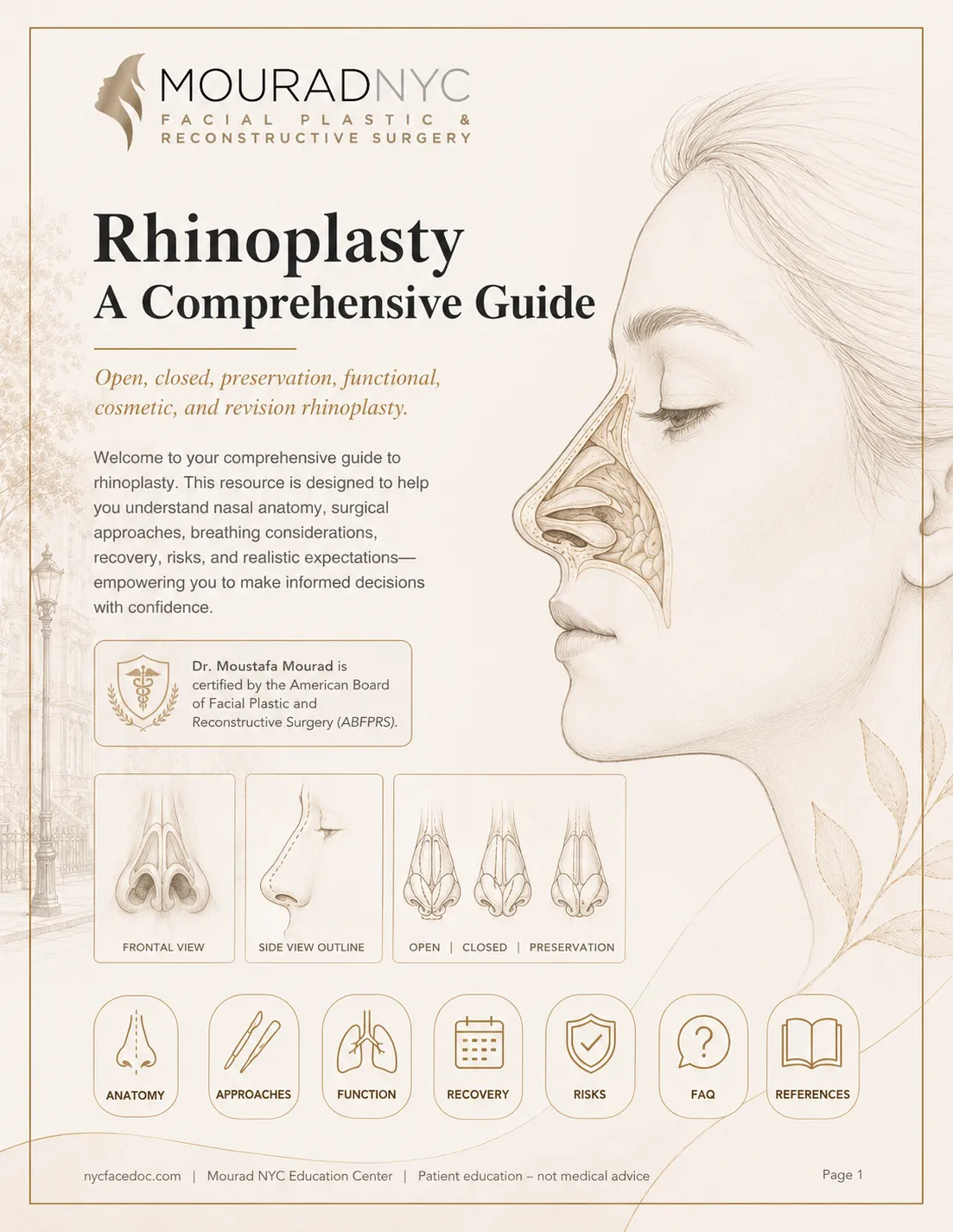
Rhinoplasty is surgery of the nose, an organ that is at once the visual center of the face and a working airway. Because those two roles are inseparable, understanding the operation means understanding both how the nose looks and how it breathes. This guide is written for patients who want that background before, during, or after their own research.
The chapters that follow move from anatomy to surgical philosophy to recovery and realistic limitations. They are meant to make consultations more productive, not to replace them. Every nose and every plan is individual, so nothing here should be read as advice about your particular case.
How to Use This Guide
Anatomy, techniques, breathing, recovery
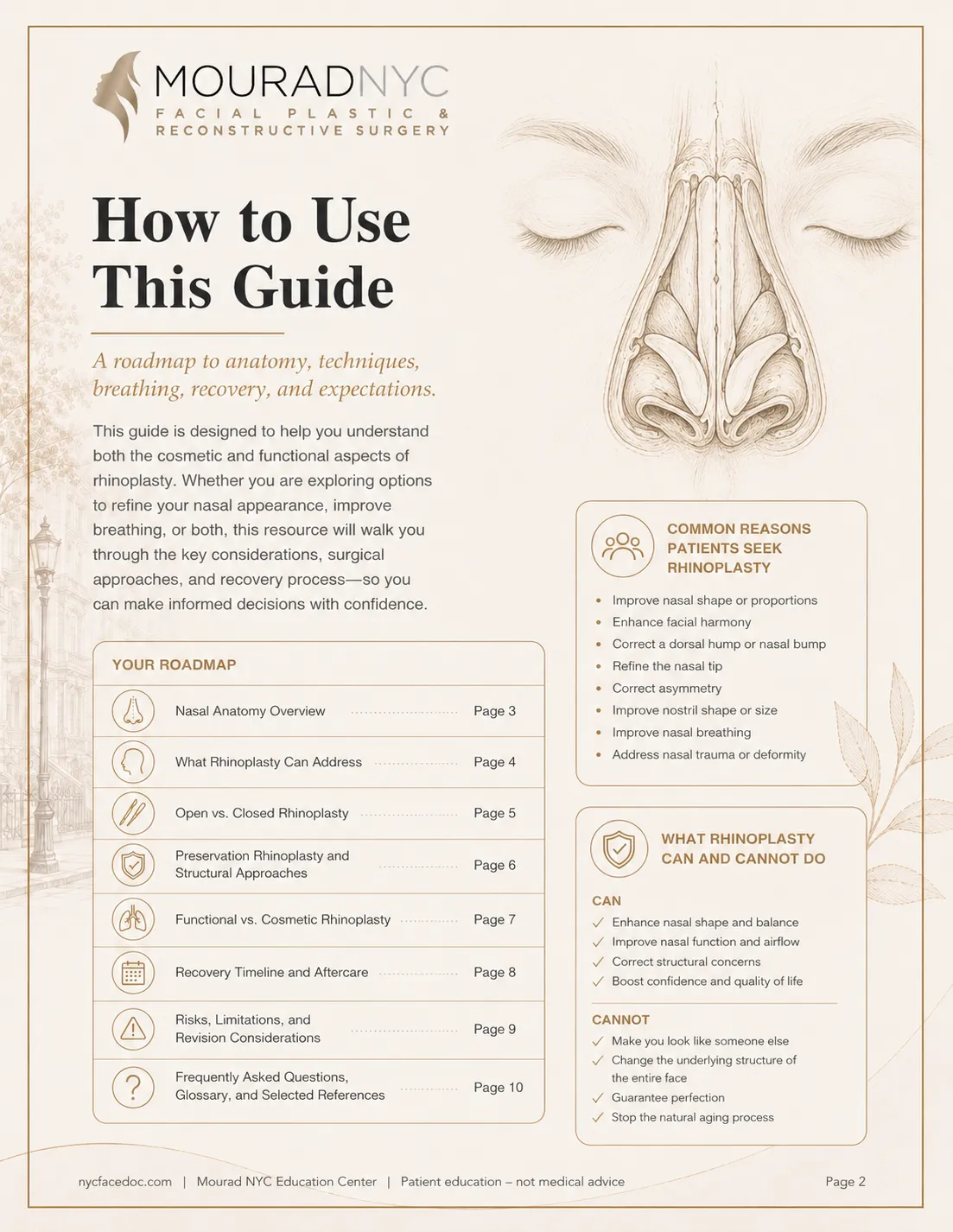
This is an educational reference, not a treatment plan. It explains the concepts and vocabulary patients encounter while researching nasal surgery, so that the words a surgeon uses at a consultation are already familiar. It deliberately avoids telling you whether surgery is right for you, because that question can only be answered by an in-person examination.
Read the chapters in order or jump to the topics that matter to you. When a chapter touches on a specific type of surgery, it links to the page dedicated to that subject — for example primary rhinoplasty for first-time surgery or revision rhinoplasty for corrective work. Those pages carry the detail that belongs to each procedure.
Throughout the guide, plain language is preferred over jargon, and any technical term is defined in the glossary near the end. Where breathing and airway topics appear, they are described alongside the cosmetic considerations they interact with, because in practice the two are rarely separated. Use the guide to prepare questions, understand trade-offs, and follow the reasoning behind a surgical plan.
Nasal Anatomy Overview
The structures that shape and support the nose
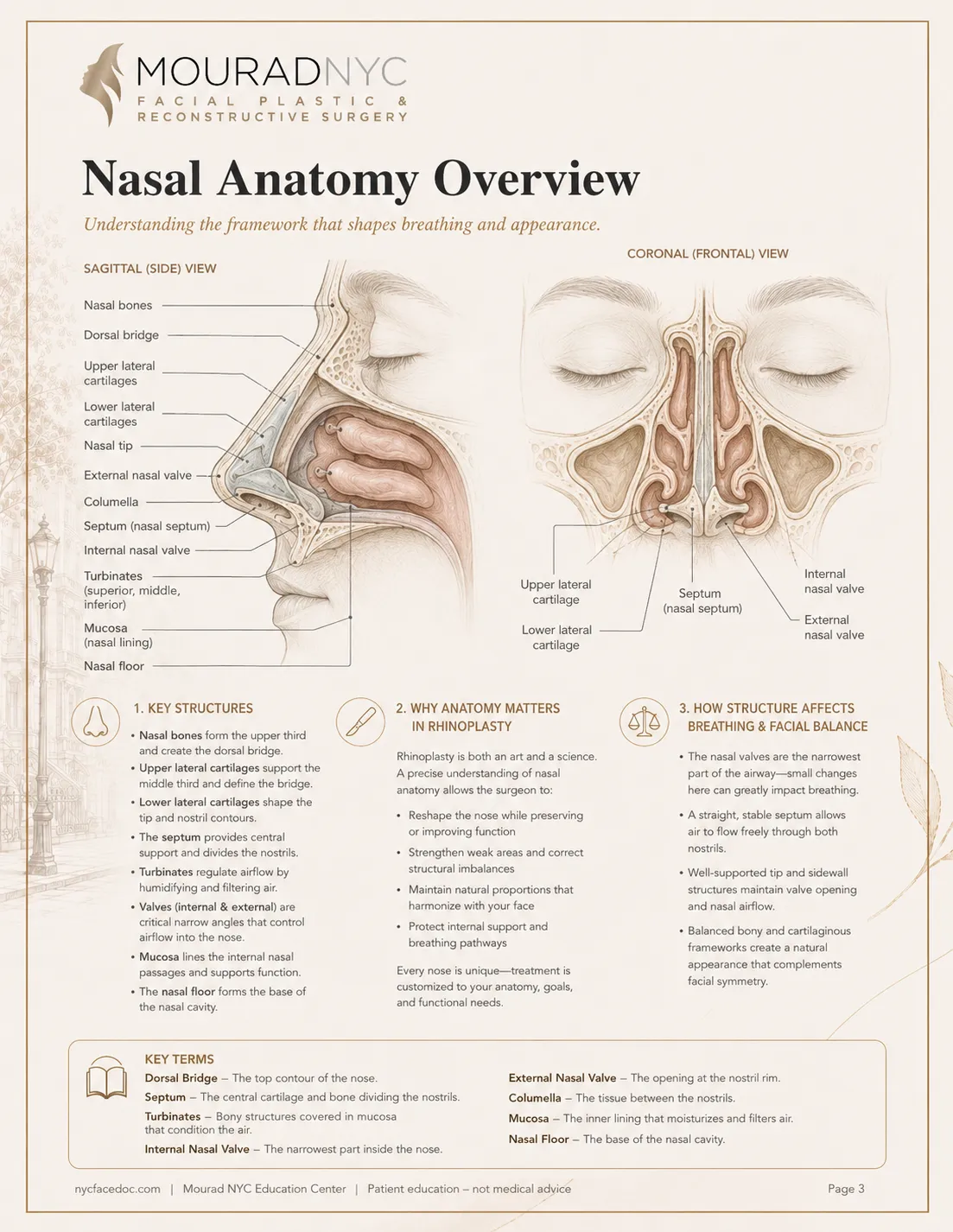
The nose is a layered structure of bone, cartilage, lining, and skin, and each layer contributes to both appearance and function. Understanding these parts makes the rest of the guide easier to follow.
The paired nasal bones form the upper third of the nose, the bony bridge you can feel between the eyes. Below them, the upper lateral cartilages continue the sidewalls and help form the middle vault. The septum is the central partition — part bone, part cartilage — that divides the two nasal passages and provides much of the nose's internal support. At the tip, the paired lower lateral cartilages create the shape, projection, and rotation of the nasal tip.
The nasal valves are the narrowest points of the airway, where the sidewall meets the septum and where small changes have a large effect on airflow. Finally, the skin and soft-tissue envelope drapes over this framework. Skin thickness varies from person to person and strongly influences how much surface detail is visible after surgery. Because reshaping any one of these structures can affect the others, surgeons plan changes to the framework and the airway together rather than in isolation.
What Rhinoplasty Can Address
Aesthetic, functional, and reconstructive goals
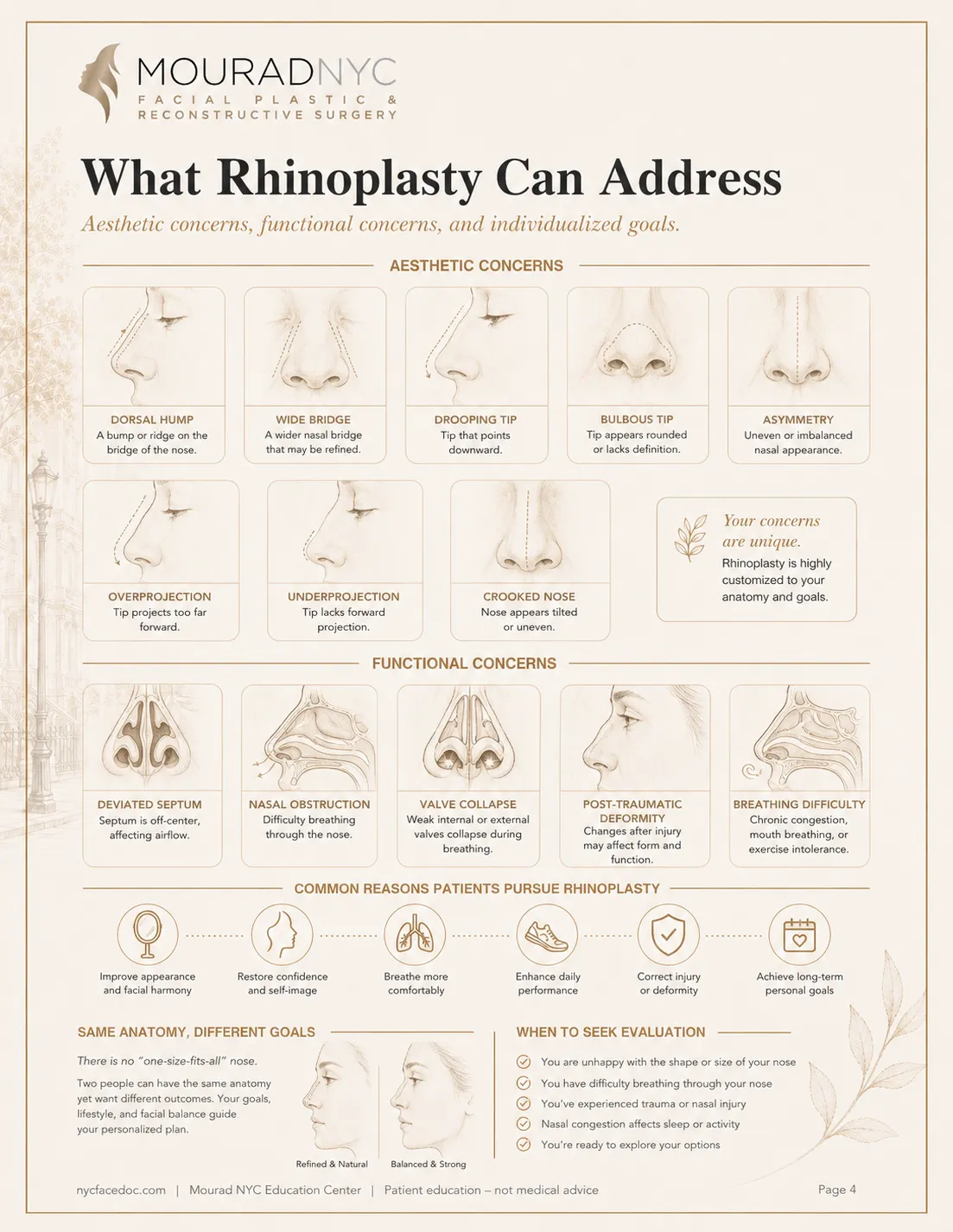
Rhinoplasty is a family of operations rather than a single procedure, and the goals fall into a few broad categories that often overlap.
Shape refers to the visible contour: the height of the bridge, the presence of a dorsal hump, the width of the nose, and the definition, projection, and rotation of the tip. Support concerns the underlying framework — cartilage and bone that hold the shape over time and keep the airway open. When support is weak, both appearance and breathing can suffer, which is why grafting is sometimes used to reinforce the structure.
Airway goals involve breathing, and address the septum, nasal valves, and turbinates, discussed further in the chapter on functional surgery. Trauma is a distinct reason for surgery: a nose that has been broken or injured may be crooked, collapsed, or obstructed, and reconstruction aims to restore both form and function. Revision addresses a previous rhinoplasty whose result the patient wants to change; because tissue has already been operated on, this is treated as its own category and is covered in revision rhinoplasty. Many real cases combine several of these goals at once.
Open vs. Closed Rhinoplasty
How the two classic surgical approaches differ
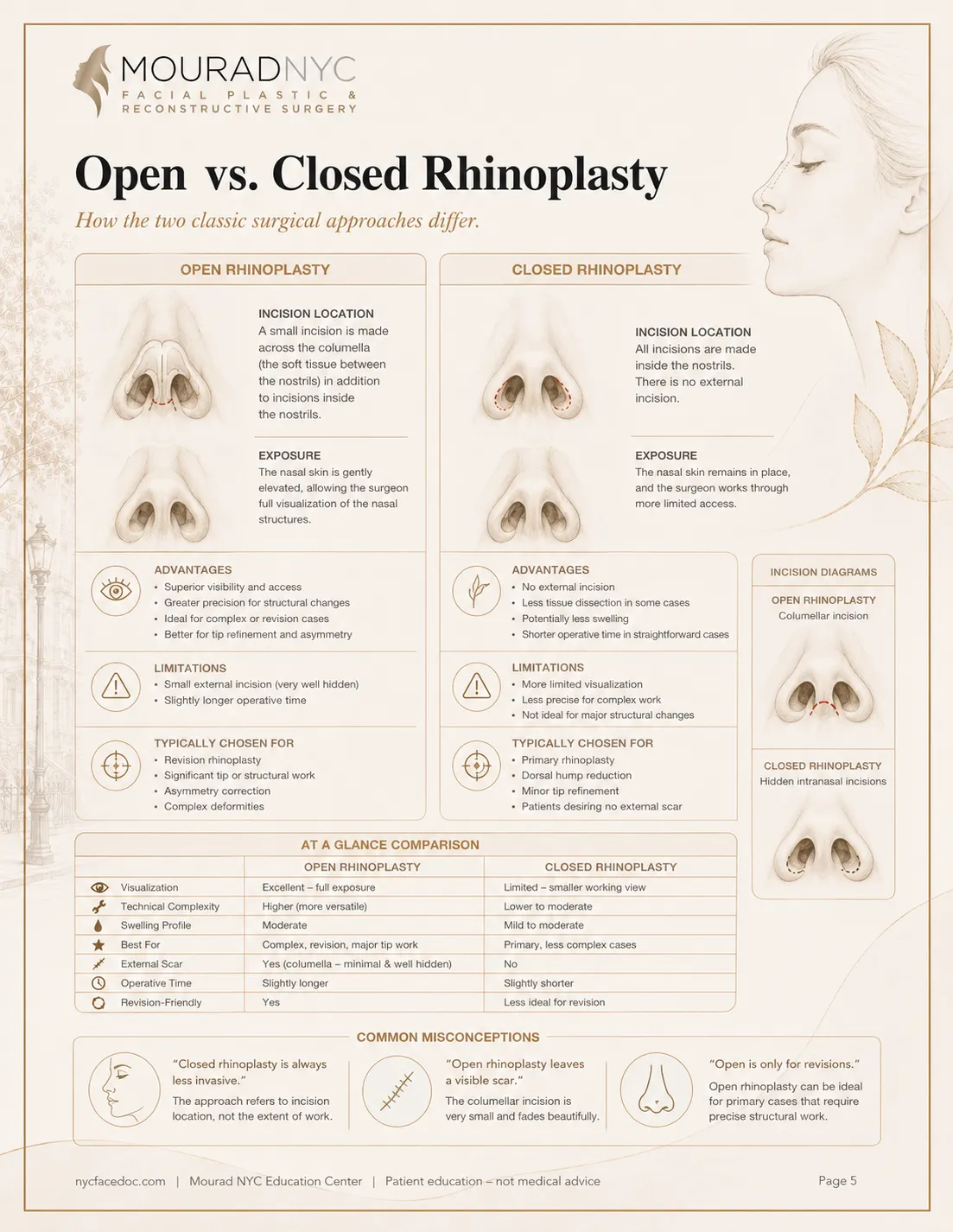
Open and closed rhinoplasty describe how the surgeon reaches the framework of the nose, not two different results. Both are established, widely used approaches.
In the closed (endonasal) approach, all incisions are hidden inside the nostrils. There is no external scar, and some surgeons prefer it for cases where the changes are more limited. Its trade-off is more limited direct visibility of the tip structures, which the surgeon works with through the internal incisions.
In the open (external) approach, a small additional incision is made across the columella, the strip of skin between the nostrils, allowing the soft tissue to be lifted for a fuller view of the cartilage framework. This exposure can help with precise tip work, complex reshaping, grafting, and many revision cases. The trade-off is a small columellar scar, which typically becomes inconspicuous over time.
Neither approach is universally superior. The right choice depends on the specific anatomy, the complexity of the plan, and the surgeon's judgment and experience. A straightforward change may be well suited to a closed approach, while intricate tip work or reconstruction may favor an open one. Both aim for the same thing: a natural, functional result — including in first-time primary rhinoplasty. For the direct comparison, see open vs. closed rhinoplasty.
Preservation & Structural Approaches
Modern frameworks for natural results
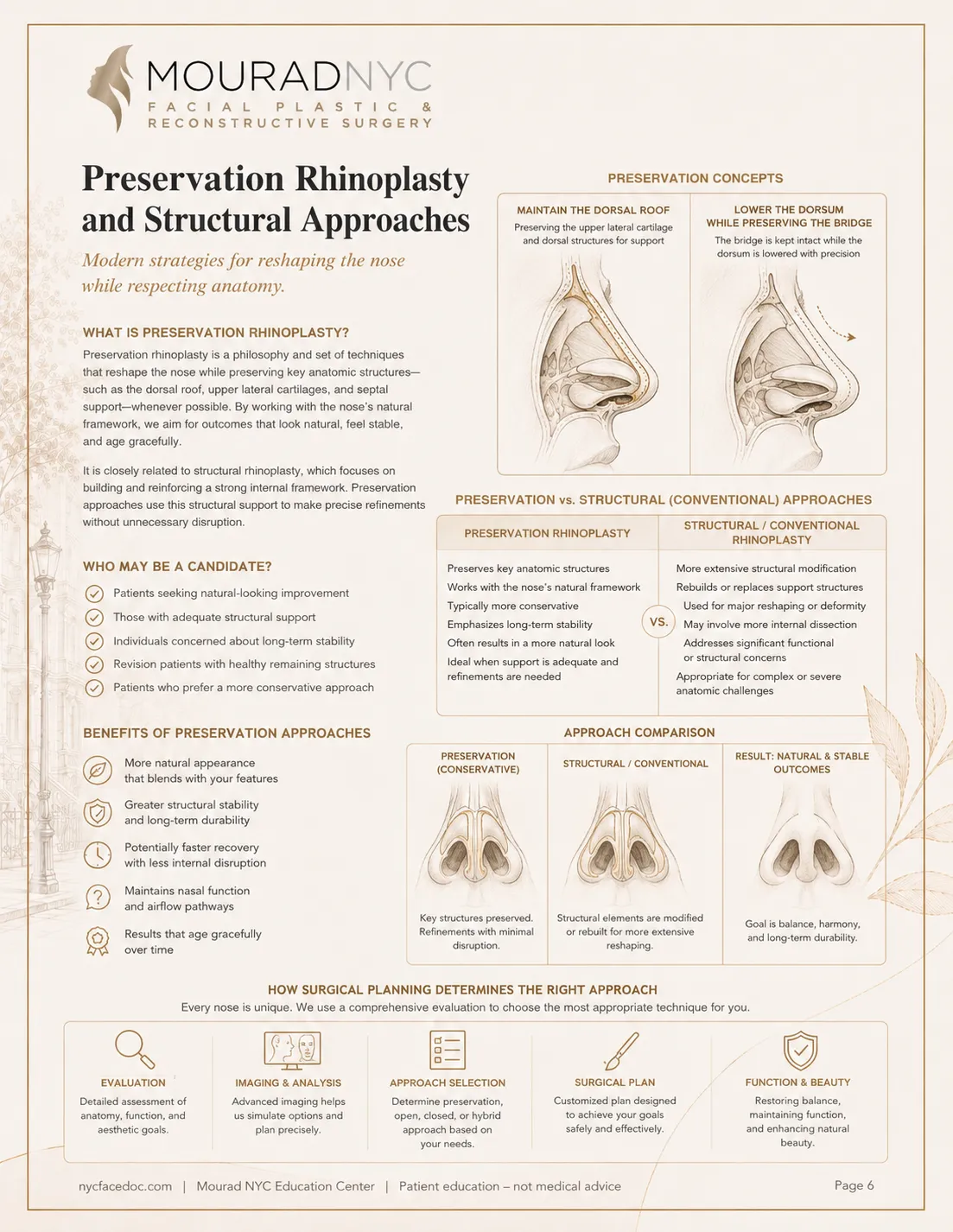
Preservation and structural rhinoplasty are two philosophies for how the nasal framework is handled during surgery. They are frameworks for thinking about the operation, and are frequently combined.
Preservation techniques aim to keep the patient's own dorsal and cartilage structures intact where possible, reshaping them rather than removing and rebuilding them. When suitable, this can maintain natural contours and the nose's original support. It is not appropriate for every anatomy, and its role is decided case by case; the dedicated preservation rhinoplasty page describes the concept in more detail.
Structural techniques rebuild and reinforce the framework, often using cartilage grafts to add strength, correct asymmetry, or support the airway. This approach is valuable where the existing structure is weak, damaged, or has been previously operated on.
In practice, many surgeons plan a hybrid approach, preserving what is stable and reinforcing what is not, rather than committing to one philosophy for the whole nose. The goal in both cases is a result that looks natural and holds its shape and function over the years, which is why the framework is planned alongside the airway rather than separately. Read more about preservation vs. structural rhinoplasty when comparing these frameworks.
Functional vs. Cosmetic Rhinoplasty
Balancing airflow with appearance
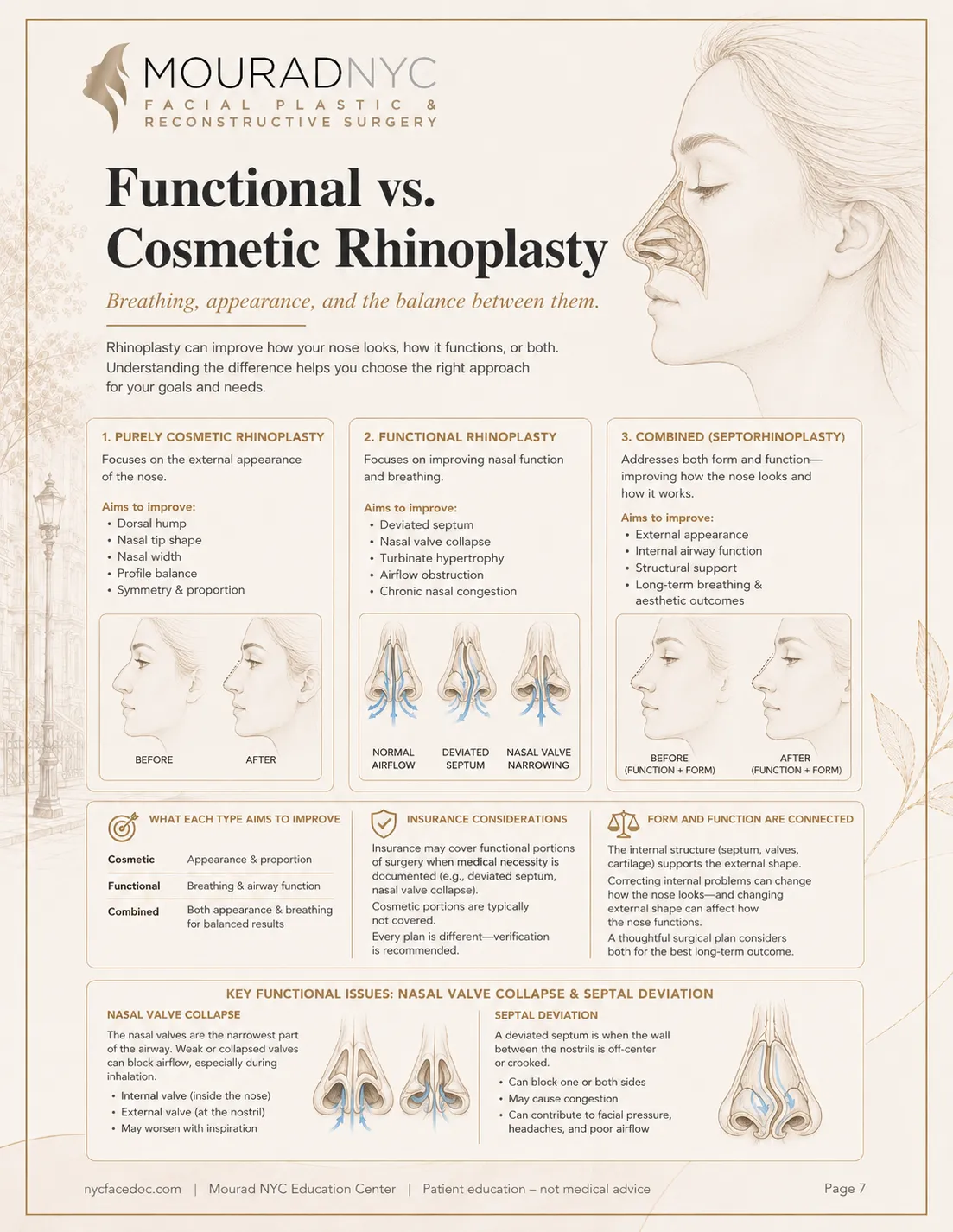
Functional surgery addresses how the nose breathes, while cosmetic surgery addresses how it looks. Because the same structures govern both, the two are usually considered together rather than as separate operations.
The septum is a common source of obstruction. When it is deviated, septoplasty straightens the partition to improve airflow. The nasal valves — the narrowest part of the airway — can collapse or be too narrow; nasal valve treatment reinforces or widens this area. The turbinates, ridges on the sidewall that warm and humidify air, can become enlarged, and turbinate reduction can relieve the resulting congestion.
When breathing and appearance are addressed in the same operation, the procedure is often called a septorhinoplasty, because it coordinates septal and functional work with cosmetic reshaping. This coordination matters: changing the external shape can affect airflow, and improving airflow can change the shape. Planning them together helps avoid creating a breathing problem while refining appearance, and it is one reason airway examination is part of a thorough cosmetic consultation as much as a functional one.
Recovery Timeline and Aftercare
What healing actually looks like
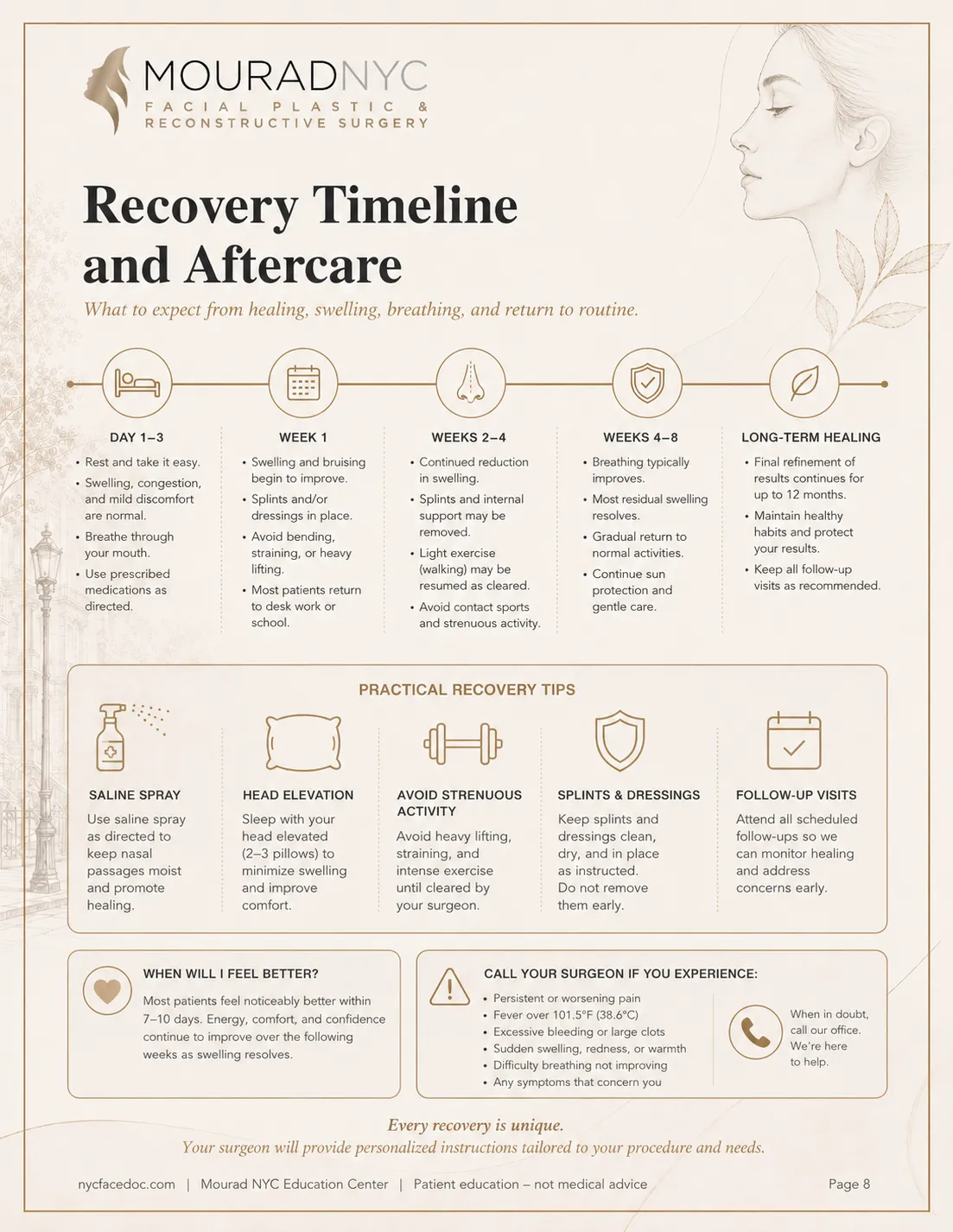
Recovery from rhinoplasty happens in stages, and the visible healing that patients notice first is only the beginning of a longer process. Timelines vary between individuals, so the following is a general picture rather than a schedule.
In the first week, swelling and bruising are expected, often around the eyes, and an external splint or cast is usually worn to protect and stabilise the nose. Most splints are removed at roughly one week, and the most obvious bruising typically fades over the first couple of weeks. Strenuous exercise and activities that risk bumping the nose are generally limited during the early weeks while the framework settles.
After the splint comes off, the nose looks presentable but is still swollen, particularly at the tip, which is the last area to refine. This tip swelling can take many months to resolve, and subtle changes continue as the tissues mature. Long-term maturation of the final result commonly unfolds over about a year, and sometimes longer for thicker skin or after revision surgery. Following the surgeon's aftercare instructions — on cleaning, activity, sun protection, and follow-up visits — supports the healing process throughout this period.
Risks, Limitations, and Revisions
An honest view of surgical realities
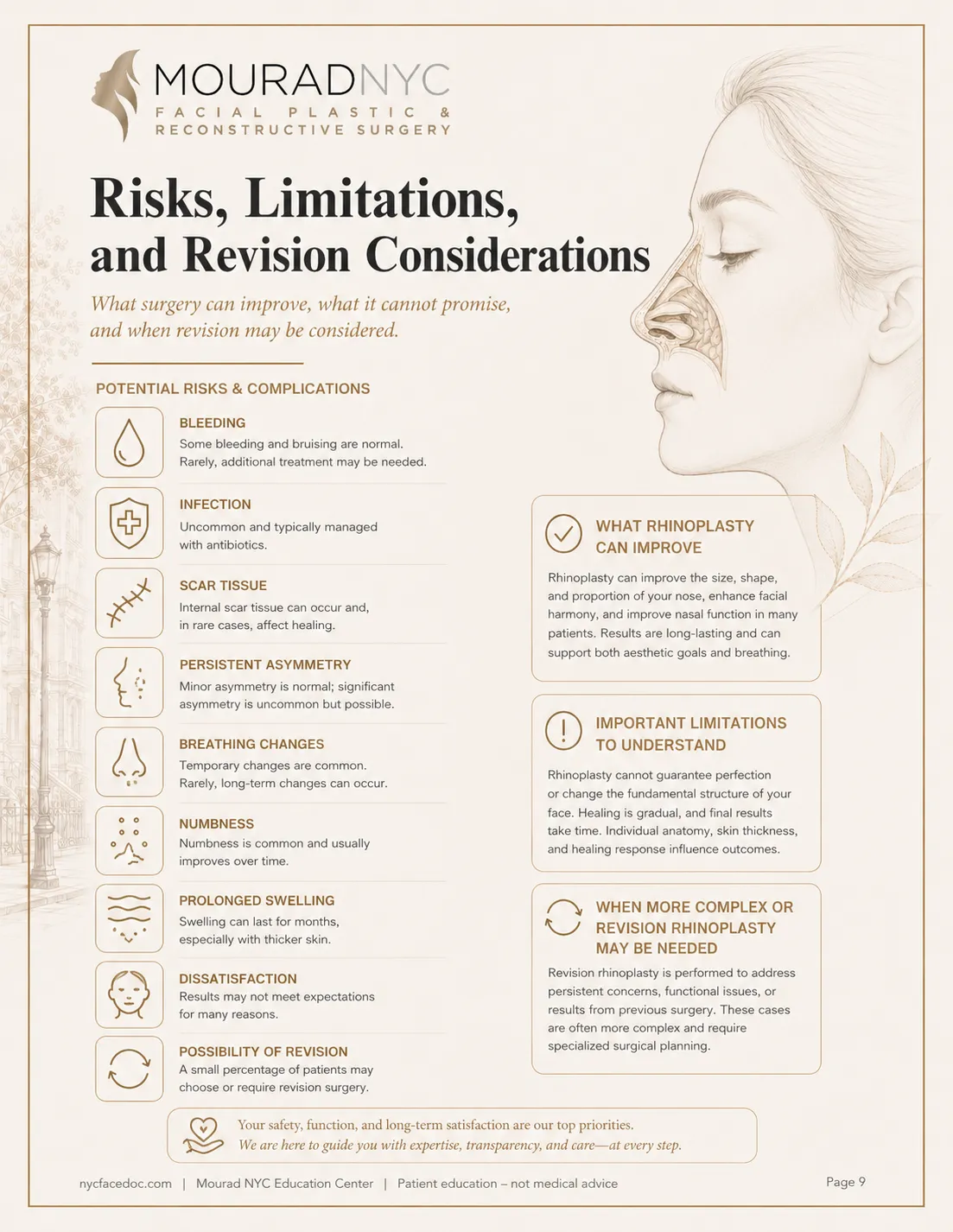
Every operation carries risk, and rhinoplasty is no exception. An honest understanding of its limitations is part of being an informed patient.
Because healing is a biological process that varies from person to person, results cannot be guaranteed. Even with careful surgery, minor asymmetry can occur, since the two sides of the face and nose are never perfectly identical to begin with. Breathing can be affected by both the original anatomy and the surgery, which is why airway function is evaluated and planned for rather than assumed. When an open approach is used, a small columellar scar results, and although it usually fades it does not disappear entirely.
Skin thickness is a genuine limitation on how much surface detail surgery can reveal: thicker skin masks fine changes and takes longer to settle, while thinner skin shows more of the underlying framework. Realistic expectations account for these factors. A proportion of patients ultimately consider a further procedure, and revision rhinoplasty exists to address results that fall short of a patient's goals or that change with healing. Discussing these possibilities before surgery is a normal and important part of planning.
FAQ, Glossary, and References
Common answers and helpful terminology
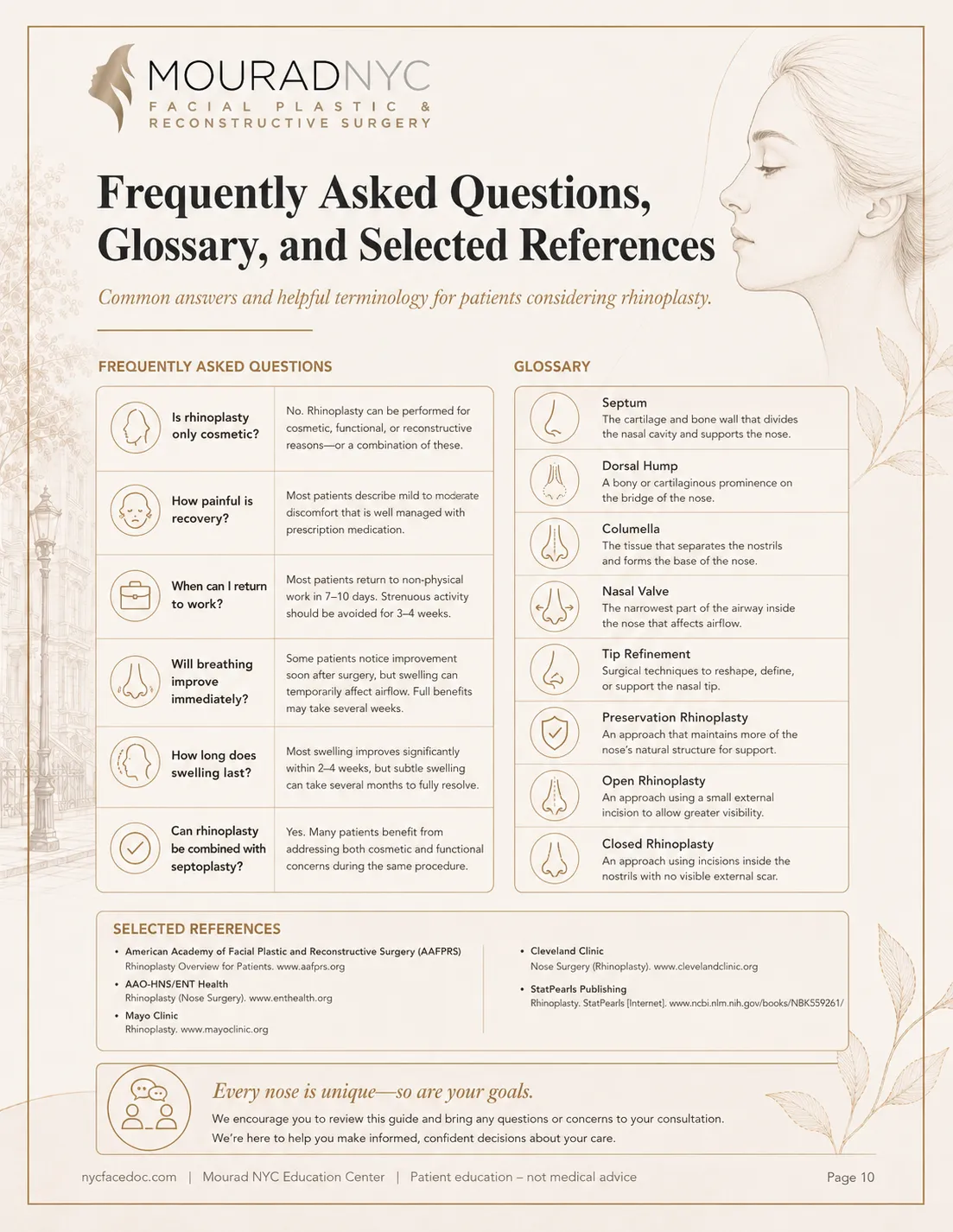
The final chapter of the printed guide collects common questions along with the glossary and reference list. Definitions of the key terms used throughout this guide appear in the glossary below, and the sources that inform this educational content are listed in the references section that follows.
What is the difference between open and closed rhinoplasty? Open rhinoplasty adds a small incision across the columella so the skin can be lifted; closed rhinoplasty uses incisions inside the nose. The right approach depends on the anatomy and access needed.
How long does rhinoplasty recovery take? The splint is usually removed at about one week, many patients return to desk work in 7–10 days, strenuous exercise commonly waits 4–6 weeks, and the final result continues refining for about 12 months.
Can rhinoplasty improve breathing? It can when the plan addresses structures contributing to obstruction, such as the septum or nasal valves. Breathing should be assessed and protected alongside appearance.
Will rhinoplasty leave visible scars? A closed approach has incisions inside the nose. An open approach adds a small columellar incision that generally heals to a fine, inconspicuous line.
Glossary
- Osteotomy
- A controlled cut of the nasal bone that lets the surgeon reposition or narrow the bony bridge.
- Dorsum
- The bridge of the nose — the profile line running from between the eyes down toward the tip.
- Projection
- How far the nose, and especially the tip, extends outward from the plane of the face.
- Rotation
- The upward or downward angle of the nasal tip relative to the upper lip.
- Columella
- The strip of skin and cartilage between the nostrils, where the incision for an open approach is placed.
- Alar base
- The width of the nostrils where they meet the face at the base of the nose.
- Spreader graft
- A strip of cartilage placed alongside the septum to support the middle vault and the internal nasal valve.
- Septal extension graft
- A cartilage graft attached to the septum to set and stabilise tip projection and rotation.
- Preservation
- An approach that aims to keep and reshape the patient's own dorsal and cartilage structures rather than removing and rebuilding them.
- Revision
- A further rhinoplasty performed to adjust the result of a previous nasal operation.
References
- American Academy of Facial Plastic and Reconstructive Surgery — Rhinoplasty patient resources
- American Academy of Otolaryngology–Head and Neck Surgery — Nose and sinus health information
- American Board of Facial Plastic and Reconstructive Surgery — About the specialty
- U.S. National Library of Medicine, MedlinePlus — Rhinoplasty overview
References are provided for general education and point to independent professional and public-health resources.
When you are ready to move from research to a personal plan, the Rhinoplasty NYC procedure page covers candidacy, cases, consultation, and cost specific to Dr. Mourad's practice.
This guide is for patient education only and does not constitute medical advice. Outcomes vary by patient anatomy and circumstance. Medical content reviewed by Moustafa Mourad, MD, FACS.