Double Board Certified · AAFPRS Fellowship Director
Deep Plane Facelift in NYC — release the ligaments, reposition the structure.
A deep plane facelift releases selected retaining ligaments beneath the SMAS so the cheek, lower-face soft tissues, and skin can be repositioned together with less reliance on skin tension. It is a technique for selected anatomy—not a claim that every patient needs deeper dissection or that one facelift method is best for everyone.
ABFPRS
Facial Plastic & Reconstructive Surgery
ABOto
Otolaryngology — Head & Neck Surgery
AAFPRS
Fellowship Director

In Consultation
"We reposition the deeper layer, so the skin never has to do the work."

A Note from Dr. Mourad
"A deep plane facelift is a technique, not a brand. It releases selected ligaments so deeper tissues can be repositioned without relying on skin tension. A natural appearance is the goal, not a guaranteed result; the operation must fit the patient's anatomy and priorities."
— Dr. Moustafa Mourad, MD
Medically reviewed by Moustafa Mourad, MD, FACS — dual board-certified in Facial Plastic & Reconstructive Surgery and Otolaryngology–Head & Neck Surgery; Clinical Assistant Professor of Otolaryngology at New York Medical College; AAFPRS Fellowship Director. The medical review identifies the anatomy, evidence, limits, and questions patients should understand before choosing a procedure.
Last reviewed: June 2026
Is this the right page for you?
- You have midface descent, deep nasolabial folds, and jowling, and you are researching a sub-SMAS technique specifically.
- You want to understand how the deep plane technique differs from a SMAS or mini facelift.
- You are weighing the deep plane approach as part of a facelift consultation with Dr. Mourad.
You may be looking for
- A general overview of all facelift options — start with the main facelift page.
- Concerns limited to the neck and jawline — see the neck lift page.
Overview
What is a deep plane facelift?
A deep plane facelift is a surgical technique that dissects beneath the SMAS — the superficial musculoaponeurotic system, the connective-tissue layer beneath the skin — and selectively releases the facial retaining ligaments. These are the fibrous tethers that anchor the midface and jowl in place as the face ages.
Once those ligaments are released, the SMAS, the deep fat, and the overlying skin are repositioned together as a single composite unit, rather than being separated and pulled independently. Because the layers move together, the vector of elevation follows the true line of descent and the surface tension on the skin stays low.
The deep plane technique is generally considered for patients with midface descent, deep nasolabial folds, and jowling that has progressed beyond what a SMAS plication can address on its own. It is one of several facelift techniques Dr. Mourad performs; the right approach is determined individually at consultation.
Anatomy & planning
Scope of deep-plane lifting
This page explains the deep-plane technique. For the broad decision about whether a facelift is appropriate at all, begin with the Facelift NYC overview. Patients whose concern is centered in the neck, eyelids, brow, cheek volume, or skeletal chin support may require a different or combined plan.
Anatomy & planning
What the deep plane changes
The defining step is release in a deeper plane so selected mobile facial tissues can be moved as a unit. The operation may improve jowling, cheek descent, jawline definition, and the transition into the upper neck when those findings arise from the structures addressed. It does not automatically correct brow descent, eyelid skin, eyelid ptosis, skin texture, pigment, or skeletal chin deficiency.
The depth and extent of release are individualized. More dissection is not inherently better. The goal is the amount of release required for a stable vector while protecting facial-nerve branches, blood supply, hairline, ear shape, and natural movement.
Anatomy & planning
Deep plane versus SMAS: how to interpret the evidence
Both deep-plane and SMAS-based facelifts can produce high patient satisfaction and meaningful rejuvenation in appropriately selected patients. Available comparative studies are heterogeneous and do not establish a universal winner. Surgeon experience, anatomy, the location of laxity, prior procedures, neck findings, and the exact maneuver performed are more useful than choosing by label alone.
An Established Academic Authority
Double board certification. Fellowship director. Published author. A surgeon's surgeon.
ABFPRS
Board Certified
American Board of Facial Plastic & Reconstructive Surgery
ABOto
Board Certified
American Board of Otolaryngology — Head & Neck Surgery
NYMC
Clinical Assistant Professor
Otolaryngology · Clinician Scholar Pathway
AAFPRS
Fellowship Director
American Academy of Facial Plastic and Reconstructive Surgery
Textbook
Published Author
Contributions to the academic literature of facial plastic surgery
Dual board certification in both Facial Plastic & Reconstructive Surgery and Otolaryngology — Head & Neck Surgery.
01 · Why Dr. Mourad
Concentrated experience in facial surgery.
Dr. Moustafa Mourad is dual board-certified in Facial Plastic & Reconstructive Surgery and in Otolaryngology — Head & Neck Surgery, and serves as an AAFPRS fellowship director, training the next generation of facial plastic surgeons.
His practice concentrates on the face and neck, and he regularly evaluates complex and revision cases referred by other surgeons. The deep plane technique requires a detailed understanding of the sub-SMAS anatomy and the facial nerve, which is why technique selection is made carefully and individually.
Every surgical plan begins with an unhurried clinical evaluation. The goal is the operation that suits your anatomy — not the one that is easiest to market.
02 · Ideal Candidates
Who benefits most from a deep plane facelift.
The deep plane technique is suited to patients whose aging is driven by descent of the deeper tissues rather than skin texture alone. Candidacy is confirmed through an in-person examination.
I
Midface Descent
Flattening of the upper cheek and descent of the midface fat pad — changes that surface tension alone cannot lift, and that a sub-SMAS release is designed to address.
II
Deep Folds & Jowling
Deep nasolabial folds and jowling along the mandible that no longer respond to soft-tissue filler, where structural elevation is the appropriate next step.
III
Healthy & Realistic
Non-smokers in good overall health with realistic expectations. The technique repositions structure; it does not change underlying skin quality or stop the aging process.
If this describes you, the next step is a quiet, unhurried conversation — not a sales call.
An Honest Note
When the deep plane technique may not be the right choice.
If your concerns are primarily skin texture, fine lines, or pigmentation, resurfacing or energy-based treatments may serve you better than surgery.
When jawline laxity is mild and the midface is well-preserved, a SMAS or mini facelift may accomplish the goal with a more limited dissection. A deeper release is not always necessary.
Active smokers face elevated risk of impaired healing; a nicotine-free window before surgery is required. Unstable medical conditions must be addressed before any elective facial surgery.
03 · How It Compares
Where the deep plane sits among facelift techniques.
A facelift is not a single operation. The editions below show how the deep plane technique relates to the other approaches Dr. Mourad performs. The main facelift page covers all of them in depth.
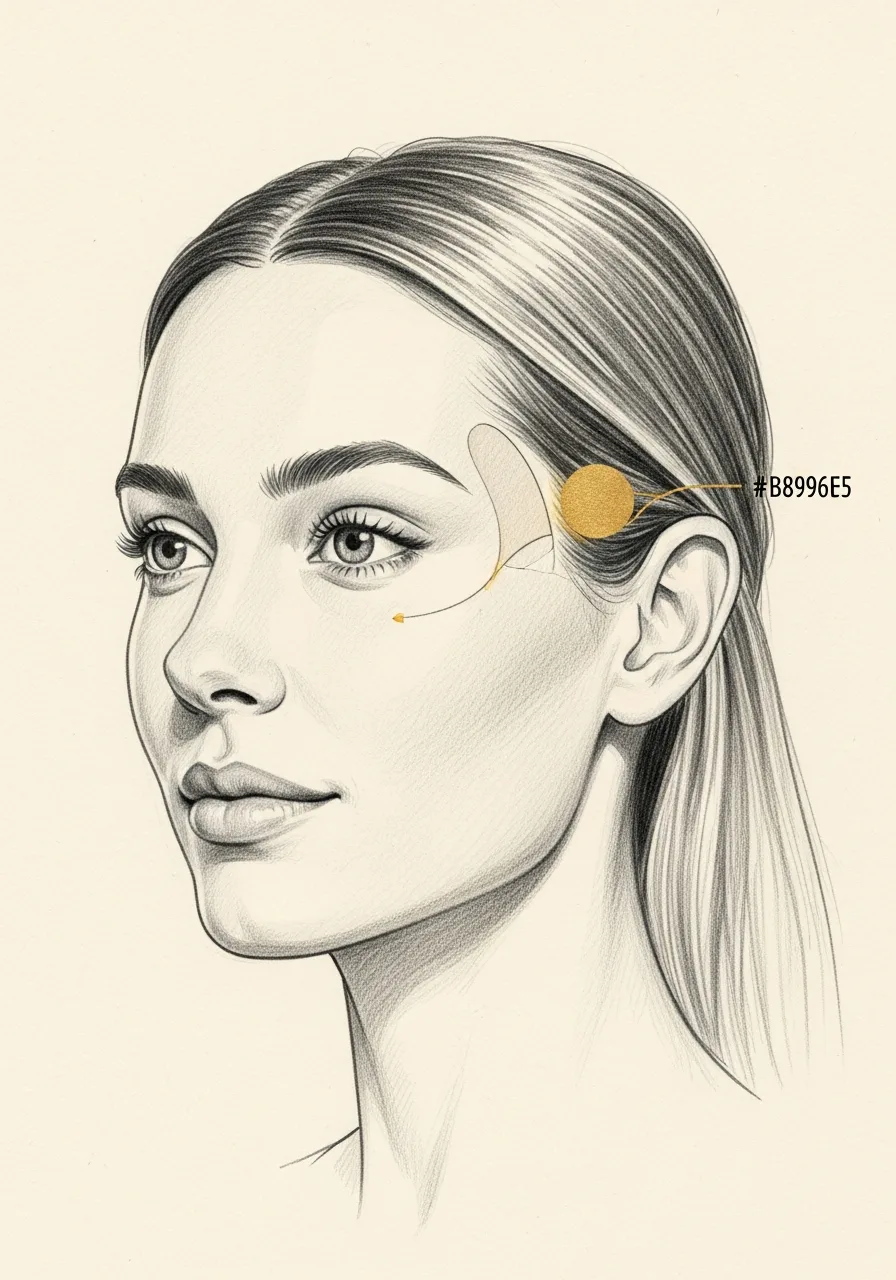
SMAS Facelift
Tightens the SMAS through folding (plication) or overlapping (imbrication) without sub-SMAS dissection. Well suited to moderate jawline laxity with a preserved midface.
Learn More

Mini Facelift
A shorter incision and a more limited suspension for early lower-face jowling in the 40s to early 50s. A contained first step, not a substitute for a fuller release.
Learn More

Neck Lift
Addresses the platysma, submental fat, and cervicomental angle. A neck lift accompanies almost every facelift in this practice.
Learn More
04 · Technique
Deep plane vs SMAS facelift.
Deep-plane and SMAS labels encompass different operative maneuvers. A deep-plane approach works beneath the SMAS with selected ligament release; SMAS plication tightens the layer at its surface, while other SMAS approaches involve different dissection. Compare the release, vectors, neck plan, tissue quality, and prior surgery rather than assume one technique is universally superior or lasts a fixed number of years.
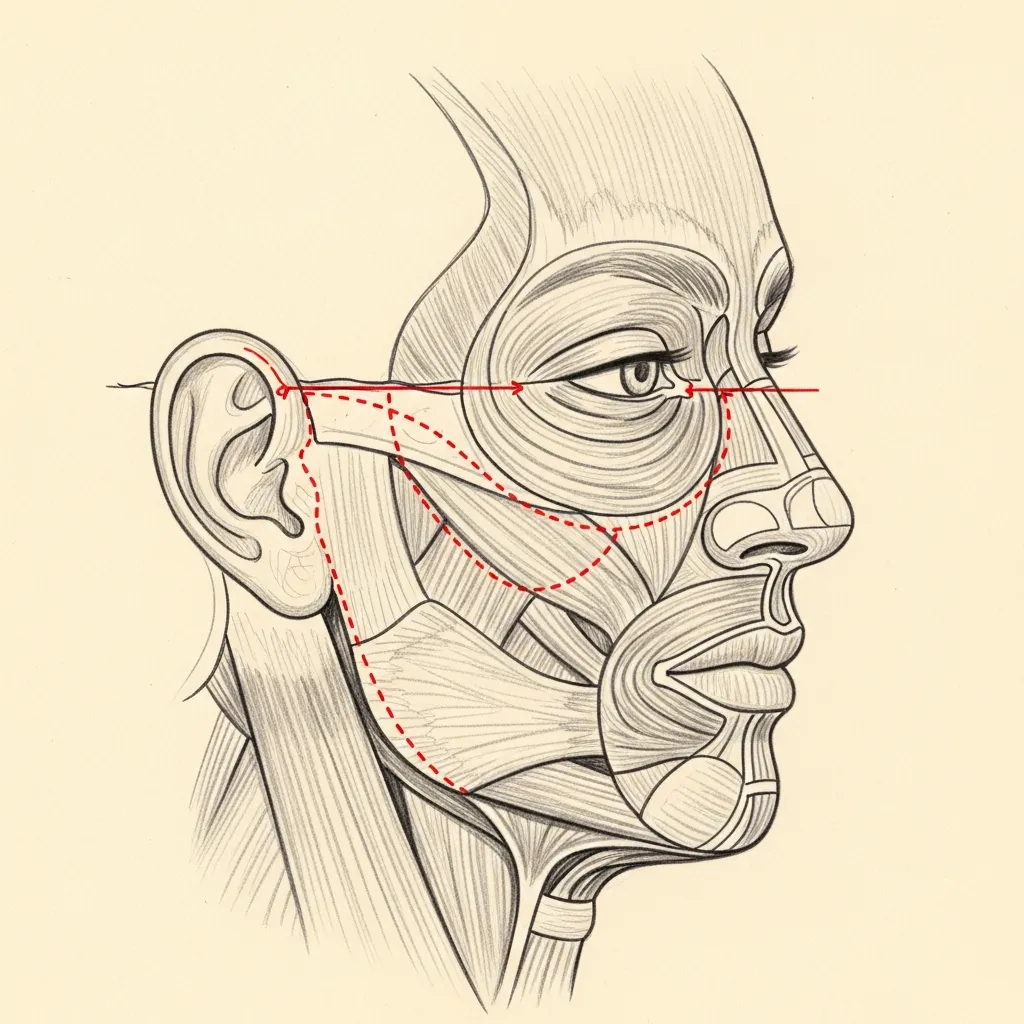
Deep Plane
Beneath the SMAS
The deep plane technique releases the retaining ligaments of the face and elevates the SMAS, fat, and skin together as one composite unit. Because the layers are not separated, the vector of elevation follows the true line of descent.
It addresses the midface, nasolabial fold, jowl, and upper neck in a single coordinated movement, and is generally considered when midface descent is part of the presentation.
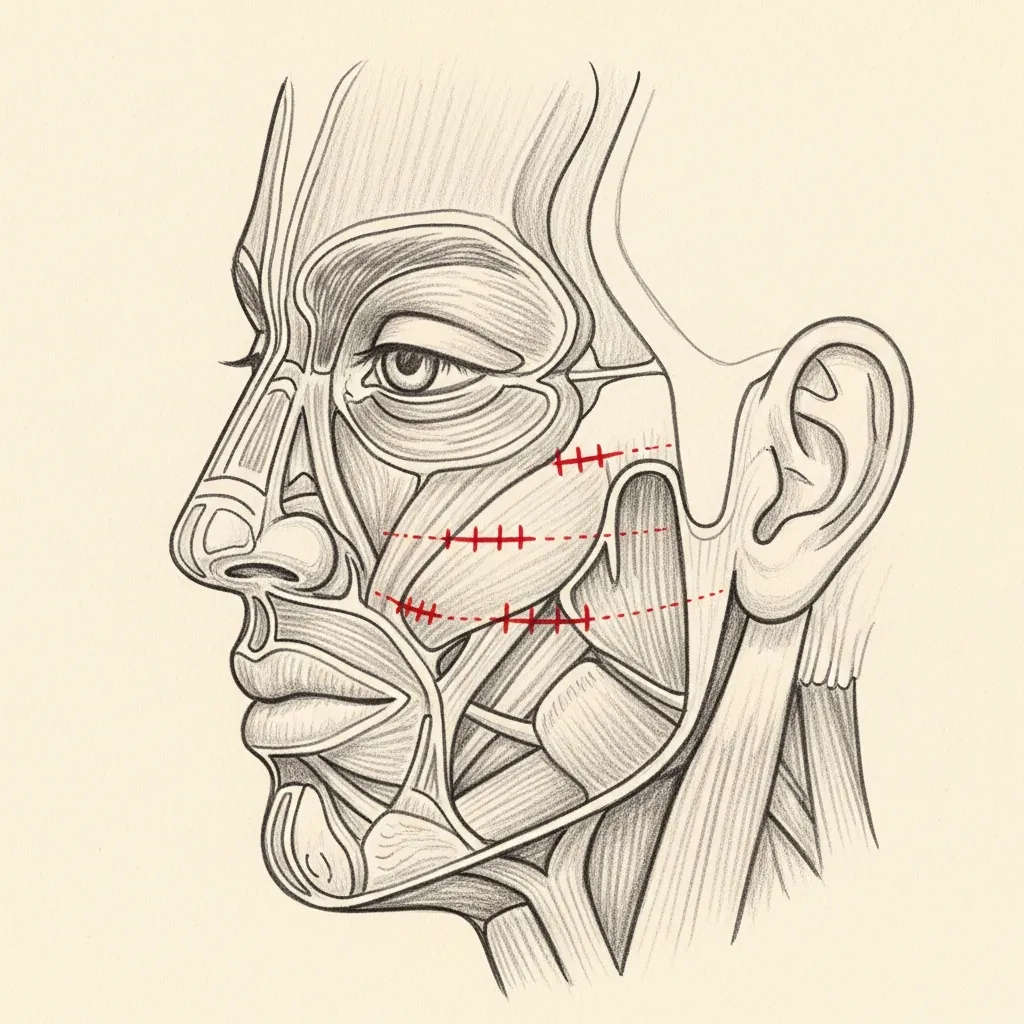
SMAS
Plication or Imbrication
A SMAS facelift tightens the SMAS layer through folding (plication) or overlapping (imbrication) without sub-SMAS dissection. It is a predictable operation with a long safety record.
It is well suited to patients with moderate jawline laxity who do not require a deep midface release. Recovery can be slightly faster because the dissection planes are more limited.
Illustrative diagrams. The appropriate plane is determined individually at consultation based on anatomy and goals. If your anatomy points toward SMAS tightening rather than a deep-plane release, that operation is described on the SMAS facelift page.
Begin the conversation
A consultation is a clinical evaluation — not a sales conversation.
Cost & Insurance
How Much Does a Deep-Plane Facelift Cost in NYC?
A deep-plane facelift typically ranges from $45,000 to $65,000+. Adding the neck — a deep-plane face and neck lift — typically ranges from $50,000 to $75,000+.
Facelift surgery is generally considered cosmetic and is typically self-pay. During consultation, Dr. Mourad can evaluate your facial anatomy, discuss your goals, and provide a personalized estimate. Payment is arranged directly with the practice. Payment terms and any required deposit are reviewed when surgery is scheduled.
| Operation | Typical surgical investment |
|---|---|
| Deep-plane facelift | $45,000–$65,000+ |
| Deep-plane face and neck lift | $50,000–$75,000+ |
What May Affect Cost
- Complexity of the surgical plan
- Degree of midface and lower-face descent
- Whether the neck is treated at the same time
- Primary vs revision surgery
- Anesthesia and facility fees
- Postoperative care
The prices listed are provided as general estimates of typical surgical investment and are not guaranteed quotes. Surgical fees vary based on the patient's anatomy, the complexity of the procedure, previous surgery, operative time, anesthesia and facility requirements, implants or hardware, virtual surgical planning when applicable, and whether multiple procedures are performed together. An exact surgical fee is provided following consultation and development of an individualized treatment plan.
05 · In Dr. Mourad's Words
The deep plane facelift, explained.
Dr. Mourad on how a deep plane facelift repositions the deeper tissues of the face — restoring structure rather than pulling skin tight.
The Modern Facelift
Dr. Mourad discusses how a deep plane facelift repositions the deeper tissues of the face — restoring structure rather than pulling skin tight.
06 · Recovery
What healing actually looks like.
Stage 01
First 24 Hours
The first 24 hours involve a soft compressive dressing, head elevation, and rest. Discomfort is generally moderate and well controlled with non-narcotic medications. Drains, when used, are typically removed within a day or two.
Stage 02
Week 1
Through the first week, bruising and swelling peak around day three and begin to subside. Sutures in front of the ear are removed around day seven. Most patients are presentable for quiet social return at ten to fourteen days.
Stage 03
Weeks 2 – 4
Between weeks two and four, residual swelling steadily declines and light makeup covers most residual discoloration. Light cardio typically resumes around three weeks; strength training is delayed further.
Stage 04
Months 1 – 12
From one to twelve months, the deeper tissues continue to settle and scars mature. Final contour is generally appreciated by six to twelve months.
Have a specific question?
Send a brief note describing your anatomy or concerns — the office will route it directly to Dr. Mourad for review.
Clinical Detail
Anatomy, safety, and how the work is planned.
The deep plane technique is defined by the retaining ligaments it releases. The zygomatic and masseteric ligaments tether the cheek and jowl tissues to the underlying bone and deep fascia; with age the soft tissue descends while these anchors stay fixed, which is part of why folds deepen. Releasing selected ligaments allows the cheek, deep fat, and SMAS to be repositioned together along the true vector of descent, rather than relying on tension at the skin.
Because almost every facelift in this practice also addresses the neck, the deep plane release of the lower face is coordinated with neck work through a small submental incision and the same pre-auricular access. Treating the cheek, jowl, jawline, and upper neck as one connected unit is what keeps the result balanced rather than isolated to a single zone.
Safety centers on the facial nerve, whose branches travel deep to the SMAS. The deep plane dissection works in close proximity to these branches, so it is carried out deliberately, with clear identification of tissue planes and careful, unhurried technique. This is one reason the approach is selected based on anatomy and performed where that depth of work is warranted, rather than applied to every face.
As with any facelift, risks include bleeding or hematoma, temporary numbness or altered sensation, scar-related concerns, and — uncommonly — temporary or, rarely, lasting weakness of a facial nerve branch. Management is proactive: meticulous control of bleeding during surgery, head elevation and monitoring afterward, and prompt evaluation of any concern such as one-sided swelling. Nicotine impairs healing, so a nicotine-free window is required around surgery.
Incisions follow the natural creases around the ear and into the hairline, with layered closure planned to keep the lines discreet as they mature. Scar placement is essentially the same regardless of the plane of dissection; how a scar matures depends more on individual healing and aftercare than on the technique itself. Every detail of this plan is reviewed with you in person, and the appropriate approach is confirmed only after examination.

Investment
Understanding the value.
A deep plane facelift is a meaningful investment. The fee reflects the surgeon's experience, an accredited operating facility, board-certified anesthesia, and a structured year of follow-up care.
Surgical fees vary with the complexity of the plan and whether the neck is treated at the same time. A personalized quote is provided at consultation.

Before You Arrive
Your consultation, prepared.
Bring photographs of your face from your 30s and 40s if you have them.
Note any prior facial surgery, injectable history, or facial trauma.
List current medications, supplements, and any blood-thinning agents.
Allow 60 minutes; expect a thorough physical examination of the face and neck.
Bring questions. Consultations are designed for a real conversation.
No decisions are made at the first visit — that is by design.
Patient Reviews
Facelift Patient Experiences
Selected public patient reviews. Individual experiences vary.
“My results are natural and stunning.”
Real patient experiences
Selected public reviews from patients of the practice.
Your privacy matters
We never share personal health information.
Board-certified expertise
Dual board-certified facial plastic and reconstructive surgeon.
Individual results vary. Reviews reflect individual experiences and are not a guarantee of outcome.
At a Glance
Deep plane facelift fact snapshot.
- Treats
- Jowling, midface descent, and deep nasolabial folds by releasing the facial retaining ligaments and repositioning the deeper tissue layer as a unit.
- Does not treat
- Skin quality, pigment, or volume loss on their own — and it is not automatically the right technique for every face; some patients are better served by other approaches.
- Evaluation
- In-person assessment of tissue descent, ligament anatomy, skin quality, and neck involvement, with the technique chosen to fit the anatomy.
- Related conditions
- Neck laxity and platysmal banding, midface volume loss, brow descent.
- Possible combined procedures
- Neck lift, fat transfer, brow or eyelid surgery, skin resurfacing.
- Recovery summary
- Most patients are socially presentable in about two weeks; deeper swelling and firmness continue to settle over several months.
- Insurance / functional distinction
- Deep plane facelift surgery is cosmetic and self-pay; it is not submitted to insurance.
- When to seek evaluation
- When established jowling or midface descent is the main concern and you want a structural rather than skin-tension result.
Frequently Asked
Patient questions, honestly answered.
It involves a deeper dissection and ligament release than some SMAS plication or imbrication techniques, but “more invasive” does not by itself predict quality, recovery, or suitability. The relevant question is whether the anatomy requires that release and whether the operation can be performed safely.
It may, but not automatically. The face and neck are evaluated separately. Platysmal bands, submental fullness, deep-neck anatomy, and skin laxity determine whether a neck procedure is included and what it involves.
Clinical references
This page draws on published clinical practice guidelines and public-health references. These sources inform general patient education and do not replace an individual evaluation with Dr. Mourad.
- 01Comparative deep-plane and SMAS systematic review and meta-analysis PubMed PMID: 40600822
- 02Deep plane versus SMAS systematic review and meta-analysis PubMed PMID: 40801931
- 03Deep-plane outcomes meta-analysis PubMed PMID: 42576065
- 04American Society of Plastic Surgeons. Facelift (Rhytidectomy): procedure, candidacy, and recovery overview. ASPS
- 05American Academy of Facial Plastic and Reconstructive Surgery. Patient resources on facial plastic surgery procedures. AAFPRS
- 06U.S. National Library of Medicine (MedlinePlus). Plastic and Cosmetic Surgery. MedlinePlus
Explore Further
Related procedures & resources
The deep plane technique is one of several facelift approaches. These pages explain how the work relates.
complete facelift overview
Learn how complete facelift overview may relate to your goals and treatment plan.
Read moreDeep Plane vs SMAS Facelift
Learn how Deep Plane vs SMAS Facelift may relate to your goals and treatment plan.
Read moreSMAS Facelift
Tightens the SMAS layer through plication or imbrication for moderate jawline laxity.
Read moreMini Facelift
A shorter-incision, limited-dissection lift for early jowling in the right candidate.
Read moreRevision Facelift
Correction of an unsatisfactory or overdone prior facelift, focused on natural contour.
Read moreNeck Lift
Almost always combined with a facelift to restore the jawline and cervicomental angle.
Read moreFacelift Recovery Timeline
A realistic, week-by-week look at what healing involves.
Read moreBefore & After Gallery
Representative facelift and neck lift cases, photographed with written consent on file.
Read morePatient Reviews
Read experiences from patients of the practice.
Read moreRequest a Consultation
Begin with an unhurried clinical evaluation.
Read moreThe Most Important Step
Your expert consultation.
A facelift consultation is a careful clinical evaluation of facial anatomy and goals. The visit is unhurried, the conversation is honest, and any surgical plan — including whether the deep plane technique is appropriate — is built around the patient.