How the face ages: four layers, several different problems
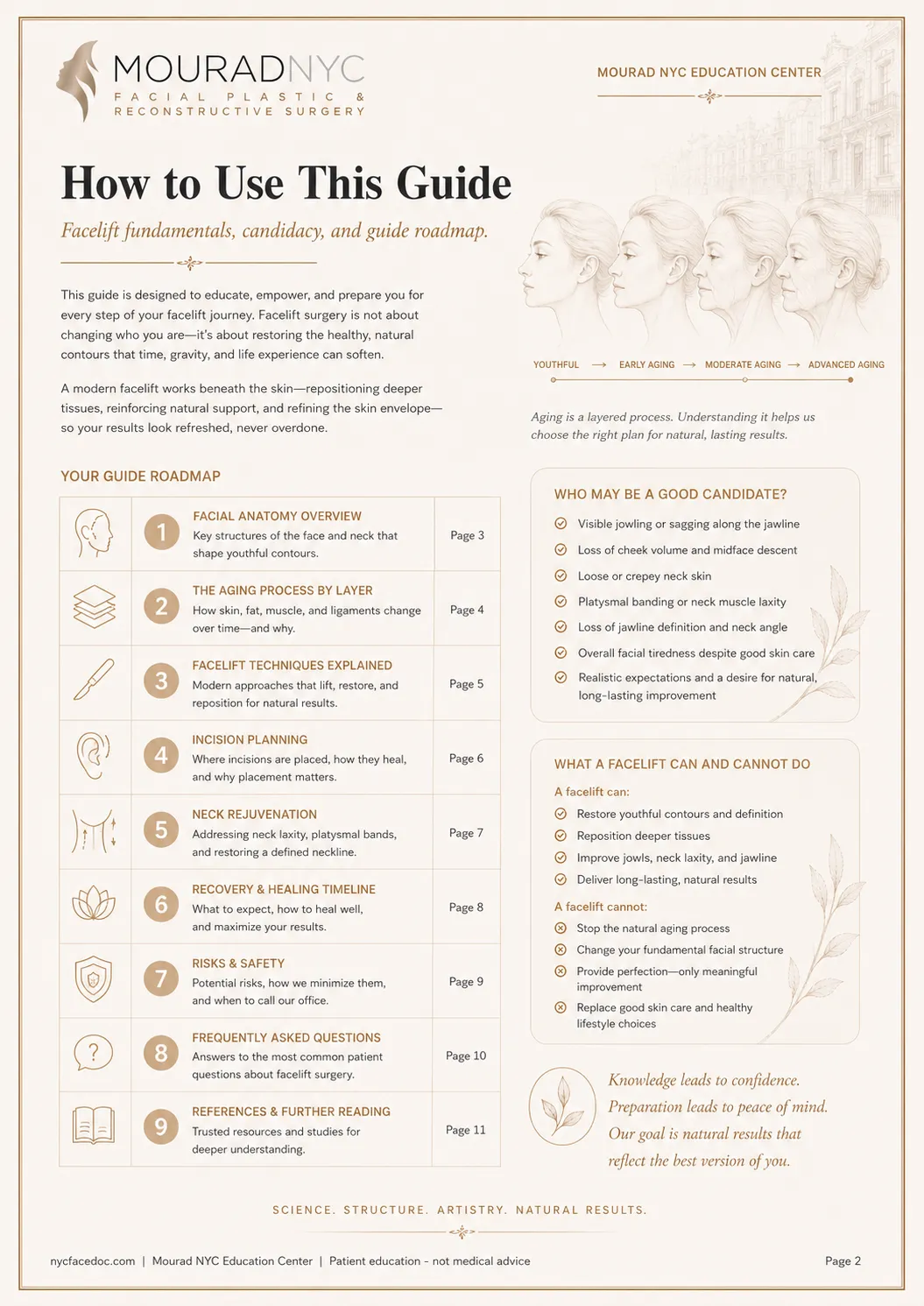
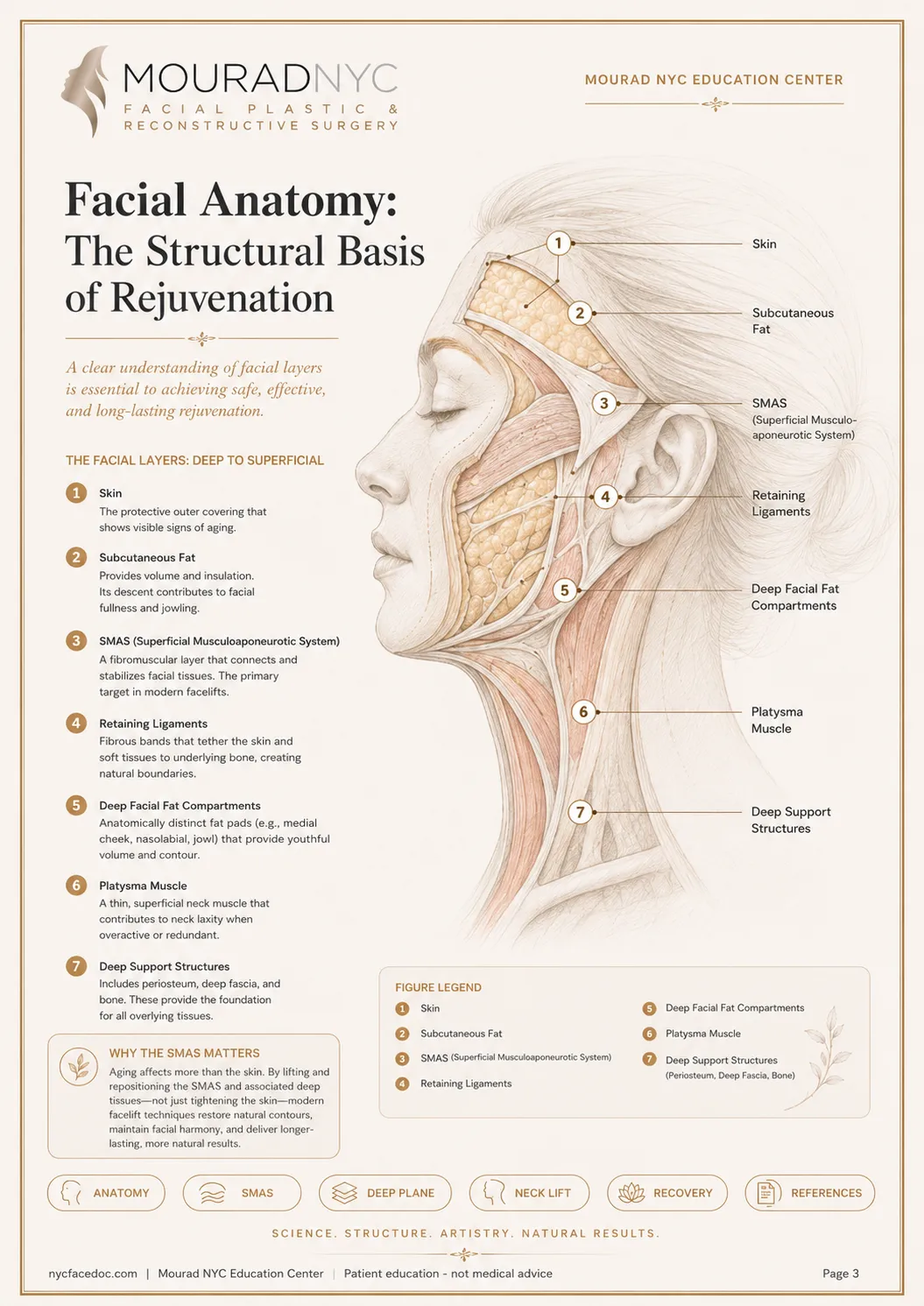
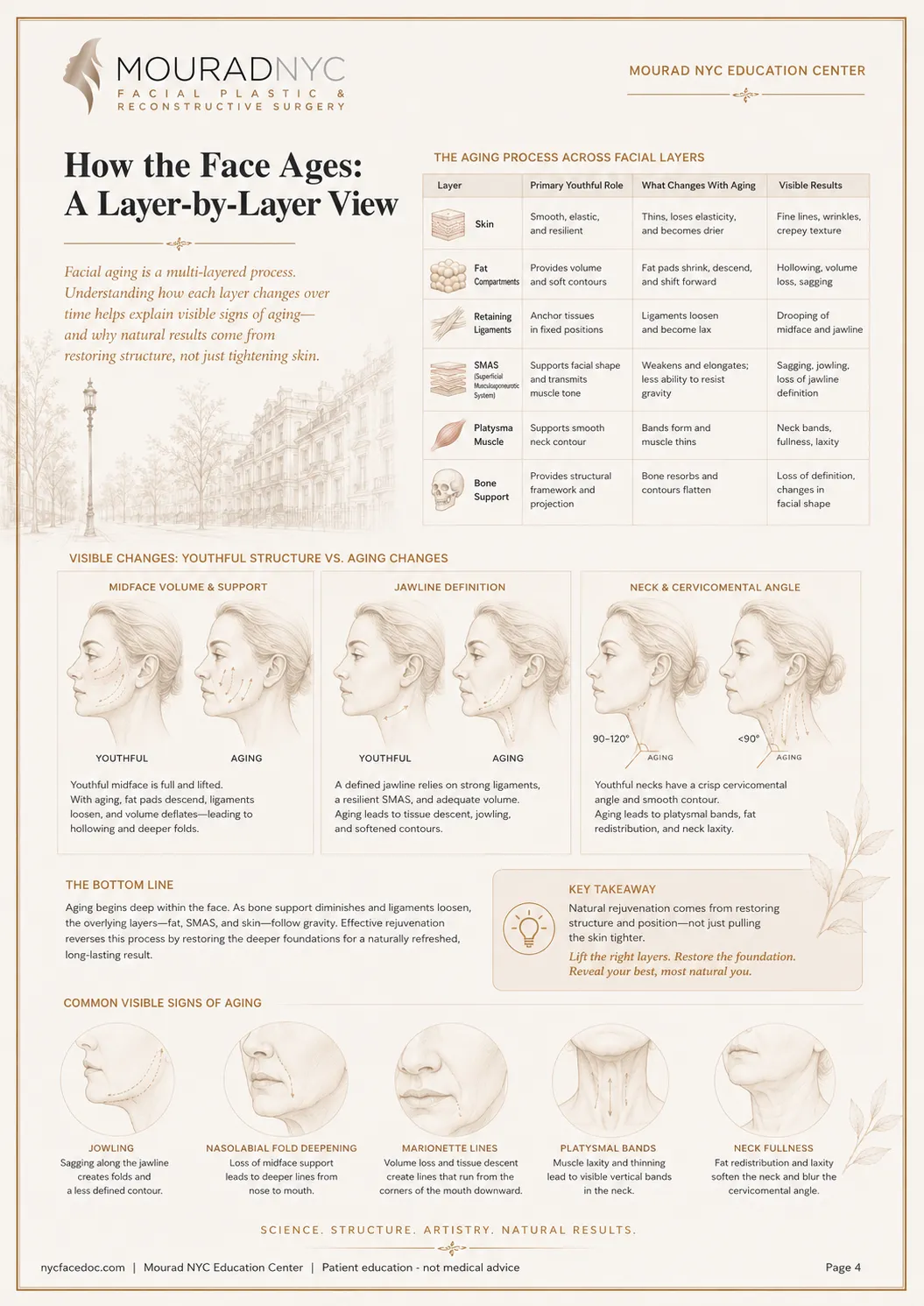
Facial aging is not one process and a facelift is not a universal answer. The surface layer is skin, which changes with ultraviolet exposure, collagen remodeling, pigment, and elasticity. Beneath it are fat compartments that can lose volume, become prominent, or descend. Deeper still is the SMAS and the muscle system that connects facial movement to the skin. The supporting skeleton and ligaments provide the fixed framework against which the mobile tissues age. A patient may have a little of each change, but the proportions are different from person to person.
Volume loss and tissue descent are not interchangeable. A hollow temple, cheek, or tear trough may reflect loss of fat or skeletal support, while a jowl usually reflects movement of soft tissue relative to the mandibular border. Adding volume to a descended cheek may improve a transition in one patient and make another face look heavier. Similarly, tightening skin cannot restore every lost contour. The first clinical task is to identify which layer is producing the patient's concern.
Skin quality, pigment, fine lines, and expression lines may remain after a lift because a lift repositions tissue rather than replacing skin biology. Sun protection, medical skin care, resurfacing, and selected injectables can complement structural surgery. They should be discussed as separate tools, not as evidence that one operation can correct every sign of aging.
The operations and what each one addresses
A facelift primarily addresses descent and laxity in the lower face: jowls, a softened jawline, and selected cheek or upper-neck changes. A neck lift focuses more directly on the skin, platysma, fat, and contour below the chin. Because the cheek, jawline, and neck transition into one another, the two operations are frequently considered together, but a neck-dominant plan or a facelift alone may be more appropriate in a particular patient.
A mid-face procedure is considered when cheek descent and the relationship of the cheek to the lower eyelid are the dominant concern. A brow lift addresses brow position and upper-face heaviness. Cosmetic eyelid surgery addresses selected excess skin, fat, or contour concerns; MouradNYC does not offer functional eyelid surgery for visual-field loss or true ptosis, which require an appropriate specialist. Chin or cheek augmentation changes projection and proportion rather than lifting every facial layer. Each operation has a distinct job.
The practical implication is that a patient should not choose an operation by the name of a celebrity result or an online checklist. A careful examination considers the face at rest and in motion, skin thickness, fat distribution, skeletal projection, neck anatomy, prior surgery, medical history, and the patient's definition of improvement.
Techniques, plainly
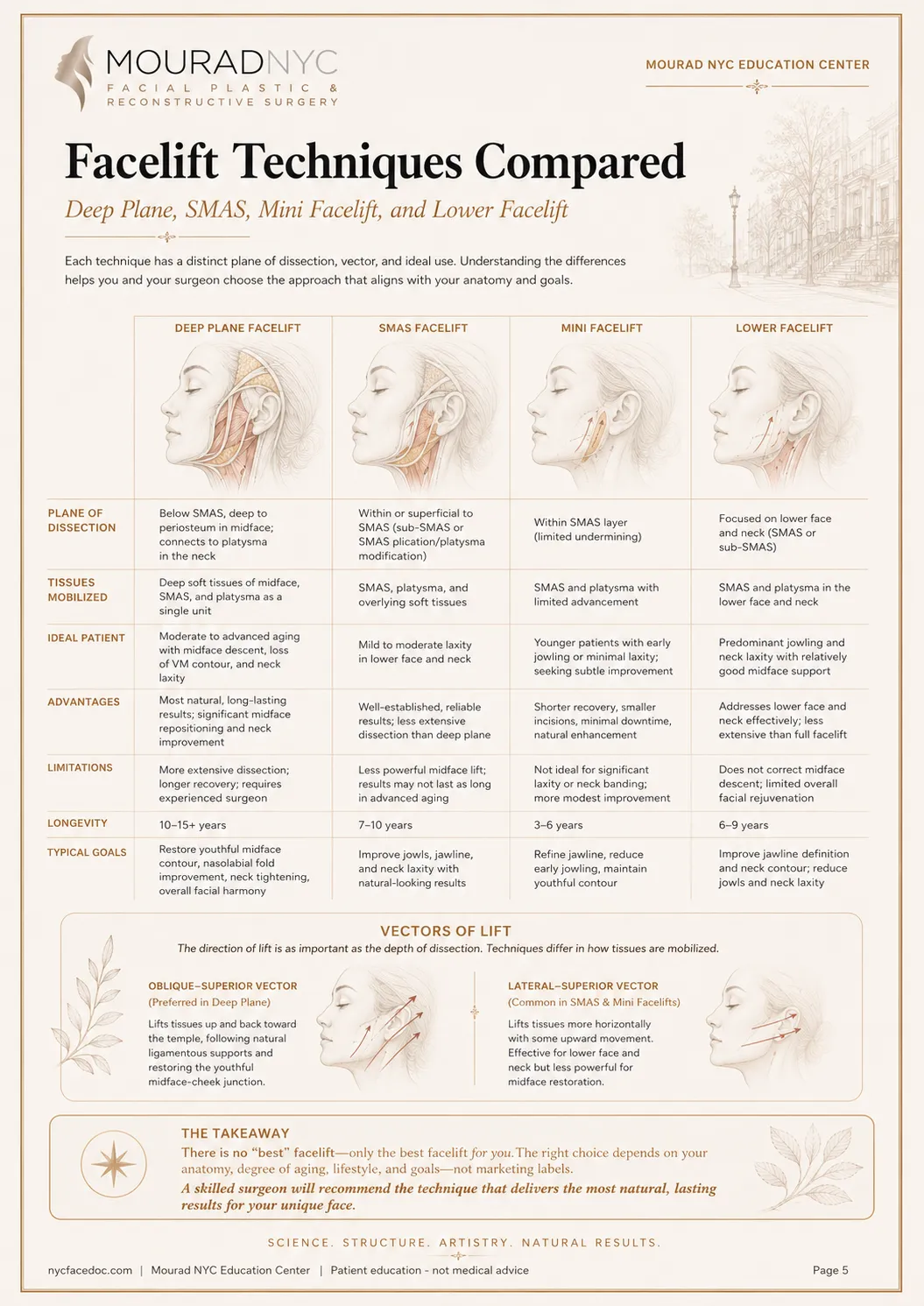
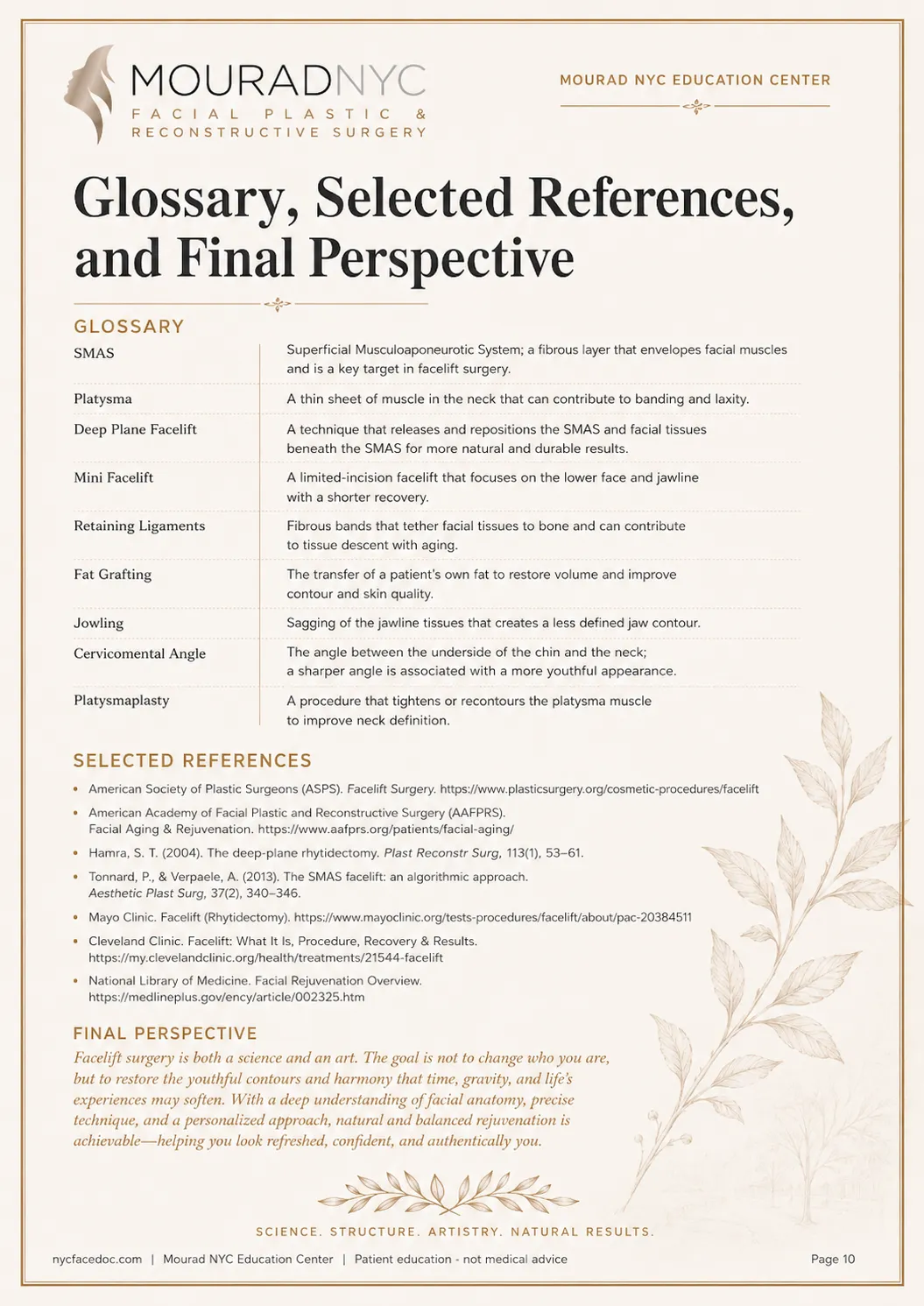
A SMAS facelift elevates the skin and then addresses the superficial musculoaponeurotic system by techniques such as plication or imbrication. A deep-plane facelift works beneath the SMAS and releases selected retaining ligaments so deeper tissues can move as a composite unit. These descriptions are useful only when they match the operation actually planned. Neither name guarantees a natural result, a fixed duration, or a particular recovery.
A short-scar or mini facelift can be sensible for carefully selected, earlier laxity. “Mini” should mean a limited operation for a limited problem, not a promise that a small incision can reproduce the correction of a comprehensive face-and-neck plan. A limited procedure may leave more skin or neck change untreated, and that is not a failure if it was explained and accepted before surgery.
The deep-plane-versus-SMAS comparison explains the anatomy and evidence more fully. Patients should ask what layer will be moved, whether the neck is included, how the surgeon protects the facial nerve, which incision pattern is planned, and which visible concerns are not expected to change.
Timing and sequencing
When several things bother a patient, sequence follows anatomy and priorities. The neck and lower face are often planned together when laxity crosses the jawline, while a brow or eyelid concern may be addressed separately or combined only when the health, operative time, and recovery plan make sense. A small chin may change the profile enough that augmentation deserves discussion before assuming that more lifting is needed.
Timing also means waiting when waiting improves safety. Active weight loss can change the skin envelope after surgery. An unstable medical problem, a major life stressor, or smoking that has not yet stopped may make postponement wiser. The goal is not to win a race to the operating room; it is to choose a stable moment when the patient can follow restrictions, attend follow-up, and judge the result patiently.
A cosmetic surgical consultation is $500. The full $500 may be credited toward surgery when the patient proceeds with and books surgery within 60 days. Payment is arranged directly with the practice; payment terms and any required deposit are reviewed when surgery is scheduled. Surgical investments vary with anatomy, procedure, anesthesia, facility, and combined procedures.
Anesthesia, setting, and preparation
Facelift surgery is performed in an appropriately accredited setting with an anesthesia plan matched to the patient and the operation. Both twilight anesthesia and general anesthesia may be offered. The choice depends on the scope of surgery, health, comfort, airway considerations, and the anesthesia assessment. Patients should disclose medicines, supplements, allergies, sleep concerns, nicotine use, and prior anesthesia problems before the date is set.
Drains are used case by case rather than automatically. Fibrin sealant may be used as needed. These are technical decisions and not a scorecard for one technique. Preparation also includes arranging transportation, help at home, prescriptions, comfortable clothing, and a quiet recovery space. Out-of-town patients should plan lodging and access to follow-up before traveling.
The consultation should produce a written plan that names the areas being treated, alternatives, expected downtime, risks, scar locations, follow-up, and what the operation cannot accomplish. A patient who leaves with only a technique label and no discussion of limits has not yet received enough information to make a considered decision.
Recovery in outline
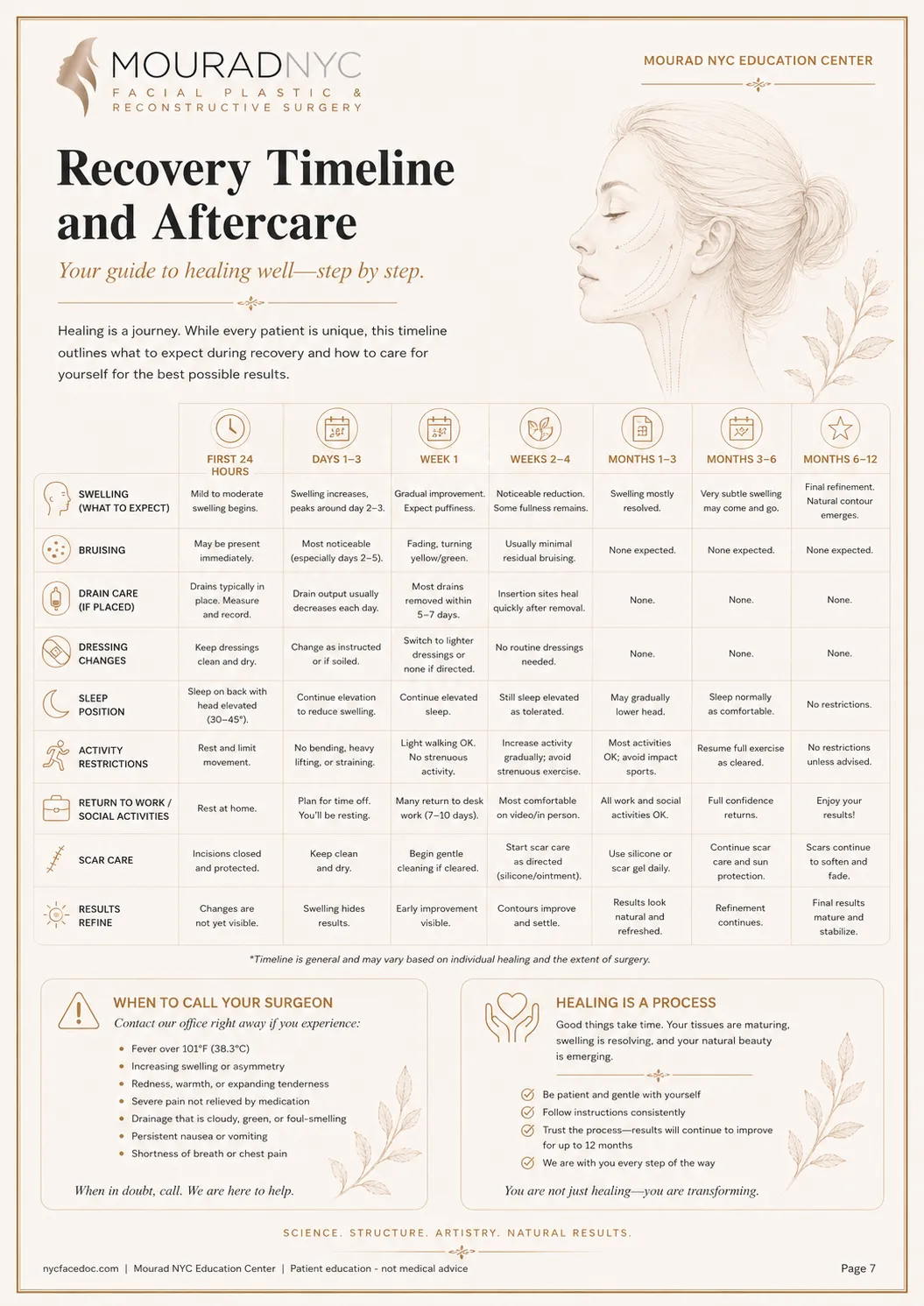
The first night is about supervision, hydration, medication instructions, head elevation, and recognizing the contact pathway if something feels wrong. Bruising and swelling are usually most visible during the first two weeks. Walking is often introduced early when the surgical team permits it, while bending, lifting, vigorous exercise, and contact activities wait for clearance. Numbness, tightness, firmness, and asymmetry can persist after the most obvious bruising fades.
Desk work and public-facing work have different timelines. A person working privately may perform quiet tasks before someone who appears on camera or meets clients. Makeup belongs only on healed skin and according to the surgeon's instructions. Travel and flying should be discussed individually because a flight soon after surgery can be uncomfortable and can complicate access to care.
A recovery guide is a map, not a promise. The dedicated facelift recovery timeline explains the usual sequence and warning signs. The written instructions from the operating team always take precedence over general education.
Scars and incision planning
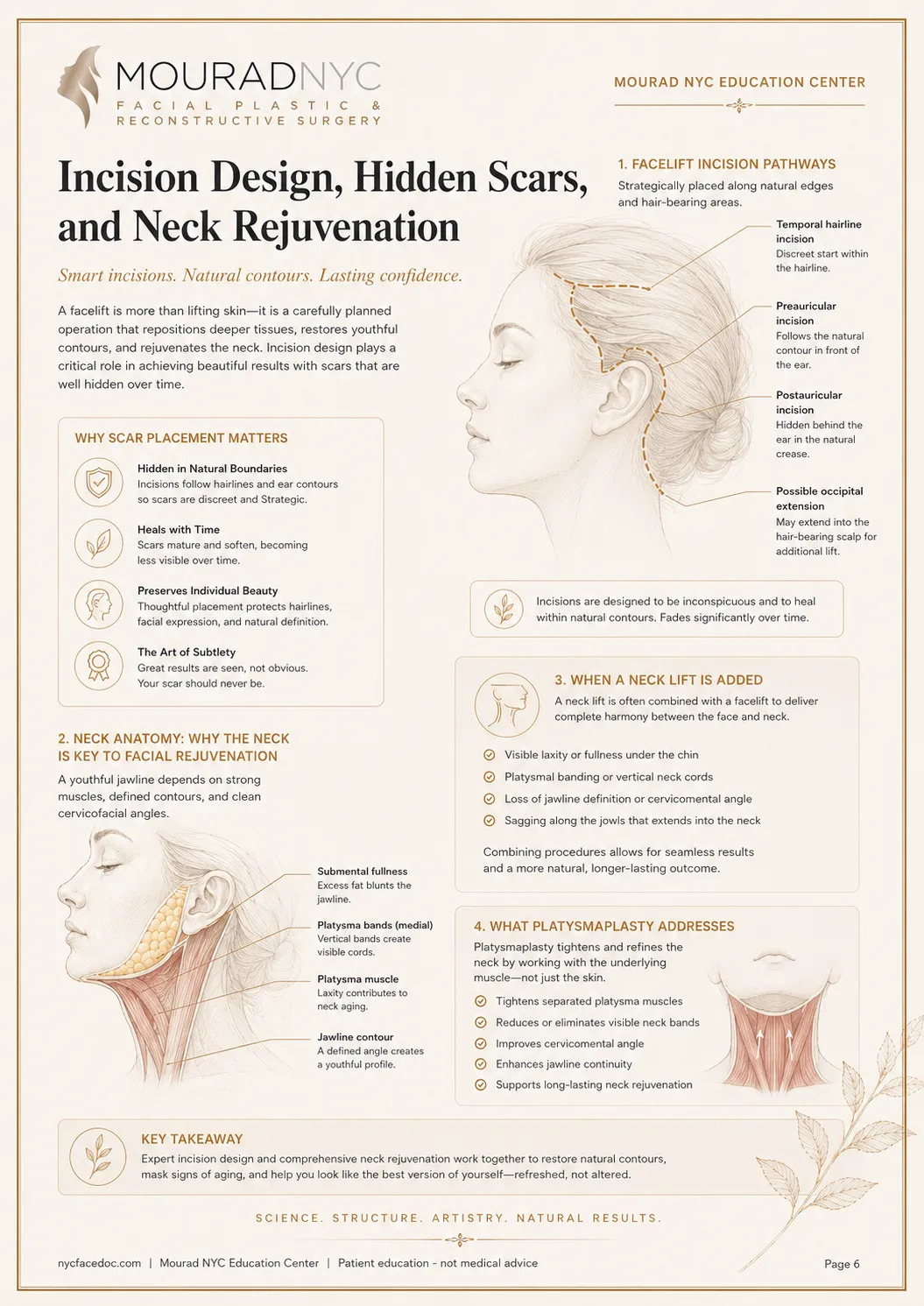
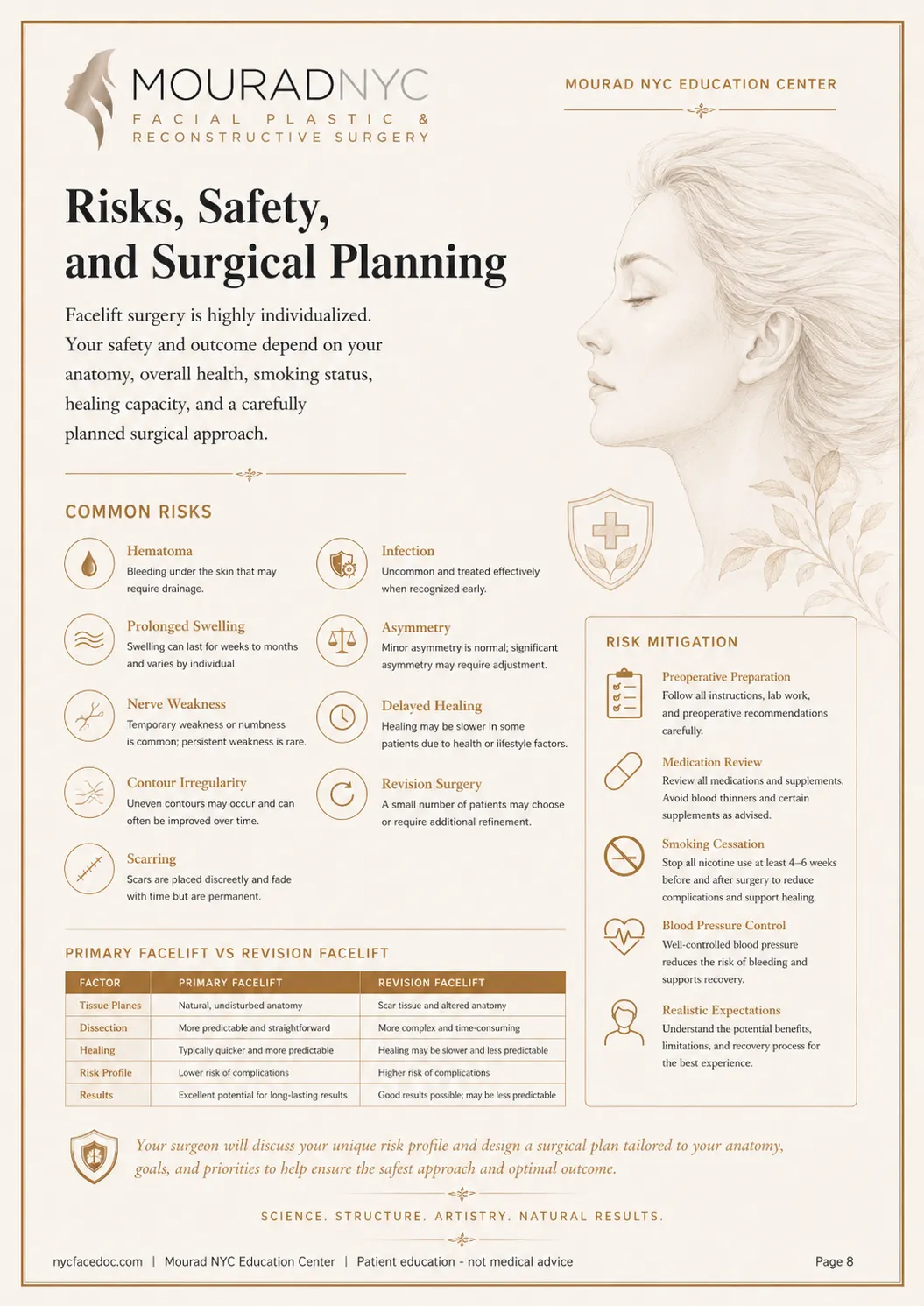
A facelift incision is a three-dimensional design around the ear, sideburn, hairline, and neck. Placement may follow natural creases in front of or around the ear and continue behind the ear into the hairline. The aim is a discreet mature scar, not an invisible scar. Skin tension, hair pattern, healing biology, nicotine, pigment, and sun exposure all influence the final appearance.
The earlobe and sideburn deserve explicit discussion. Excess tension can pull the lobe downward or shift hair-bearing skin. Men may need a plan that respects beard-bearing skin and shaving patterns. Early redness and firmness are normal possibilities, and scar maturation continues for many months. Silicone, taping, massage, and sun protection are used only when appropriate and after the surgeon confirms the incision is ready.
The dedicated scars and incisions guide covers placement, healing, and when a scar should be reassessed. Revision is not an automatic solution for an early scar; time and examination are important.
Cost in outline
A surgical investment reflects the operation, anatomy, operating time, anesthesia, facility, postoperative care, and whether the neck or another area is included. A headline number without a written scope is difficult to compare. The facelift cost guide explains how to read a plan and what questions to ask.
MouradNYC does not offer financing programs or represent third-party financing. Payment is arranged directly with the practice. Cosmetic surgery is generally self-pay, and the exact terms are reviewed when surgery is scheduled. A consultation can clarify what is being quoted, what is separate, and which choices would change the investment.
Cost is one part of the decision, not a substitute for credentials, relevant experience, facility standards, a clear plan, or an honest discussion of risks. A lower number is not automatically a better value, and a more extensive operation is not automatically the right one.
Choosing a surgeon and setting expectations
Review credentials that are relevant to facial surgery, not only a marketing title. Ask about training, board certification, facility, anesthesia, follow-up, and experience with faces and concerns resembling your own. A portfolio is most useful when the photographs are consistent, the lighting is understandable, and the surgeon can explain what was and was not changed. Patient photographs are not guarantees and should never replace a clinical examination.
A good consultation is specific about anatomy. It explains why a brow, eyelid, chin, cheek, neck, or skin treatment may or may not be relevant. It addresses asymmetry, nerve injury, bleeding, infection, wound-healing problems, altered sensation, scars, recurrence, revision, and the possibility of an outcome that does not meet expectations. It also explains what surgery cannot fix, including every line, pigment change, and future aging.
The appropriate plan may be a comprehensive facelift, a neck-dominant operation, a limited procedure, cosmetic eyelid or brow surgery, non-surgical care, observation, or no surgery. The safest decision is the one that matches the patient's anatomy, health, priorities, and willingness to accept recovery. This guide is education, not medical advice; final recommendations require an in-person evaluation and informed consent.
Questions to bring to the consultation
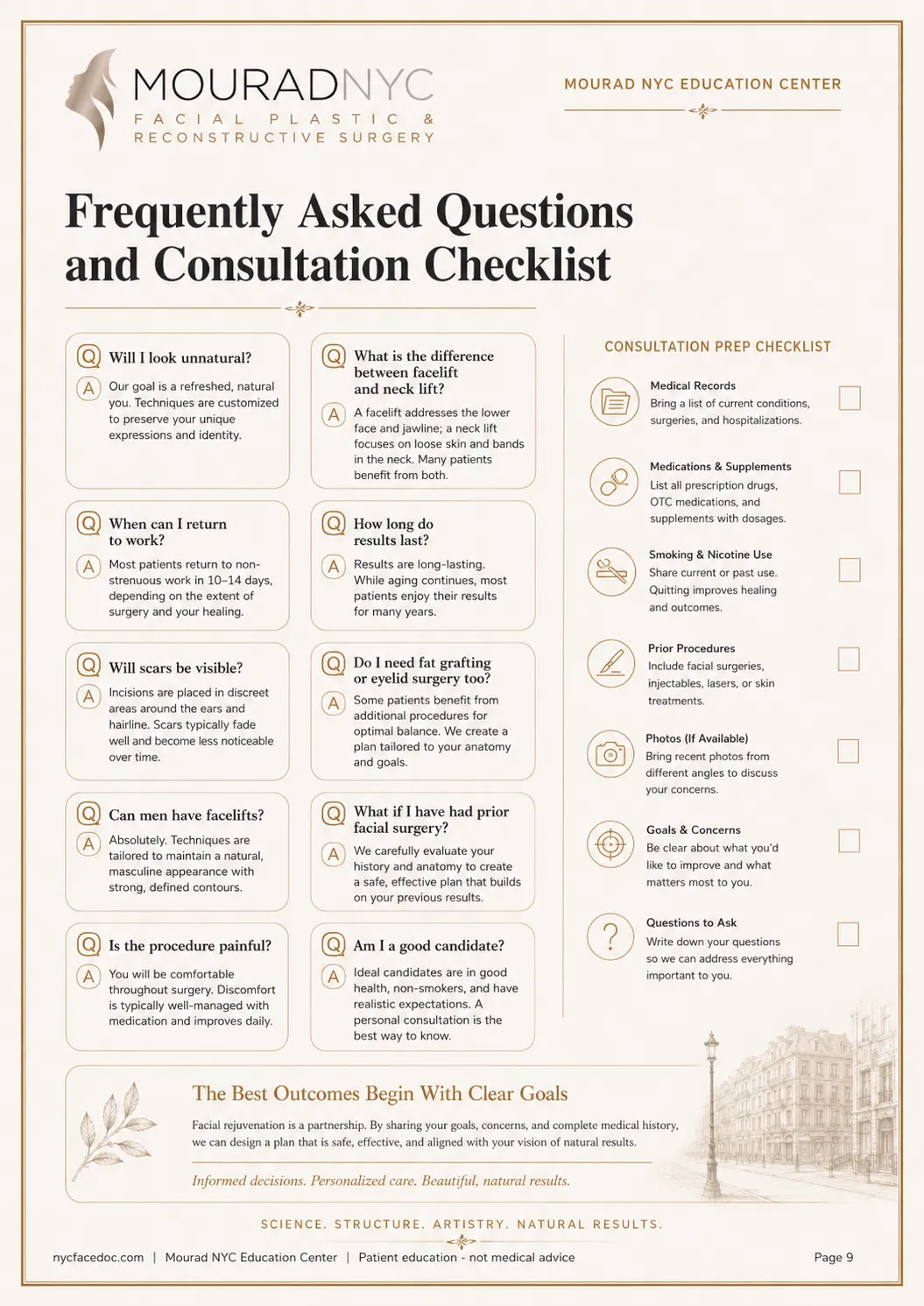
Bring a short list of the changes you want to see, the changes you do not want, and the dates that matter in your life. Ask which anatomic layer is responsible for each concern, which operation addresses it, and what will remain unchanged. Ask whether the neck, chin, cheek, brow, or skin quality affects the recommendation. A plan that answers those questions is more useful than a plan that only names a technique.
You can also ask where the incisions will sit, how hair and the earlobe will be protected, whether drains or fibrin sealant are expected, which anesthesia options are available, and how follow-up works if you travel. Ask what symptoms should prompt an urgent call and when work, exercise, driving, makeup, and flights may be considered. These practical details are part of informed consent, not administrative extras.
Bring a medication list and information about prior facial procedures, fillers, significant weight changes, allergies, nicotine use, and any history of difficult scars or anesthesia. If you have photographs that show a concern in motion or at a different weight, they may help explain what you notice, but the examination remains decisive. The most useful consultation is collaborative: the surgeon supplies anatomy and risk information, and the patient supplies priorities, context, and enough time to decide carefully.
Do not hesitate to ask for plain-language explanations or a second visit before deciding. Understanding the plan is part of safety.
You should also understand who provides postoperative care, how quickly questions are answered, and where an urgent examination would occur if you are out of town. Ask whether photographs, visits, or additional treatment are included in the written plan. Clear logistics reduce avoidable stress and make it easier to follow the medical instructions during the period when swelling, bruising, and uncertainty are greatest.
Before scheduling, repeat the plan in your own words: the target area, the expected improvement, the limits, the recovery, and the warning signs. If any part remains unclear, pause and ask. Informed consent works best when the patient can explain the decision without relying on a slogan.
Finally, ask what the surgeon would recommend if you chose not to have surgery now. Observation, skin care, non-surgical treatment, a staged plan, or a different operation may all be reasonable. A consultation is successful when you understand the choices and their trade-offs well enough to make a decision without pressure.