Nose · Editorial Journal
Preservation Rhinoplasty Philosophy: What It Means for Modern Nose Surgery
The contemporary shift from reduction toward preservation — what it means structurally, what it offers patients, and where its limits lie.
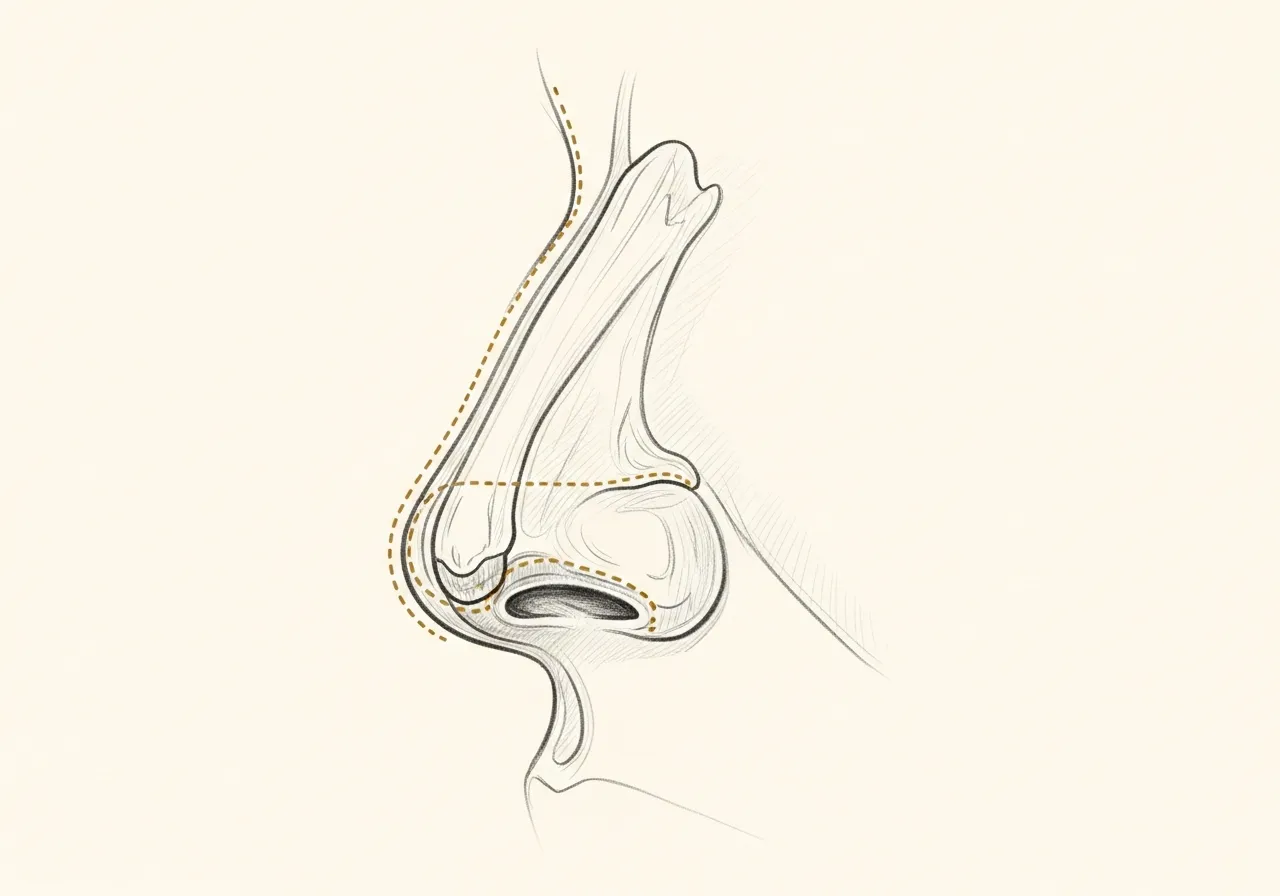
The traditional reductive rhinoplasty of the twentieth century treated the nose as a sculpture to be carved — dorsum lowered, tip reduced, structure removed. The results often looked good in the short term and uneven over decades. Preservation rhinoplasty represents a different premise: the goal is to refine while preserving native anatomy that took a lifetime to form.
What 'preservation' actually means
Preservation rhinoplasty is not a single technique. It is a structural philosophy expressed through several specific maneuvers — preserving the dorsal aesthetic lines, retaining the keystone area where bone meets cartilage, and adjusting nasal height through bony work below the dorsum rather than by removing the dorsum itself.
The internal counterpart — septal preservation, retention of supportive cartilage at the lower lateral region — is just as central. When done correctly, the operation alters appearance without disrupting the structural lattice that supports breathing and long-term shape.
Why the philosophy is shifting
Two converging forces have driven the shift. First, long-term outcome studies on traditional reductive rhinoplasty have shown structural complications that emerge a decade or more after surgery — inverted-V deformity, dorsal irregularities, tip drop. Second, revision rhinoplasty has become a sub-specialty in its own right, with surgeons routinely rebuilding what previous operations removed.
Preservation is a response to both: an effort to make the first operation more durable, and to leave intact the anatomy that future surgeons (or the same surgeon a decade later) might need.
Candidate selection
Preservation rhinoplasty is best suited to patients with a smooth, mild-to-moderate dorsal convexity, good underlying skin quality, and a generally well-supported nose that needs refinement rather than rebuilding. Patients with previous nasal trauma, marked asymmetry, very thick or very thin skin, or a need for major structural change may be better served by a structural rhinoplasty using grafts. These factors are what determine preservation rhinoplasty candidacy, which is confirmed in person.
The honest version of this conversation matters. Not every nose is a candidate for preservation, and a surgeon who applies the technique to every patient is not practicing preservation rhinoplasty — they are using a single method without regard for anatomy.
Candidacy is ultimately an in-person determination. Our Preservation Rhinoplasty NYC procedure page outlines who tends to benefit, how recovery unfolds, and representative gallery cases.
"Preservation is a philosophy of restraint. The patients best served by it are the ones whose anatomy invites restraint — and the surgeon's job is to know the difference."
What the recovery looks like
Recovery from preservation rhinoplasty is broadly similar to traditional rhinoplasty — an external splint for the first week, bruising and swelling that resolve over the first two weeks, and continued refinement of the contour over months. Where preservation often differs is in how the result evolves over years rather than in the immediate post-operative period.
For patients weighing this approach, a preservation rhinoplasty consultation reviews candidacy, cost, recovery, and gallery cases in detail.
Continue Reading