Nose · Rhinoplasty · In-Office Tip Elevation
Nasalift™: 15-Minute In-Office Nasal Tip Lift in NYC
Nasalift™ is a focused in-office nasal tip lift under local anesthesia, about 15 minutes, for selected patients with a drooping tip.
ABFPRS
Facial Plastic & Reconstructive Surgery
ABOto
Otolaryngology — Head & Neck Surgery
AAFPRS
Fellowship Director

In Consultation
"A focused, 15-minute in-office nasal tip lift for selected patients."
A Note from Dr. Mourad
"Some patients do not need every part of the nose changed. Their concern is very specific: the tip sits low, or it drops when they smile. Nasalift™ is designed for that focused problem — a controlled elevation of the tip through a small internal approach, without the recovery of formal rhinoplasty."
— Moustafa Mourad, MD, FACS
Medically reviewed by Moustafa Mourad, MD, FACS — dual board-certified in Facial Plastic & Reconstructive Surgery and Otolaryngology–Head & Neck Surgery; Clinical Assistant Professor of Otolaryngology at New York Medical College; AAFPRS Fellowship Director. The medical review identifies the anatomy, evidence, limits, and questions patients should understand before choosing a procedure.
Last reviewed: June 2026
Nasalift™ at a glance
- Treatment setting: in-office.
- Anesthesia: local anesthesia.
- Procedure time: about 15 minutes.
- Incision: small internal membranous septum incision.
- Sutures: two to three internal support sutures.
- Visible external scar: none expected.
- Bruising: varies by patient and procedure details.
- Swelling: varies and is reviewed during consultation.
- Downtime: individualized according to healing and activity demands.
- Return to routine: discussed individually with postoperative guidance.
Overview
What is Nasalift™?
Nasalift™ is an in-office procedure designed to elevate and support a drooping nasal tip in carefully selected patients. It is not intended to reshape every part of the nose. Instead, it focuses on one of the most influential relationships in profile balance: the position of the tip relative to the bridge, columella, and upper lip.
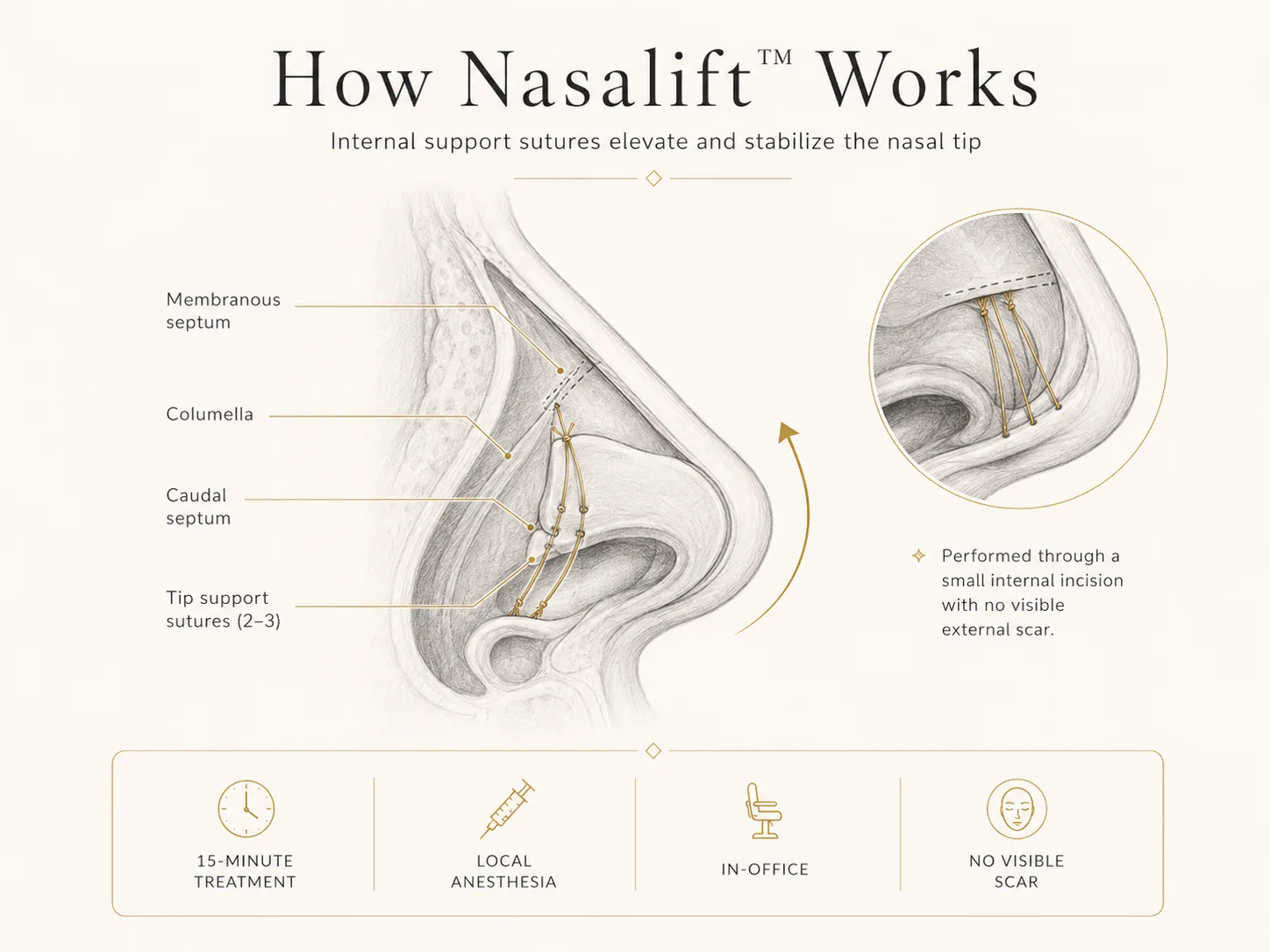
A small incision is made internally in the membranous septum, the soft tissue between the caudal septum and the columella. Through this internal access point, two to three support sutures are placed to set the columella back at a higher position and slide it upward along the caudal septum. This changes the resting position of the tip, providing controlled elevation and support without an external incision.
For the right patient, a relatively small change in tip position can produce a meaningful improvement in the way the nose relates to the rest of the face. A low tip can make the nose look longer and can make a dorsal hump appear more dominant. Elevating the tip may improve that balance even though the bridge itself is not being reduced.
Nasalift™ is a focused option for selected low-tip or dynamic tip-droop concerns. It does not directly remove a dorsal hump, narrow the bridge, reconstruct the airway, or replace formal rhinoplasty when broader structural change is needed.
The Concept
A subtle change with an outsized effect on profile balance
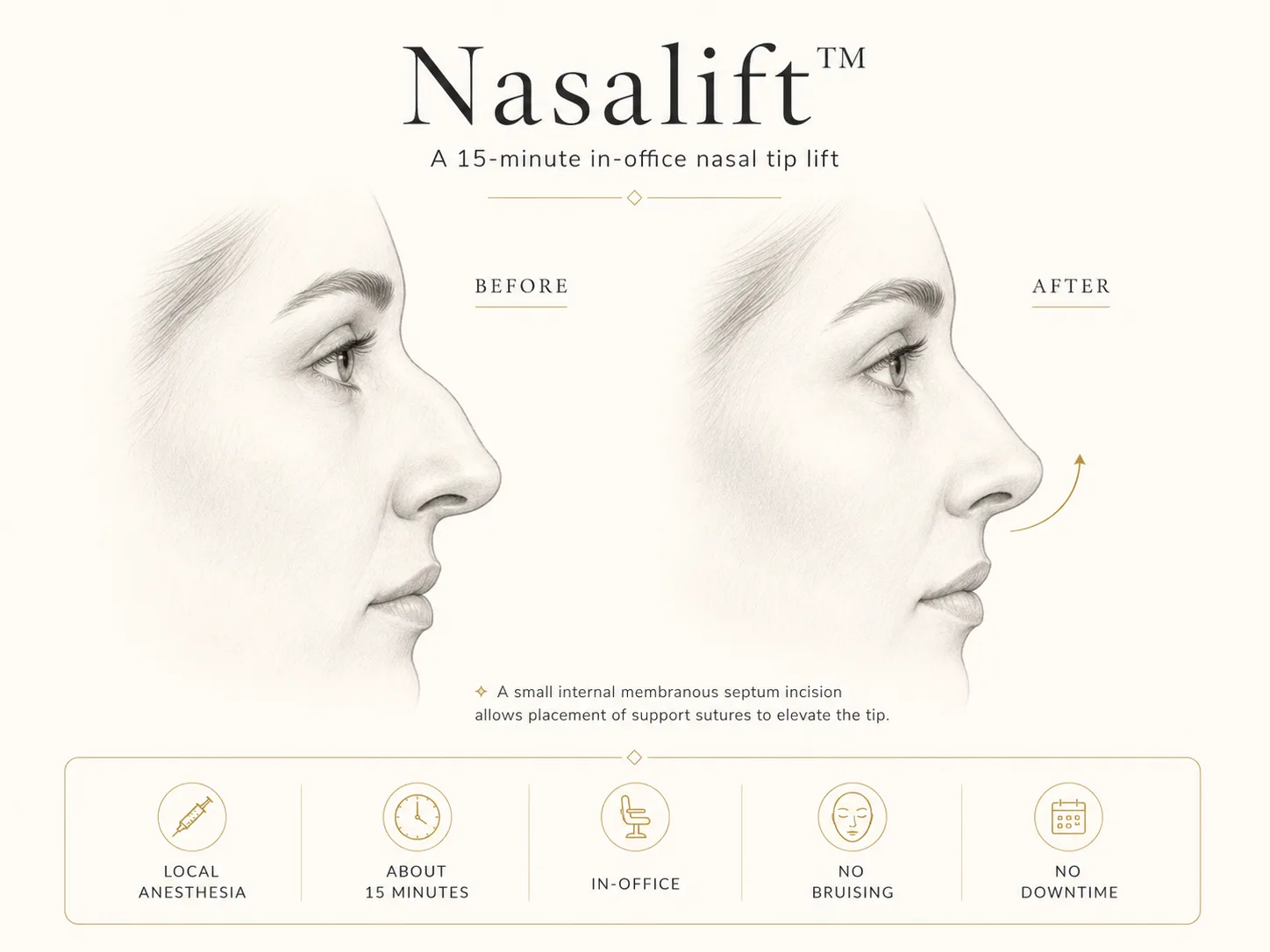
The illustration below is conceptual — it is educational art, not a patient result. It shows the principle behind the procedure: when a low tip is elevated and supported, the nose can appear shorter and better balanced in profile, and a dorsal hump can appear less dominant even though the bridge itself has not been changed.
Nasalift™ does not directly remove a dorsal hump. In selected patients, elevating the tip changes the visual relationship between the tip and the dorsum, which may reduce the apparent prominence of the hump. Whether that visual effect is achievable for a given nose is an anatomical question answered in consultation.
The Concern
“My nose droops when I smile”
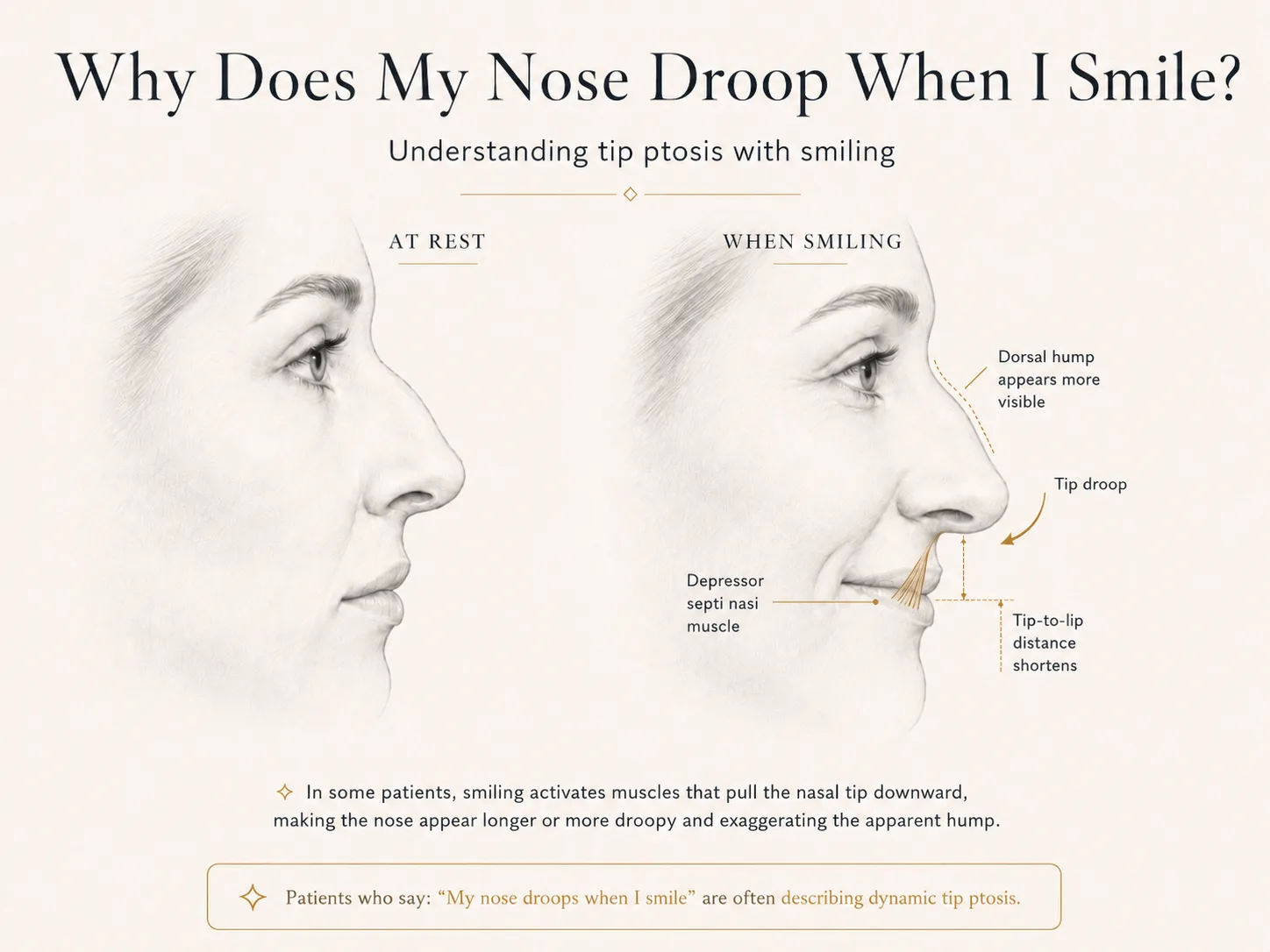
Many patients do not initially use terms such as “tip ptosis” or “tip rotation.” They describe what they see: “My nose looks fine until I smile.” “The tip drops in pictures.” “My hump looks bigger when I smile.” “My nose looks longer when I smile.” “The space between my nose and upper lip disappears.”
These observations may reflect dynamic nasal tip ptosis — a downward change in tip position during facial animation. Smiling activates several muscles around the upper lip and base of the nose. In some patients, the depressor septi nasi muscle and related soft-tissue attachments pull the columella and tip downward.
As the tip descends, several visual changes can happen at once: the nose appears longer; the tip appears heavier or more droopy; a dorsal hump can look more prominent because the tip is now lower in relation to the bridge; the visible tip-to-upper-lip distance can shorten; and the smile and nose can appear crowded together in profile photographs.
The important point is that the bridge has not necessarily changed. The apparent worsening of the hump may be caused partly by the tip moving downward. This is why a treatment plan should evaluate the nose both at rest and while smiling. The muscle is not the sole cause in every patient — cartilage support, caudal septal anatomy, columellar attachments, soft tissue, and prior surgery may also contribute. For a fuller explanation, see Why Does My Nose Droop When I Smile? in the Journal.
The Technique
How Nasalift™ works
The procedure follows a deliberate sequence, performed entirely in the office under local anesthesia:
- —Local anesthesia. The treatment area is numbed with local anesthesia. The goal is to keep the patient comfortable while allowing the procedure to be performed efficiently in the office. Patients may feel pressure or movement, but the area is anesthetized before the supporting sutures are placed.
- —Small internal incision. A small incision is made in the membranous septum. Because the incision is internal, there is no visible external scar across the columella.
- —Two to three support sutures. Two to three sutures are placed to reposition and stabilize the columella at a higher point along the caudal septum. The exact number and configuration are selected according to the patient's anatomy and the degree of elevation needed.
- —Controlled elevation of the tip. As the columella is repositioned upward on the caudal septum, the nasal tip rotates and elevates. The goal is not an exaggerated or “turned-up” nose. The goal is a subtle change that improves support and restores a more balanced relationship among the tip, bridge, and upper lip.
- —Immediate assessment. Because the procedure is performed in the office and the change is focused, the new tip position can be assessed immediately. Final appearance still depends on individual anatomy, tissue response, and healing.
Candidacy
Who may be a good candidate?
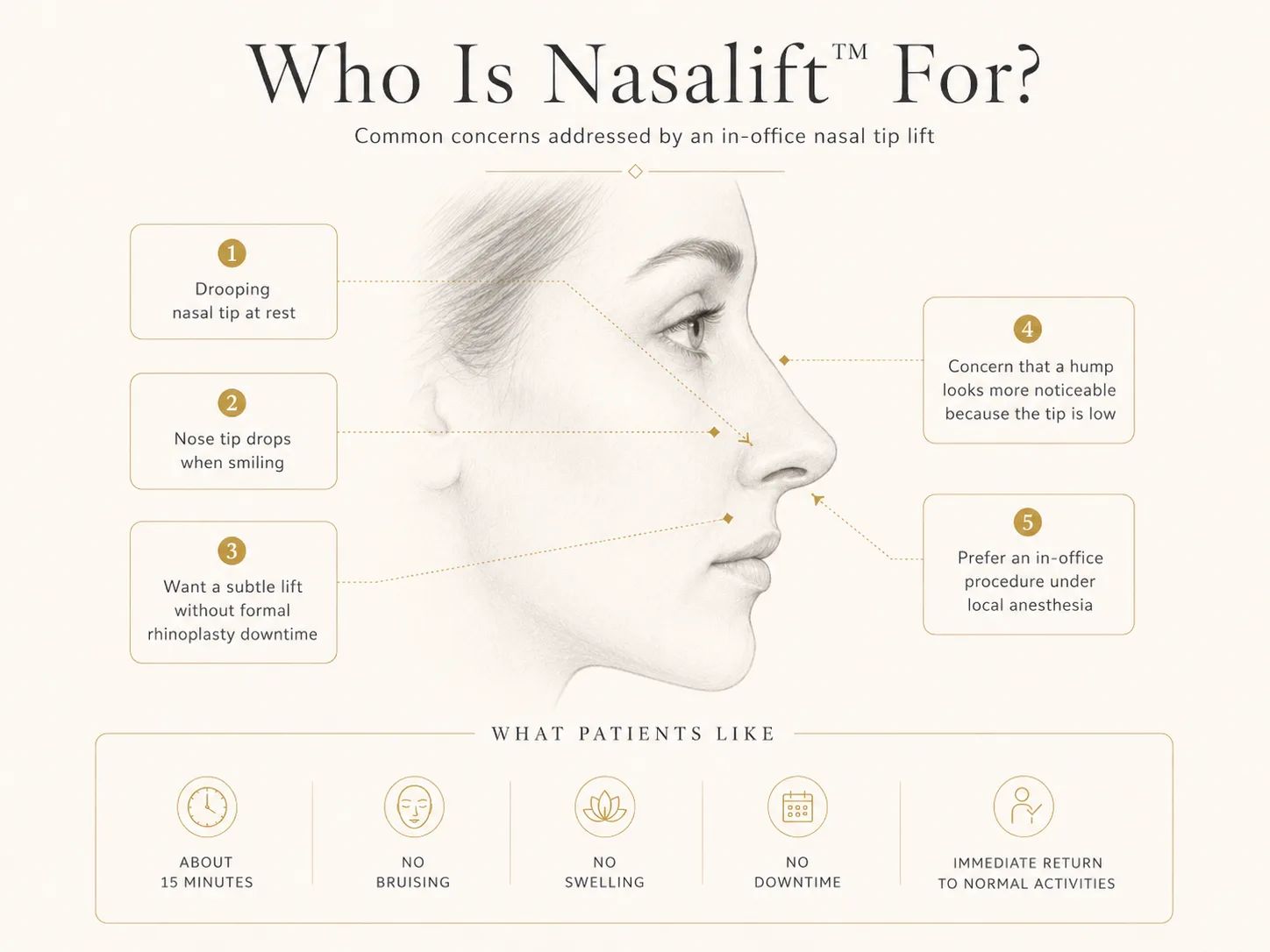
Nasalift™ may be appropriate for a patient who:
- —has a mildly or moderately drooping nasal tip
- —notices that the tip drops further when smiling
- —feels the nose looks longer in smiling photographs
- —feels a dorsal hump looks more prominent because the tip sits low
- —wants a subtle change rather than comprehensive nasal reshaping
- —prefers an in-office procedure under local anesthesia
- —understands that the procedure focuses on tip elevation rather than every component of the nose
- —has anatomy that can be safely and predictably supported with the described suture technique
- —has realistic expectations about the degree of change
The Evaluation
What happens during the consultation?
A consultation is essential because similar-looking concerns can arise from different anatomy. A low tip may reflect weak cartilage support, a long caudal septum, skin-soft tissue characteristics, prior surgery, muscle pull, or a combination of factors. The correct treatment depends on the cause.
The consultation begins with the patient's own description of the problem. Dr. Mourad evaluates the nose at rest, in profile, from the front, and during smiling. Photographs or videos that show the concern in motion can be useful because dynamic tip droop may be less obvious during a static examination. The examination considers:
- —resting tip rotation and projection
- —how far the tip descends with smiling
- —strength and shape of the lower lateral cartilages
- —columellar position
- —caudal septal anatomy
- —the relationship between the bridge and tip
- —skin thickness and soft-tissue behavior
- —prior nasal surgery or trauma
- —breathing symptoms
- —whether the concern is isolated or part of a broader rhinoplasty problem
The Visit
What to expect on the day of treatment
The goal of the consultation is not simply to decide whether the tip can be lifted. It is to decide whether lifting the tip alone will address what the patient actually dislikes.
Nasalift™ is performed in the office. After the treatment plan is reviewed, local anesthetic is administered. A small internal incision is made in the membranous septum, and two to three support sutures are placed to reposition the columella higher along the caudal septum. The tip position is assessed, the internal incision is managed, and the patient receives individualized aftercare instructions.
The procedure itself generally takes about 15 minutes, although total appointment time may be longer to allow for preparation, local anesthetic, assessment, and post-procedure instructions.
Indications
What can Nasalift™ improve?
Nasalift™ may help selected patients with:
A drooping nasal tip at rest
A low resting tip can make the nose appear long, heavy, or less defined. Elevating the tip may improve rotation and profile balance.
A nasal tip that drops when smiling
For patients with dynamic tip ptosis, the procedure may reduce the degree to which the tip descends during a smile by improving support and changing the resting position of the columella-tip complex.
A dorsal hump that appears more prominent because the tip is low
Nasalift™ does not shave or remove the hump. However, raising the tip can alter the visual relationship between the dorsum and the tip. In selected patients, this makes the hump appear less dominant.
A nose that appears longer in profile
Tip elevation can shorten the visual length of the nose and improve the nasolabial relationship without changing the entire nasal framework.
A patient seeking a focused alternative to full rhinoplasty
Some patients want a small, targeted improvement and do not need or want comprehensive nasal surgery. Nasalift™ may fit that goal when the anatomy is appropriate.
Compare with rhinoplasty →These benefits depend on proper patient selection. A quick procedure is not automatically the right procedure for every nose.
An Established Academic Authority
Double board certification. Fellowship director. Published author. A surgeon's surgeon.
ABFPRS
Board Certified
American Board of Facial Plastic & Reconstructive Surgery
ABOto
Board Certified
American Board of Otolaryngology — Head & Neck Surgery
NYMC
Clinical Assistant Professor
Otolaryngology · Clinician Scholar Pathway
AAFPRS
Fellowship Director
American Academy of Facial Plastic and Reconstructive Surgery
Textbook
Published Author
Contributions to the academic literature of facial plastic surgery
Dual board certification in both Facial Plastic & Reconstructive Surgery and Otolaryngology — Head & Neck Surgery.
Before & After
Nasalift™ example cases
Documented Nasalift™ cases from the practice gallery show before-and-after lateral profile views at rest and while smiling. Photographed with written consent on file. Results vary by patient; these cases are representative, not predictive.
Nasalift™ ·
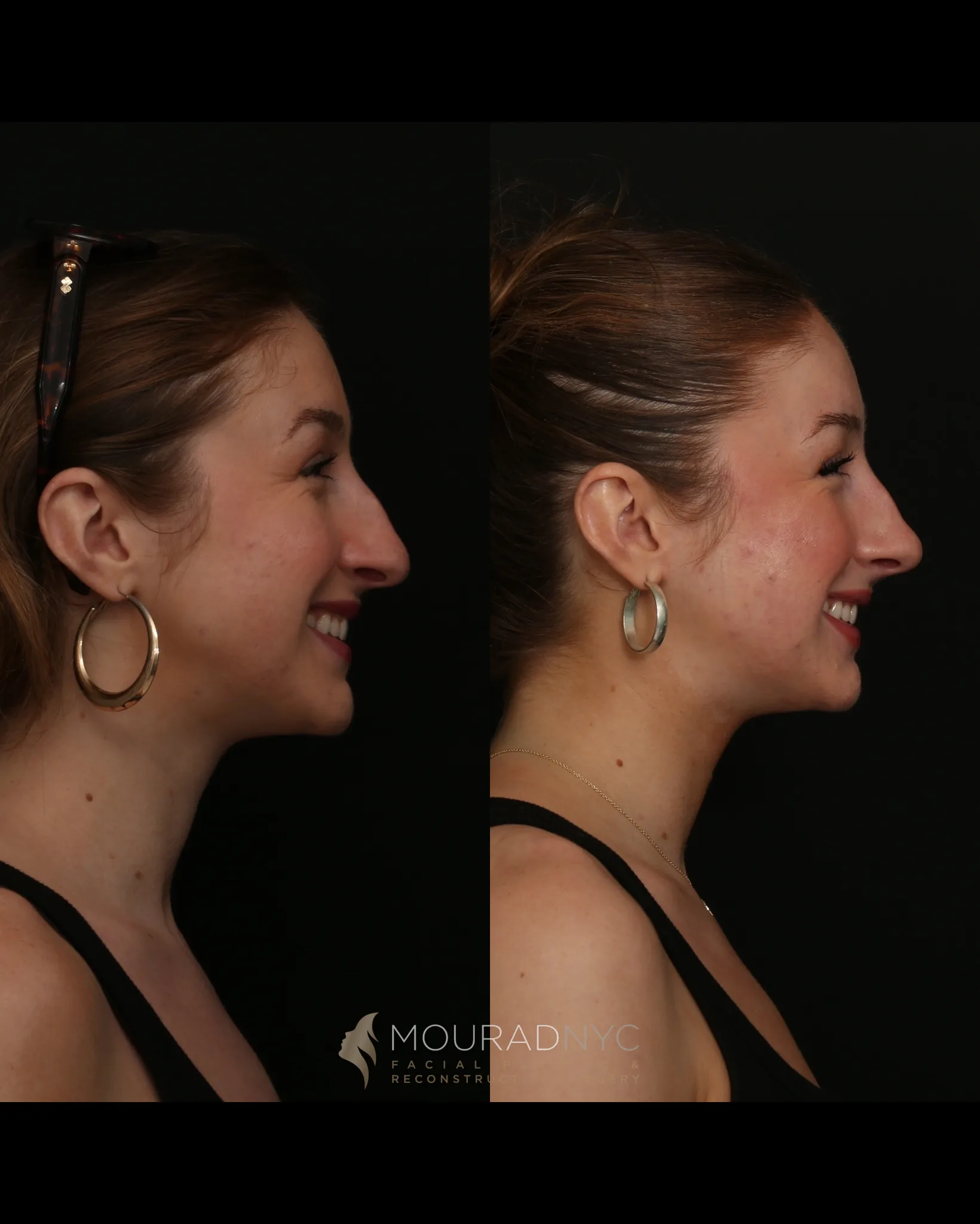
Nasalift™ performed to elevate and support the nasal tip in a selected patient. Shown in a smiling right lateral profile comparison before and after the procedure; photographed in standardized studio conditions with written consent on file. Results vary by patient; this case is representative, not predictive.
Nasalift™ · Female
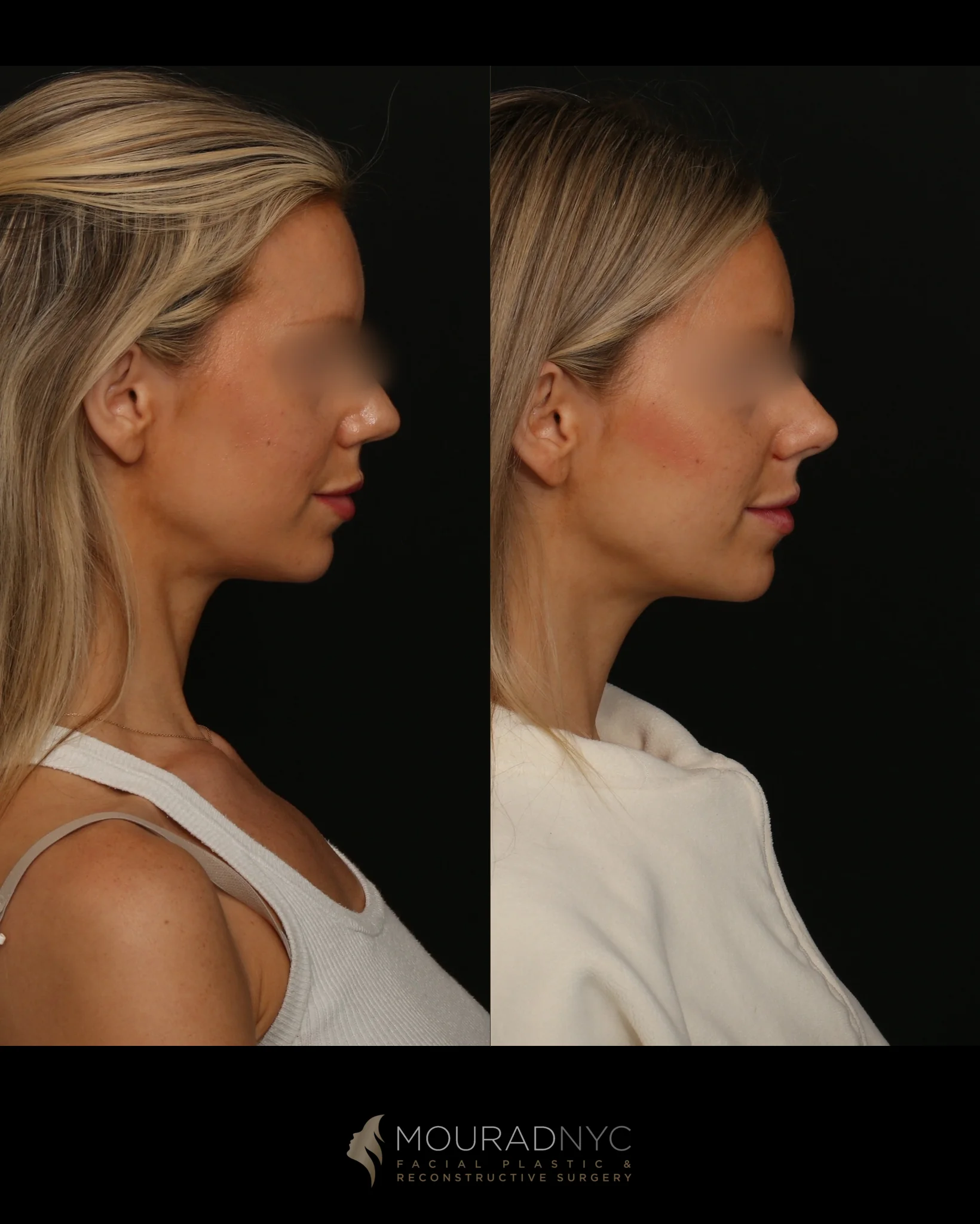
Before-and-after right lateral profile photographs of a Nasalift™ patient at rest and while smiling. The left half of each comparison is before and the right half is after. Eyes have been blurred for privacy; written photographic consent is on file. Individual results vary; these photographs do not predict another patient's outcome.
Pre and post-operative comparison · Photographed in standardized studio conditions · Written consent on file
An Honest Note
A tip concern is not always a full rhinoplasty concern
A low or drooping nasal tip may prompt a different discussion from a bridge hump, a wide nasal base, or a breathing problem. Nasalift™ is a focused option for selected tip-elevation concerns; it should not be described as a substitute for comprehensive reshaping or structural reconstruction.
When the concern is nostril width or flare, ask about an alar-base assessment. When several parts of the nose are involved, the rhinoplasty consultation provides a broader starting point. Direct hump reduction, substantial bridge narrowing, major tip reshaping, correction of significant asymmetry, changes in projection, reconstruction of weak or previously altered cartilage, revision after prior rhinoplasty, correction of a crooked or post-traumatic nose, and septal or nasal valve work for breathing may require a formal rhinoplasty.
Nasalift™ is distinct from selective temporary botulinum toxin treatment for dynamic nostril flaring: Nasalift™ is a permanent surgical solution performed without Botox or filler, while botulinum toxin does not correct a structurally wide or permanently flared nostril.
Side by Side
Nasalift™ compared with rhinoplasty
The two procedures address different scopes of concern. This comparison is educational — the right choice depends on individual anatomy and goals, determined in consultation.
| Nasalift™ | Formal rhinoplasty | |
|---|---|---|
| Primary goal | Focused nasal tip elevation and support | Comprehensive reshaping and/or functional reconstruction |
| Setting | Office | Operating room / surgical facility |
| Anesthesia | Local anesthesia | Usually general anesthesia, depending on the plan |
| Typical procedure time | About 15 minutes | Several hours, depending on complexity |
| Incision | Small internal membranous septum incision | Open or closed rhinoplasty incisions, depending on the operation |
| Downtime | Little to none | Traditional rhinoplasty recovery |
| Bruising / swelling | Typically none or minimal | Swelling is expected; bruising varies |
| Direct hump reduction | No | Yes, when indicated |
| Major tip reshaping | No | Yes |
| Structural breathing correction | Not the primary purpose | Can be addressed when indicated |
| Best suited for | Selected patients with a focused low-tip concern | Patients requiring broader aesthetic or functional change |
Considering this procedure
A consultation is the only honest way to know if this is right for you.
Aftercare
Recovery and return to normal activities
Stage 01
Immediately After
Nasalift™ is designed to avoid the traditional recovery associated with rhinoplasty. There is no external splint and no visible external incision. Most patients can return to normal day-to-day activities immediately or very shortly after treatment.
Stage 02
The First Days
Bruising is typically not expected, and visible swelling is typically minimal to none. Patients follow individualized restrictions on manipulation, pressure, exercise, or other activities as directed by the office.
Stage 03
As Healing Settles
Even when a procedure has little downtime, the tissues still need to heal. Patients should follow all post-treatment instructions and contact the office with any unexpected symptoms.
Risks, limitations, and considerations
- Although Nasalift™ is focused and minimally invasive compared with full rhinoplasty, it is still a medical procedure.
- Potential considerations may include bleeding, infection, and tenderness or temporary discomfort.
- Aesthetic considerations include asymmetry, under-correction or over-correction, and an elevation that does not fully meet the patient's expectation.
- The lift may recur or partially relax over time; suture awareness, irritation, exposure, or reaction is possible.
- Scar tissue or internal healing changes and a change in columellar position can occur.
- Some patients may need adjustment, suture removal, revision, or formal rhinoplasty.
- Other patient-specific risks are identified during consultation, which includes an individualized discussion of benefits, alternatives, limitations, and risks.
Results
When will I see the result — and how long does it last?
The elevated tip position is generally visible immediately. Minor internal tissue response can continue to settle after treatment. The final appearance depends on the starting anatomy, amount of elevation, tissue quality, healing, and how the support sutures interact with the patient's nasal framework.
No result should be judged against a generic “ideal” angle. The appropriate amount of tip elevation is different for every face and should preserve the patient's natural identity.
The procedure is designed to create structural support with internal sutures, but the duration and stability of the result can vary by anatomy, tissue characteristics, smile dynamics, healing, and time. During consultation, Dr. Mourad can discuss the intended result, what is known about the patient's anatomy, and the possibility of recurrence, adjustment, or future rhinoplasty if broader change is later desired.
Have a specific question?
Send a brief note describing your anatomy or concerns — the office will route it directly to Dr. Mourad for review.
From the Journal
Why does the nose droop when smiling?
The companion Journal article Why Does My Nose Droop When I Smile? explains the anatomy of dynamic nasal tip ptosis — how facial animation can pull the tip downward, make the nose look longer, and exaggerate the apparent prominence of a dorsal hump — and how the finding is evaluated at rest and in motion.
Frequently Asked
Patient questions, honestly answered.
Nasalift™ is a focused in-office procedure that elevates and supports a drooping nasal tip through a small internal membranous septum incision. Two to three support sutures reposition the columella at a higher point along the caudal septum.
No. Rhinoplasty can reshape the bridge, nasal bones, tip cartilages, septum, valves, and other structures. Nasalift™ is narrower in scope and primarily addresses tip position in selected patients.
Explore Further
Related reading and procedures
Why Does My Nose Droop When I Smile?
How facial animation can pull the tip downward, make the nose look longer, and exaggerate an apparent hump.
Read moreRhinoplasty NYC
Comprehensive cosmetic, structural, and functional nasal reshaping when the concern extends beyond tip elevation.
Read morePrimary Rhinoplasty
Planning a first nasal operation with attention to structure, breathing, and natural proportion.
Read moreRevision Rhinoplasty
Evaluation and reconstruction when prior nasal surgery has altered support, shape, or breathing.
Read moreThe Next Step
Schedule a Nasalift™ consultation in NYC.
A consultation is the appropriate next step for determining whether a focused tip lift will address the concern or whether a broader rhinoplasty plan is more appropriate. Dr. Mourad evaluates the nose at rest and during smiling, explains the anatomy driving the change, and recommends the least extensive procedure that can reasonably achieve the patient's goal.